Showing posts with label best books. Show all posts

Tuesday, December 17, 2013

Book review: "War Master's Gate" by Adrian Tchaikovsky

Well, I am going onward with "Shadows of the Apt" series by Adrian Tchaikovsky. I finished the ninth and so-far last book in series, "War Master's Gate", which means that for the first time I have to wait for sequel to come out. This is too bad, because the series became great in last few books!


"War Master's Gate" is the first book in series that breaks the usual pattern, but the things have come to a level where everything is epic and you can't separate magic and technology storylines. It continues the events immediately after last book, "The Air War". This means that the war for Lowlands and Collegium continues where it stopped, minus the focus on air duels - even though they still play a large role in this book. General Tynan tries for the second time to conquer the Collegium, but Warmaster Stenwold Maker has his own trick to throw at them, and this time, the air supremacy in on Bettles' side. Up north, General Roder was on a way to attack Sarn, but he is stopped by direct order and appearance of Empress Seda, who has personal interest in the forest that hides the Mantis holds Etheryon and Nethyon. Sarn also has a new Tactician, who will prove a menace for both Sarnesh enemies and allies. And in the forest itself, Cheerwell and Seda confront directly, in race to conquer the old and dark power, not suspecting that this power is there to guard something even more terrifying...

It's good thing that I read the previous book not so long ago, because the series has progressed so far that you really need to be familiar with rich setting and large cast of characters. Even so, some references to past events were blurry to me. As I said, the book continues immediately after the events in the last one, and it feels very much like it. Again we have a big focus on military, sieges, defense, air machines and so on. There are no much new inventions, but Tchaikovsky uses marvelously what he brought so far, and makes a very consistent and unique setting. On the side of magic, here we have as large upgrade as we had with technology in "The Air War". We learn much about history, see some direct uses of Moth and other magic, and see first evidences of a new player to come.

Plot is very complex, mostly because it is shown from so many POVs. Constant jumps are maybe a bit tiring, combined with short chapters - but at the same time it forces one to read on. There were lots of surprises throughout the book, especially because they came as surprises to the characters themselves (the Hornets, for example; or Empress' orders for Spiders). The book ends in several cliffhangers, like the fate of Che and Seda. Similar is with Stenwold Maker - his part look a bit obvious, but maybe it is the exact opposite. The ending is very strong and emotive; especially between Tynan and Mycella, and Eujen and Straessa. A great part of the book is the epilogue, with afterlife in Collegium, and first appearance of the Worm.

Characters are also phenomenal, both old and new. We actually don't spend much time with most of them, but because of fast POV changes it feels like we do. The number of character in series has grown much, even the important characters. At the beginning of the book we have a superb scene with Che, her first impact on the Ants, Mantids and rest. Tchaikovsky became great in presenting all sides of the conflict without playing favorites. When the fight is told form Wasp's POV, you are rooting for Waps; but when the same battle is told from Collegium's POV, then they are your favorite. Also, he is not afraid to really kill the characters. The fate of Mantis race was a very sad and powerful scene, and it was masterfully told from several side: the sadness, the anger, the fear! Also, again a nice moral ambiguity with Collegium and Sarn turning themselves to Wasps to defend from Wasps.

I can honestly said that with last few books, and especially with "War Master's Gate", this series became one of my favorites. Great battle scenes, both technological and magical; powerful and emotive scenes from both sides of conflict; and revelation that will shake the plot so far. An excellent book.

Sunday, October 13, 2013

"Vorkosigan Saga" reread: "The Vor Game" by Lois McMaster Bujold

I am going forward with my reread of the "Vorkosigan Saga" by Lois McMaster Bujold, so last week I finished "The Vor Game", the second book featuring adventures of Miles Vorkosigan.


"The Vor Game" takes place few years after "The Warrior's Apprentice". Miles has spent last three years in the Imperial Academy, training to become a normal (as he can be) Barrayaran officer. After finishing it successfully, he gets another test before being let to proceed with his career - a 6-month post on Kyril Island, one of most extreme and stressful bases on Barrarayar. After almost managing to avoid any troubles, he is forced to choose between his career and his conscience, which again lands him in political troubles. All this is just a prelude into his new adventures that will once again join him with his Dendarian Fleet. Miles will be forced to manipulate both his friends and his enemies. But this time, much more depends on Miles - life of his Emperor, and fate of several planets.

Even though "The Vor Game" was written after several other books in the same setting, it is not such a smooth read as was "The Warrior's Apprentice", at least in the beginning. Bujold introduces a lot of expansions on the setting and throws in a lot of unfamiliar terms (fast-penta, galactic history and relationships, and so on...). Nevertheless, this doesn't damage the enjoyment of reading this book. Again, Bujold was able to make a SF setting far in the future without disclosing the technology behind it - instead focusing on characters and the plot. Again, the book is darker than I remembered it.

There are lot of similarities between plots of "The Vor Game" and its prequel, but as I said before, this one is for bigger stakes. First part of the book (one third, maybe) is focused more on Barrayar, and it brings it much closer that the first part had. But as the book goes forward, so the plots becomes much faster and risks bigger. My favorite part of it is the head-to-head negotiation between Miles and Commander Cavilo near the end - some really good fast-talk. It is funny and thrilling at the same time.

Characters are Bujold's forte, starting with Miles. You can see he has grown, but he became more solid and thicker in the frames that were set in "The Warrior's Apprentice". Other characters are also great. In this book we are first time really introduced to Simon Illyan who will have a large role in series, as one of most important reference points for Miles. If I have to point one thing that I didn't like, that was the easy shortcut that Bujold took with Admiral Oser.

"The Vor Game" continues and expands the formula Bujold wrote with "The Warrior's Apprentice" - a thrilling and rushing military SF. Except if you are a really hard-core hard SF fan, this is a book and series I would recommend to anybody

Sunday, August 18, 2013

"Vorkosigan Saga" reread: "The Warrior's Apprentice" by Lois McMaster Bujold

When I was in high-school and library was my only source of books, and very limited one, "Vorkosigan Saga" by Lois McMaster Bujold was one of the series that I would read every year or so, including also ASoIaF, "The Lord of the Rings", "Hyperion Cantos" and few others. Since I refocused myself on buying new books I haven't reread these books, which means some 10 years. But Bujold has published two new books in series recently and before reading them, I decided to reread all previous books. This is not going to be a classical reread when I read all books in one go, but instead an occasional reread, one book every few months. Also, I mean to include only the main books in sequence


In "The Warrior's Apprentice" we start the story of Miles Vorkosigan, the main protagonist of the series. A victim of unsuccessful assassination attempt on his parents, Miles was left physically deformed and undeveloped, which is considered a great shame and disadvantage on his planet Barrayar. Barrayar is very strict society, based I would say partly on Soviet Russia and partly on Medieval Europe, and quite militaristic. They have a feudal system and until few dozen years they lived as in medieval times (consequence of prolonged isolation from other human cultures), but recently they again acquired means to interact with other planets. This, of course, caused many changes on their culture which is now a mix a feudal society and high technology democracy (swords and spaceships). It is understandable that as a freak and invalid Miles is feeling awkward in his surrounding, especially as heir of famous noble family, distinguished by its past victories. Additionally, Miles' father is former Regent of Barrayar Empire and current Prime-Minister. After failing to join the Imperial military academy (both his and his father's and grandfather's dream), Miles is feeling like having no reasons for life anymore. To past the time and to help his childhood friend to see some of the world (universe), they travel to Beta Colony, his mother's home-planet, where they will more or less blindly wander into an adventure including space mercenaries and civil war on another planet...

Books in this series always have interesting plots, even though they are driven primarily by Miles' characters. Such is this one: after using his cunning and intelligence to pull himself and his followers from one trouble, Miles usually manages to entangle to another, more dangerous one. Add to this his basically chivalrous nature (especially toward women and weak) and the fact that his family is one of the crucial members of his culture, you can surmise that these plots are pretty vivid. Nevertheless, Bujold's writing makes all this feel natural and consistent. 

Point of view is third-person, but it reveals much of Miles inner working, which is probably one of the biggest appeals of the series. It relies very much on his hyperactive behavior and his byzantine plots. Other character will get more (much more) place in further books, but in this one we focus mostly on Miles and more-or-less only superficially get to know other characters. Miles presents a very interesting plot, with his physical deformities but great mind. His motivations are also very intriguing - even though his society hates or dismisses him, all his life he tried to become a part of it. This will prove even more the focal point of series in later books.

As I mentioned, setting is SF, with advanced military technology, worm-holes for space traveling and other wonders. On the other hand, we have Barrayar, which is such an antique society (it is considered almost barbaric by others). Later we will get to know other, even more quaint places. Bujold made a very successful mix, drawing both fans of SF for the setting, and fans of fantasy for the plots and characters. Because, in essence, replace technology with magic and you get a classical fantasy book. Technology never gets much background explanation and this makes it still feel fresh (even though some of the books were written 20 years ago).

I remember these books as very easy and fun read. So I was left a bit surprised how dark this first book actually is - and further books are even darker. Sure, we get a happy end (or a kind) in every book, but main characters do die or suffer irreparable damage. And they deal with it. Innocent and weak also suffer and our protagonist is not always able to save everybody. So, a pretty realistic books - not gritty but not sunny also.

So, as a start of the series, "The Warrior's Apprentice" is a very good book. Interesting, with flamboyant main character but also with a dose of realism, with solid setting, it is a book I would recommend to anybody, not just fans of specific genre. One of my favorites...

Tuesday, August 13, 2013

Book review: "Emperor of Thorns" by Mark Lawrence

I don't usually read sequelling books immediately one after another, but like to spread them over some time, maybe insert a reread now or then. But after reading "Prince of Thorns", I just couldn't resist reading "King of Thorns", as I also couldn't resist reading "Emperor of Thorns" immediately it was published last week. With this, I finished "The Broken Empire" trilogy by Mark Lawrence.


"Emperor of Thorns", similarly to KoT, has three plots-lines. The main one, the present, is happening two years after Jorg Ancrath's defeat of Prince of Arrow and becoming a King of seven nations, instead of just one. As the book starts, Jorg is just preparing for a journey to the Congression, a meeting of rulers that happens every four years and on which the Emperor can be chosen. Jorg is going there pretty sure he will be selected Emperor, because if he is not, he will pretty upset... Second plot continues immediately his adventures at Horse Coast, expanding them eventually to continent of Afrique. And while in KoT we had Katherine's story, here we have Chella's story, a POV by character opposite to Jorg from the first book.

If you have read first two books in "The Broken Empire" trilogy, you know what to expect: blood and violence. In my review of "King of Thorns", I said one or twice that Jorg felt softer than in "Prince of Thorns", not killing or maiming people randomly. This is also true here; as Jorg says, he has overgrown killing people on whim, but it doesn't mean that he will balk of anything necessary to protect those he cares about. And people, Jorg actually openly cares for somebody in this book. This makes him at the same time softer and harder than before. Softer, as I said, because he is not a loose cannon anymore; but harder, because he will not stop at anything defending what is his.

I really have to congratulate Mark Lawrence for making Jorg develop so much, but making it feel so natural. And also for successfully making such brutal and unique character, more evil than villains in some books, a protagonist and a person to root for. Because, it is quite impossible not to root for Jorg. And if you have any liking for anti-heroes, gray-morality or for gritty literature, you will just adore this book.

I see that I am not lonely in this sentiment, because my e-book edition had more highlights than last 10 books I read together. And consider that the book was out only few days when I have read it... This will be one of the top books of this year.

The plot is pretty interesting, especially the main one. As the book was coming to close, I kept wondering how Lawrence will be able to resolve all the started threads, but I have to admit that he did it magnificently. This book and trilogy has just a great ending - it leaves just enough questions unanswered, but gives a decent resolution of the story. Jorg keeps pulling rabbits out of his hat, but rarely it feels like something forced - Lawrence makes him pretty believable and consistent. The pace if constantly intense and there is not time for leisure. There are just so many powerful and memorable scenes in the book.

A small objection could be raised that the identity of the main villain is revealed pretty early in the book. Not openly revealed, but there are enough clues to guess it almost at the start. But this doesn't hurt the story much. Also, the plotline dealing with events in Afrique belittles the events in "King of Thorns" a bit, revealing Jorg knew about future more than enough to fix a score...

Setting was vastly expended in KoT, compared to PoT, and in "Emperor of Thorns" it gets filled decently. As I said, enough questions are with no answers to keep us waiting for more, but there are no inconsistencies. When I started reading this series, I would never be able to guess how perfect blend of SF and fantasy it would turn out to be in the end.


Again, I have to repeat my opinion that "Emperor of Thorns" will be one of the top books of this year: thrilling plot, superb main character, with unique and gritty way of presenting the story. A big recommendation for this book and the trilogy to anybody who likes dark stories!

Monday, August 12, 2013

Book review: "Colours in the Steel" by K. J. Parker

This is the first book I have read by K. J. Parker, and my reaction is: why haven't I found about him before? I can't say I was familiar with him prior to this book, but I noticed this name here and there, mostly good references and comparisons.


"Colours in the Steel" is the first book in "The Fencer Trilogy" by K. J. Parker. The story introduces as to the wondrous City of Perimadeia, a commercial and technological center of the world. Except these two things, another thing differentiates this city from the others: its unique legal systems, based on fencers (advocates) who duel to death to resolve the cases. Bardas Loredan is an advocate with quite a few years in the profession (over 10, which is very long for this kind of job), but not especially successful or known for it. A routine case of commercial law and fight with a newcomer will lead to unexpected turn of events: a deadly curse from newcomer's cousin, friendship with highest leader of magicians, and responsibility for defense of so-far-undefeated City against savage (at least until now) barbarian hordes led by young new chief Temrai...

First, I knew I was going to like Parker after reading first few pages. The writing was superb, full of light humor throughout all narration, subtle instead of forceful. I like this very much in books. It is a great fun to read "Colours in the Steel", even though the theme of it is not - imagine style of Erikson's short stories about Bauchelain and Korbal Broach, expanded to a real, serious book. As I said, there is nothing evidently extraordinary, but writing is actually superb and makes you expect more and more of this book. Another thing that reminded me on Erikson is how Parker uses the same trick of introducing a totally unimportant character, focusing on in for few pages and then discarding it. The book is not grimdark, but it isn't exactly shy of grittiness.

Setting is unique. I understand that all Parker's books are set in this same setting, only different parts of it. This book focuses exclusively on City of Perimadeia, with only few mentions of neighboring countries. But you get the feel that setting is competently imagined and consistent. It is based on classical medieval setting, but a lot of focus is put on commerce, technology and society. Actually, Parker even sometimes gets too technical with descriptions of technology. It's not boring, and you can see that he understands what he is talking about, but it can be tedious to read through. Setting is also humorous - like the Holy Pirates, and so on. I will enjoy discovering other part of the setting in next books.

There is no widespread use of magic in the setting, even though already-mentioned Order and its Patriarch Alexius play a great role. Instead of magic, you have (at least for now, we'll see in next books) only the Principle, which encompasses the nature and everything, and sometimes can be used to work wonders... Like the curse over Bardas.

Plot is good, but it is secondary to this book. It is used mostly as a mean to introduce the setting and the characters. And the characters are simply great. Bardas Loredan is perfect anti-hero: not young any more, prone to wine, lazy, not really honorable, cynic. It is really a pleasure to read about him and see the world through his eyes. Other POV characters, Alexius, Temrai, others... are all also great. Especially Temrai, who constantly wonders about his choices - which are sometimes morally questionable, so it is good that he wonders. The plot is pretty simple and predictable, but this didn't damage my joy in reading this book. If you are expecting a happy end and laugh after it, don't - this is not that kind of book. I appreciate how sometimes we skip weeks or months and characters have their own life in the meantime. Also, even though the book finishes the started plot, there is lot to discover behind it - and I wonder where this will take us to.

As I said, I am somewhat disappointed in myself for not discovering Parker before. But if sequels of "Colours in the Steel" prove as half as good as this one, it means that I have a dozen good books to read in future. I recommend this book to all fans of darker and anti-heroic fantasy.

Monday, July 1, 2013

Book review: "King of Thorns" by Mark Lawrence

Since I was at vacation the Monday I finished "Prince of Thorns" by Mark Lawrence, Tuesday next day, I continued with reading its sequel "King of Thorns". I must say that it's been long since I have read with such enthusiasm, leaving everything else besides! I was able to finish it at Tuesday after noon.


After getting his revenge in "Prince of Thorns" and becoming a King of Renar Highlands (one of the smaller and poorer regions in the neighborhood), Jorg is still not peaceful because there is another his unfulfilled ambition: becoming the Emperor (of the World, just to mention it).Four years after and he is sitting in his (only) castle, waiting for his future bride (whom he never met) and slowly becoming surrounded by army ten times bigger than the one he has. And to his greater chagrin, this army is led by Prince Orrin of Arrow, favorite by people and nations (for being good and caring ruler), descendant of last Emperor (while Jorg's line descends only from his Steward), and most important, favorite of all magicians and soothsayer (the real power behind thrones). So, what does a person in Jorg's position does? He attacks, of course...

"King of Thorns" is a different book from its prequel. First, it's longer: around 500 pages, where PoT was some 300 pages. While PoT had two timelines (the main one, and one four years ago describing how Jorg becomes what he is), KoT has three. First, there is again the main one, which I described in last paragraph. Curiously, this line of events get only sporadic chapter, at least until the end, when it really hits. Again, there is one happening four years ago, describing what Jorg did after coming to Renar Highlands and what lead to his "quarrel" with Prince Orrin. I was very surprised with this part, because after PoT, I didn't expect to find a classical fantasy quest/journey, where Jorg travels around the country, meeting new and old people, and does some "training". And third, a minor plot-line is a collection of excerpts from private diary of Katherine, who Jorg met in last book and who become his object of... Well, we'll not call it love, so call it obsession. I like it when storytelling is nonlinear and there is lot of wandering during it. So, definitely a plus.

Another thing that differs this book from previous part is that it is much softer. While "Prince of Thorns" was full of raping, murder and torture, "King of Thorns" is much lighter. Jorg is still cynical, dark and "practical", but he doesn't even meaninglessly kill anybody in this book (well, there's maybe that part with the lion...). His band of Brothers is still here, even though much smaller, but they also grew accustomed to some other principles. One could say that this is a complete reversal, but Lawrence wrote it so well that is feels very natural. On the other hand, there are still lots of graphical descriptions and not-so-honorable acts (hello Miana) that we all like so much.

Even so, Jorg is much softer. Not only in his conduct (he in now just a political psychopath, instead of a literal one), but is his skill also. While in PoT there was no task impossible for him, here we see some of his limits. But don't worry, Jorg is a resourceful one. Now he plays for larger scales that just revenge: strength of his country and army, position in game of thrones, even seeking alliances. This book is full of his retrospectives and memories of childhood. Even a happier childhood, in some instances...

As I said, I liked the traveling sequence, especially when he comes in the south - it reminded me to some other, more classical fantasy books when our hero trains to become a hero. If you gave only this few chapters to someone who haven't read "Prince of Thorns", he could have thought this a regular fantasy book... I also liked the part when they met the Circus.


One of strong-points of "Prince of Thorns" was its setting. "King of Thorns" tops it by a good margin. You can see it by map, which is much larger. But you also get more information about its history and present. Magic "system" also gets extended, and some new enemies have their introduction. I have never met Jack Vance's "The Dying Earth" stories, even though I hear much about them. I read some reviews mentioning that post-apocalyptic part of the setting is strongly influenced by this works, so I will definitely read them in future.

While "Prince of Thorns" was a great book, "King of Thorns" is even more so. I can sincerely say that it was one of best books I have read lately, in range of R. Scott Bakker, Joe Abercrombie's earlier books, Patrick Rothfuss. If "Emperor of Thorns", which is due for publishing very soon, be a book good as this one, "The Broken Empire" series will be one of the best ever! Definitely a recommendation to fans of first part, but also for all those who like a darker fantasy.

Sunday, June 30, 2013

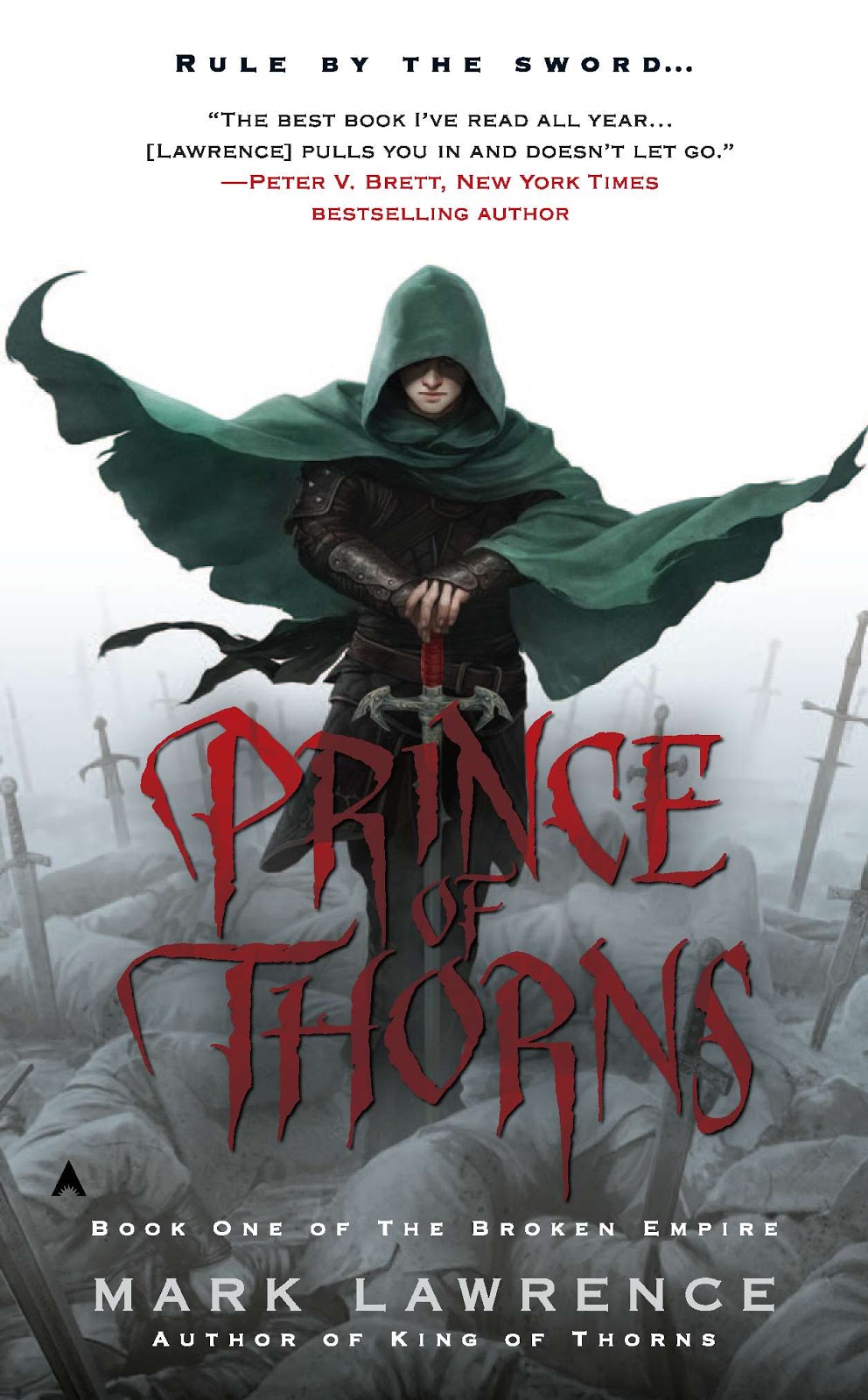
Book review: "Prince of Thorns" by Mark Lawrence

I have noticed "Prince of Thorns" by Mark Lawrence immediately after it came out, even though I don't remember how (I think of Tor.com), and it's been sitting in my Amazon wish-list ever since. My initial enthusiasms dropped after reading few reviews describing it as grimdark and unnecessary gritty. But last Sunday I decided to give it a try - and finished it at Monday's morning...


"Prince of Thorns" is told from first point of view and narrated by Honorous Jorg Ancrath. When the story starts, he is fourteen years old and a leader of brutal and violent bunch of bandits called the Brotherhood. Killing a brother for challenging him as leader is a normal occurrence. Attacking villages, burning people and raping their women is what the Brotherhood do - and Jorg is a scariest of them. But Jorg is a more than a simple bandit: Prince Jorg, the only heir of kingdom of Ancrath. Jorg was always a precocious child and had the best of tutors. But when he was 10 years old, his beloved younger brother and mother will brutally killed in front of his eyes. Thrown in the bush of briars, he accidentally survives, but something has snapped in his mind... After his father the King decides not to seek vengeance against Count Renar and accepting some material amends, Jorg escapes from home in seek of revenge, but as the book progresses, it will turns out that there are more complex game being played around...

First, if you want to enjoy this book, you just have to accept that Jorg is fourteen and leader of bandit gang. We could now discuss psychological and physical problems of a teenager leading bunch of big old men, but this is out of the point - it is fantasy after all. If you can accept it, you are ready for one hell of a ride.

This book is really grimdark - very brutal and graphically violent. Killing and burning people, raping and visiting whorehouses, unstable relationships in families - you have it all. But after you finish the book, you can notice that most (but not all) of this brutal stuff is in first part of book. Like Lawrence wanted to make a state about this being a gritty book and wished to make an impact. He succeeds in both point very well, and I noticed that "Prince of Thorns" is very successful book, so you can presume that people very hungry for it. Hype for "Game of Thrones" and ASoIaF proves it, as it does the success of Joe Abercrombie's "First Law" series and its sequels, and Richard Morgan's "A Land fit for Heroes" series.

This is not just the story of revenge. It first starts as it, but as it goes on, you will notice that Jorg has other goals of just revenging himself against Count Renar. He wants to prove himself to his father (who is maybe even bigger psychopath than Jorg, in class of Tywin Lannister), but more than that he wants to "win the game" and become the Emperor (we will get back to it later). But he is not the only with a larger agenda, especially when you meet Sageous. The story in general becomes much wider after they return to the Tall Castle. Another interesting thing is the parallel story of four years ago, that explains what happened after Jorg's brother and mother were killed, how he escaped and how he met the band. It also gives more background and explains how Jorg became the man (he is definitely no child anymore) he is.

The characters are also very deep. Since it is told from first POV, you get to know Jorg the best. He is just a crazy and violent psychopath at first, but you will soon see that there is more to him... You know that typical young fantasy hero, who is strong and tall good with sword, has natural affinity to magic, and it is also intelligent, outspoken and charming? Well, Jorg is exactly like that, only he is the anti-hero, using all this traits for getting his goals through, never mind who gets killed or injured along the way. He is terrible, but you have to root for him on account of his gutsiness and "never bend" attitude. Nevertheless, Lawrence is smart enough writer and makes him have some weaknesses, not to make him irritating. It reminds me much on Richard Morgan, whose Ringil is also so confident, but you see him afraid and insecure sometimes. Other characters are interesting and have several shades to them, but Jorg is the star of the book. I liked the short descriptions of Brothers before chapters - they were quite funny (in gristly sort of way). There was also a touch of Black Company camaraderie and Croaker's humor in Jorg's descriptions of his fellows.


Another surprise is the setting. In the beginning, Ancrath is just a typical medieval kingdom, and so it the world. Sure, there are some ghosts and some, let's say magicians, but this is typical fantasy at first. But as the book advances, you realize that this is actually a post-apocalyptic world!! The story takes place in Europe, castles are actually skyscrapers, and some of the magic is actually technology. I liked this turn of events very much. There is some really magic here also, but it fits very well.

Lawrence writing was very easy to read, without being too simple, and the book has very fast pace. Unfortunately, it is quite short - only 350 pages. But, at least is very intense read. Another small objection I have is that Jorg is sometimes just too lucky, even for a fantasy-story protagonist.

So, it can definitely be said that "Prince of Thorns" is not just a "gritty-book". It starts very violently and simply, but it expands in every way: story, characters, setting. For fans of Martin, Abercrombie and Richard Morgan...

Wednesday, February 13, 2013

Book review: "A Memory of Light" by Robert Jordan and Brandon Sanderson

Well, we have come to this. This book signifies end of several periods: four months of my reread, nine years of my personal acquaintance to "The Wheel of Time" series, and twenty three years since publishing of first book, "The Eye of The World". I first one to say, that even though I am sad for the end, this last book, "A Memory of Light", give a wonderful closing to the whole series.

I have a special connection to this series: it was my first series after I have started buying books. Before that I've read some fantasy (there was very restricted selection at my local library, but I have read it and reread it more than few times), including "The Lord of the Rings" and first few books of "A Song of Ice and Fire", but this was a first big ("Knife of Dreams" was the first book I had to wait for to come out) epic series. Since that time I've read it a lot (ASoIaF, "Malazan Book of the Fallen", "Midkemia" sagas, "The Belgariad" and "The Malloreon", R. Scott Bakker, etc.), but WoT has stayed my favorite series. Not best; I think that ASoIaF and MBotF (even more so) are better series. But WoT is my favorite, period.

I haven't read a book in such short time for a while now. I started reading "A Memory of Light" at Saturday afternoon (without reading at evening), read whole Sunday (except for two or three hours) till midnight, continued at Monday late afternoon after work, and finished at after midnight of the same day. I planned to write this review yesterday, but I was too exhausted yesterday and had to recover some of my energy.


"A Memory of Light" is a final book of fourteen book longer series, so things are pretty much all set for the final clash between Light and Shadow. Rand, who started as young shepherd, has become almost King of the world. His announcement that he will break the Seals that keep the Dark One imprisoned has successfully gathered almost all armies of humanity at one place. Mat has done great things in the past, but he now has one more thing to accomplish - to persuade Fortuona, Empress of Seanchan to join Rand's battle. Perrin has also become a leader of men. Even though his part is not so visible, he is one of three ta'veren that have to support Rand. Egwene, now a  secure Amyrlin Seat, and as such viewed as one of most superior authorities, doesn't agree with Rand's decisions - but is Amyrling Seat's authority above that of the Dragon? Elayne is one of the strongest Aes Sedai, now ruler of both Andor and Cairhien, and also lover of the Dragon Reborn - she will have to balance a lot of roles in this book.

This covers five main characters of WoT (I used to include Nyneve, but she was a bit neglected in last books), but even though they got most coverage, they represent only a fraction of POVs from this book. I think that most of the characters from previous books got at least a short POV part. The book has 900 pages, so it is not the longest book in series, but it feels quite long nevertheless.

So you can expect this to be a very complex book. I think I will have to do a reread eventually to grasp it all (as I have to with MBotF), but not this year I think. I don't even have to mention multiple changes of POVs in chapters - diagram showing characters vs. chapters structure will definitely be even more complex that the one in "The Gathering Storm" (link). Maybe it would have been better if last two books were split in three. This would gave them more clarity, but than they would lose much of their intensity, especially this one. And "A Memory of Light" is intense!

I first had an awkward feel, but I was able to recognize it. It is strange to have so many POV characters at the same place without knowing the thoughts of every one of them. Lot of characters get ignored for a long times (e.g. Taim, rulers), but there is simply no help to that. Also, even though all plotlines in this book happen in same time-frame, Sanderson used a trick that time doesn't flow at the same speed for everyone. He justified it quite soundly in book, and reaped much of benefits from it, but you will have to decide for yourself whether you are OK with it (as I am) or you think it as cheap trick.

When I started with this book, I also started with keeping notes of my impressions (I started doing this during this reread, to help me organize my thoughts), like
  • Wow! It is rare to see the inner workings of Shadow like with the Town, and
  • Plotline in the Black Tower is simply great! Especially the dual bond.
But soon I had to abandon it because really too much happens in here. Also, I want to avoid spoilers in this review. Nevertheless, here are some of my biggest impressions:
  • I kept trying to guess who Demandred is hiding as. This particular point was stressed during series, and even at the beginning of this book, so it was only normal to wonder. The answer is here, don't worry. On the other hand, maybe you should worry, because he proves himself as one of most capable and deadly of Shadow's proponents.
  • I was very surprised when Rand entered the Pit of Doom before the end of book. Even though this sounds as expected course of events, Jordan (I don't think that this was Sanderson's call, but maybe I am wrong) take an unconventional turn.
  • This book is one big battle! Well, six battles actually, but most of this book is made of battle and fighting scenes. Also, it has the longest chapter in WoT history: 189 pages.
  • There is some great humor in this book, but one line was really LOL moment: Androl's and Pevara's "You look good in black". Also, even though Mat is a touch too expressive (outspoken), he has a bunch of funny scenes. I especially like his bragging fight with Rand! And also, Knotai!!!
  • Well, I can't believe I missed the thing with the Horn of Valere!!!
One more thing I want to mention is Padan Fain's disappointment. His part was very promising, in this book and in series also. He had a potential to become the unknown element, Joker, hidden ace... But then he was cut short. There are some good lines here, but it is only a part of what it should have been.

I saw some comments describing this book as emotionally draining - it is! I spent last couple of hours with tears in my eyes - whether from sadness, happiness, laughter or anger. It really provides a full scale of emotions. There are some really unexpected things here, even deaths of characters you would never expect to be gone.

A good new element this book introduces is inserting the gray morale with the Seanchan. Is rooting for Tuon a good thing or not? I wonder was this Jordan's or Sanderson's decision.

You are probably wondering about the ending. Don't worry: it is a wonderful ending, one of best ever. It doesn't provide too many answers. I think this is better than it would be explaining and elaborating everything (like, these two lived there for years, got two child...). Also, it feels more natural, without any forced celebrations or gathering of main characters. You are really left wondering about many things, but not frustrated for it. I wonder was the ending written by Jordan? I think it is - I don't belittle Sanderson, but Jordan was the master of "The Wheel of Time".

So, with bitter-sweet feelings, I can say that "A Memory of Light" provided a wonderful ending for "The Wheel of Time". Not perfect, but even better for that!

Saturday, February 9, 2013

The Wheel of Time reread: "Towers of Midnight" by Robert Jordan and Brandon Sanderson

So, after more than four months of rereading, I am finally done with my "The Wheel of Time" reread. I don't usually write my post immediately after reading the book, and instead I wait for some free time, but this time I wanted to do it right, and do it cleanly. So, after this I can start "A Memory of Light" unencumbered with any unfinished business.


"Towers of Midnight" is a penultimate book of "The Wheel of Time" series, and as such is really preparing us for the final blast and Tarmon Gai'don. Rand has finally found balance with the Dragon Reborn, and now is fixing loose ends and past mistakes before he starts the Last Battle (which is exactly a day away at the end of the book). You could say that he is "cleaning the rubble". Perrin wasn't "lucky" as Rand, so he is still searching for his peace with the wolf and leader inside him - and at the same time he has to take care for tens of thousands of people, sue for peace with the Whitecloaks, and avoid traps set by Forsaken. Mat had his balance since beginning, but that doesn't mean that he is without problems: gholam is after him still, and now very close. And before he finds a solution for it (the invulnerable creature immune to the One Power), he cannon go on quest to find Moiraine and save her from snake and foxes. The White Tower is now joined behind Egwene, but she still has a problem with a hundred or so Black Sister and a Forsaken hiding in the Tower. Elayne has also consolidated her rule, but after Andor there are another two big bites for her: the rebellious Two Rivers and chaotic Cairhien.

Except the five of them, a bunch of other characters get their time in this book. There are much more changes between POVs (even more than in "The Gathering Storm"), even throughout chapters - which makes a faster pace. I would say that maybe there is a bit too much happening in this book. But I presume they (Jordan and Sanderson) had a lot to add in last two books. So clarify my statement, there are two pictures from a site Encyclopaedia WoT, which has a very detailed recaps of chapters from WoT. I use it sometimes when I am not sure about some details (like, how many chapters Mat had in a book). First picture shows the structure of chapters vs. character's POVs in "The Fires of Heaven", while the second one shows the same for "Towers of Midnight". You will notice how more complex ToM is...


I really like the first POV by Lan - it is very honorable and epic, but also funny at the same time. I like even more the first chapter with the new Rand, especially when you compare him to Rand in TGS. And even more I like the second chapter with him, when he finally meets Egwene (after some seven or eight books) as Amrylin Seat. I was a bit unsympathetic toward her because of her opinion that Rand has to be "handled" and "contained", but Rand really blows her mind this time. And not just her...

This book is very much about meetings after a long time: Mat and Elayne, Perrin and Elayne, Mat and Perrin, Elayne and Galad, Galad and Morgase, Morgase and Elayne, Gawyn and Elayne, Gawyn and Morgase, Moiraine and Mat (and Thom), Rand and Egwene, Egwene and Nyneve and Elayne, Rand and Tam (for real), Aviendha and Three-Fold Land, Rand and Almen Bunt (after twelve books!!)... There are two really great scenes: Mat's letter to Elayne (I got a really good laugh there) and Perrin "easing the badger" that Mat caught (there is a tavern called "Easing the Badger" in "The Dragon Reborn" where Perrin wonders where the name comes from - things really go in circles in these books).

This is the first time that book takes different time-frames and that plotlines are displaced in time. We had a case or two when when book started at the time before ending of last one, but nothing like this one.

After the debacle with Mat in last book, Sanderson got him right this time, right to the point. There is only one thing that really bothered me: the "confession" between Thom and Moiraine. OK, it was announced in last books, but it nevertheless sounded forced and fake. Although the blame cannot be put wholly on Sanderson... The part with snakes and foxes was done great and it justified the hype about it.

There are several very intense action scenes with Perrin here. I think that Sanderson did better job with him than even Jordan had. You could say that Perrin is the most outstanding main character in this book. It is very funny when Perrin patronizes Egwene in World of Dreams (not that I have anything against her).

There are several great POVs with Rodel Ituralde. I dont' know why I like this guy so much, but I really do. But the crowning moment is when Rand saves them - this was really something.

I can say this without any reservations: "Towers of Midnight" is a really glorious book. So much more positive and funnier book (especially after "The Gathering Storm"), it is much focused on finishing the various (and numerous) plotlines. It contains so much good scenes that I could say it is one of my favorite books in series.

Sunday, February 3, 2013

The Wheel of Time reread: "The Gathering Storm" by Robert Jordan and Brandon Sanderson

I've read "The Gathering Storm" in very short time, only few days. I am currently at half of "Towers of Midnight", hoping to start with "A Memory of Light" soon.

First I have to mention that this is first "The Wheel of Time" book written by Brandon Sanderson. Robert Jordan has passed away after writing "Knife of Dreams", so the fate of WoT was in question for a time. Jordan's widow Harriet McDougal picked Brandon Sanderson, at that time relatively unknown writer, to finish the WoT. Jordan's death didn't come sudden, so he was able to prepare lots of notes for what was supposed to be the last WoT book, and even write some parts. Thanks to that, Sanderson had a skeleton of story, and he "only" needed to flesh it.


In "The Gathering Storm", we have two major plot-lines. Rand, after losing his hand by Semirhage in "Knife of Dreams", is continuing his preparation for Tarmon Gai'don. But the stresses, wounds and betrayals he has survived has left a great toll on him. He becomes increasingly harder and darker - and not all Dark One's seduction is obvious. Egwene is still a captive in Tar Valon, but everything points that her efforts are paying off and she is winning the fight for Amyrlin Seat. But what will happen when she is forced to confront Elaida directly - is is better to bend like a willow, or finally make a stand? Nyneve is only major character with important part in this book - as the only Aes Sedai and advisor that doesn't send Rand into fits. Mat and Perrin present, but more with cameos than with real story, and Elayne is completely absent, thus making her the last main character to be absent from one of the books.

First POV in prologue is a great introduction to the book. Until now, we have had a direct insight into fight between light and dark, but always from the highs. But now, this struggle has reached even the common little man. Prologue in general is very good.

This is definitely Rand's book, as it not had been since "Lord of Chaos". He has been under an unimaginable stress for years now, and the time to release it had finally come. I must confess that I never expected Jordan (because I presume that it was his original intention) to make Rand so dark, even evil.  There is a curious part of chapter with Rand and Moridin - it is strangely pity for Rand that he can feel comfort near his greatest enemy, who is actually his antithesis. His parts are disturbing, but they are very well written. "I have been forced to revise this particular inclination" - I think this quote gives goosebumps to every fan of WoT. Even though it is not good, I must it is funny to see Cadsuane finally cowed. Book has a very strong ending.

Egwene is only slightly behind Rand in importance in this book. Her parts have been very good for several books now, so there is no need to praise them anymore. She has one of the best action scenes in series, comparable to battle in tFoH or earlier battles (Rand against various Forsaken). Elaida is on pinnacle of disgust here.

As I mention, there is lot of Nyneve, who is left as one of last person with some influence on Rand. She didn't have this much attention since Ebou Dar, if ever. There is also lot of Min, who sometimes look unobtrusive, but she is an important characters. We also have few POVs from Aviendha, which are rare.

Both Mat's and Perrin's parts are not really important in this book - they are "saved" for next one, ToM, and they are here only not to be absent. I don't mind this as such. Perrin's part is actually pretty good, except the small spoiler for next book (meeting between him and Galad). But what I do mind is Mat's POVs. Sanderson blundered with Mat. It is not written badly, but Mat and his humor are very off, and the story is unnecessary and irrelevant. Thankfully, he accepted the criticisms and did much better in ToM.

All in all, Sanderson did a very good job with continuing "The Wheel of Time". There are no major differences in writing, although there are some words and phrases that Jordan didn't use. There is one apparent change: shorter chapters to fasten the pace, with lots if jumps between POVs. My version of the book (Orbit hardcover) has a mistake - Sulin is mentioned as with Rand, except with Perrin. I hope this will be corrected in newer editions.

In general, "The Gathering Storm" is a great book, itself and as part of "The Wheel of Time". Much darker that any before, it really presents struggle, in various forms. And it finally puts in focus the Tarmon Gai'don, the Last Battle.

Saturday, January 26, 2013

The Wheel of Time reread: "Knife of Dreams" by Robert Jordan

Few days ago I finished with reading "Knife of Dreams" - only two more books and I need to hurry. My copy of "A Memory of Light" has come earlier than I expected, so I don't need to hold back. Now, if I only had more time for reading...


It is easy to shortly introduce "Knife of Dreams" because it mostly continues plot-lines that were started before. Rand is still mostly in hiding after cleaning the Saidin, jumping all around the world and preparing for the Last Battle. His biggest concern now are the Seanchan - he can't fight them at the same time as he fights Tarmon Gai'don, so he has to find some solution for them. Perrin has finally forged a plan for rescuing Faile, and with the help of Seanchan army, he will put it in action. Mat is slowly running away from the Seanchan while struggling to start to understand Tuon, his wife-to-be. When he finds out there is a plot to kill her, he must find a way to protect her without letting himself be captured. Egwene, who has been captured by White Tower at the end of last book, slowly realizes that this is not the end of her fight against Elaida - this is actually her biggest chance. But she has a peculiar battle to fight. Elayne is not enviable position - surrounded by her competitor's army, she discovers there is enemy in her lines, also. Also, her pregnancy is not helping her mood.

Well, the biggest difference between "Knife of Dreams" and last four books is that it finished plot-lines instead starting them. In first six books of "The Wheel of Time", we had a normal sequence of starting and ending a plot-line in single books. But next five books feel more like a part of one (very) big book, and KoD is its ending. I enjoyed previous books very much, but I would lie if I said that I didn't like to see these endings. Also, this book feels much more packed - there is much happening, especially with our five main characters (minus Nyneve).

Again, we have a humongous prologue - 90 pages. Again, it features Rodel Ituralde, which I like very much. There is one line that I remembered especially well: "He always looked ahead, and always planned for every eventuality he could imagine, short of the Dragon Reborn himself suddenly appearing in front of him." - this will be very funny when we come to "The Gathering Storm".

Last few times I read this book, I used to check how more I had till Mat's POV. This time I enjoyed almost everything. Elayne's part was a bit dragging again, though. I always forgot whether Sareitha or Careane is a Black Sister - even though I read it only few days ago I forgot again. And for some reason, I always disliked two chapters with Elayne's fight against Black Sisters.

I don't have any big impressions about Rand's, Perrin's and Egwene's parts, except that I enjoyed reading them. Loial's POV is interesting - and the Trolloc attack in that chapter. But part with Nyneve and Lan, and especially what Nyneve does, is one of my favorite parts in whole series!

Again, Mat's POVs are slightly above the rest, but only slightly. Luca Valan is a great character, especially when he turns around performer's minds. And I like chapters with Furyk Karede, especially the one when he catches up with Mat.

So, "Knife of Dreams" presents a welcome change to "The Wheel of Time", clearing out some rubble and preparing for the ending of the whole series. At the time it was written, that was supposed to be the penultimate book, but more about it in post about the next book in reread.

Monday, January 14, 2013

The Wheel of Time reread: "Crossroads of Twilight" by Robert Jordan

I am getting closer: I finished "Crossroads of Twilight", and now I am reading "Knife of Dreams". Only few more weeks, and I will finish the complete "The Wheel of Time" series. I hope that it will have a deserving ending.

Also, I now have to be careful to avoid anything mentioning "A Memory of Light", to avoid possible spoilers. Even Wikipedia could be dangerous now.


After two shorter books, "Crossroads of Twilight" is back to a normal length for novel of such caliber: 800 pages. Somehow, in my mind, I always considered it as Mat's book; at the contrary, he has only 5 chapters, (6 if count Furyk Karede's) as Elayne and Egwene, while Perrin has 6 (7 if we count Faile's). But let's go by the order. After cleaning Saidin in last book, Rand is in hiding and resting - therefore he (actually, his plot-line) only gets two short chapters. Curiously, I realized that this time Nyneve is absent, except by mention in his part. After three books, he finally comes to good terms with Cadsuane, meaning that this is the first time (and last for some time), that she is not irritating. Perrin is still caught up with trying to save Faile, although now he is forced to accept that it will not be done in matter of days, and that he has other responsibilities. Mat has successfully left Ebou Dar; unfortunately  he is not away from Seanchan, or from Daughter of the Nine Moons. Elayne, now pregnant and without Nyneve, is trying to win the throne of Andor, even though her prospects doesn't look very good. Egwene is now accepted as real (rebel) Amyrlin Seat, but that doesn't mean that she is without problems - even her Aes Sedai still find ways to make troubles for her. And currently, the times are even tougher, since they are besieging Tar Valon.

Of course, except our main character, we have several POV from minor characters. And also, we have a long prologue. Jordan must have been full of ideas, with no place to put them, except in such long prologues. I especially like Ituralde's POV - here and in next books. There is a great but somewhat disturbing chapter with Alviarin, Mesaana and Shaidar Haran. And I hope there will be a clear explanation what kind of vile events were happening after Aiel War that so much of Red sisters were forced in exile.

I am having some troubles reviewing this book, because nothing really happens. Oh sure, there are lots of stuff going on, but all these plot-lines have started in prior books, and not one of them is finished here. More so, first half of the book actually happens at the same time as events in "Winter's Heart". This doesn't mean that I don't like the book, at the contrary. But only that I have tough time finding momentous impressions from it to write about.

Elayne's part here was a bit too long. Not bad (I liked the part when she meats the High Seats), but it could have been shorter. Also, did Jordan put such focus on clothes and details before? There was good Eenia's POV - you can really feel how she is always angry. Even though she is obviously intelligent, this anger thwarts her in reaching further. Jordan did great job capturing that.

Egwene's part is great here, too. I especially like the chapter when they decide to approach Asha'man.

Perrin's POVs are split in two groups. I didn't overly enjoy first ones, at the beginning of the book (probably because I was impatient for Mat's part to start), but the second one were good. I don't know why, but I always like the So Habor part.

I know that it is probably tiring hearing me saying how great Mat's part is, but it really is so. I really like his interactions with Tuon, but also his impression of everybody else. He is just perfectly comical without becoming so.

So, even though "Crossroad of Twilight" is a book without momentous events and somewhat slower plot, I had a very good time with it.

Wednesday, January 2, 2013

The Wheel of Time reread: "Winter's Heart" by Robert Jordan

Well, I was able to figure out what happened with my "Lord of Chaos" post: I opened the post on my mobile-phone before it synchronized, and so saved the older version over the new, full one. I am still deciding is this a bug or a feature.... Anyway, I'll be more careful in future.

So, I am slowly getting toward the end of "The Wheel of Time" series. With "Winter's Heart" I finished 9th book out of 14. Four more books before "Memory of Light" - with luck, I will finished them just in time to receive MoL.


"Winter's Heart" is slightly larger that was "The Path of Daggers", somewhat below 700 pages. There are four main plot-lines here. Faile was in last book captures by Shaido, and now is trying to figure out what to do, while Perrin is trying to rescue her, while at the same time balancing Masema, Ghealdanin, Aes Sedai and Wise-Ones, and Berelain. Elayne has arrived in Camelyn and started her campaign to win the Throne of Andor, but she also has her hands full: open and hidden opponents, enmity between Aes Sedai, Kinswomen and Atha'an Miere, a massive army of Borderlanders with unknown intention. Rand is, on the other side, focused on a single goal: executing rebel Asha'man. That is, before he can turn his attention to a much larger goal: cleaning the Saidin. And at South, in Ebou Dar, recently conquered by Seanchan, we have Mat Cauthon, who is trying to escape his fate, not knowing that Daughter of Nine Moons is coming closer.

Only now I realized that Egwene is absent from this book, as were Rand, Perrin and Mat before. She only appears in short cameo with Elayne. I have read these books at least three or four times before, but I haven't realized it before: it is because they are not encompassed and defined as were the early ones. Also, does this mean that Jordan considered Egwene as fourth main characters? As most reviewers, I always considered Rand, Perrin and Mat the three protagonists.

I have only words of praise for this book. I still like Perrin's and Faile's part, and I don't see myself changing my opinion. Perrin is being a bit too emotional, but that is who he is. And he is surrounded with such different characters that his observations (especially when he smells them) are very interesting.

Elayne's part is maybe too long in whole, but here is not; I always liked reading about politics. I especially liked the chapter when she is meeting with the Borderlanders. And the chapter with Elayne, Min and Aviendha finally making some deal with Rand makes me happy, as much for them as for Rand.

This is the first time that Nyneve is having her own adventures, without Elayne. She was in her company without break from "The Great Hunt": eight books! They sure had a lot adventures together. Anyway, Nyneve is great together with Elayne, or by herself. In last book I didn't like Nyneve with Atha'an Miere and Kinswoman, but this time all that is very funny.

As for Rand, I think this book proves my claim that things are going down for the Light. Even though they succeed with a major success, Rand's mental condition is again getting worse. I really liked the great chapter when Rand meets Elayne, Aviendha and Min: it is always funny to see their misunderstandings revealed. Also, Far Madding chapters are very interesting.

And of course, there is my favorite part of the book. Mat's part is simply great and very funny.

All in all, "Winter's Heart" is probably my favorite book of this section, from "A Crown of Swords" till "Crossroads of Twilight", maybe even "Knife of Dreams" (I will have to decide after I read them). It is very fun, full of action and full of enjoyment.

Sunday, December 30, 2012

The Wheel of Time reread: "The Path of Daggers" by Robert Jordan

Since I have had few days of vacation this week, I was able to finish "The Path of Daggers" sooner that I planned. Looks like I will be finish with the whole "The Wheel of Time" series just in time for "Memory of Light". That book is coming out at the beginning of January, but it will arrive at my place around month later.


With less than 650 pages, "The Path of Daggers" is the shortest book in series. "The Shadow Rising", "The Fires of Heaven" and "Lord of Chaos" were all around 1000 pages, so this is quite shorter. "A Crown of Swords" is somewhere in between. PoD, as CoS, also takes short time in book-time, around a month. There are four major plot-lines. After killing Sammael and conquering Illian, Rand believes himself on a roll, so when he finds out that Seanchan has again arrived, he decides to personally deal with them, leading the first Asha'man army. Connected to Seanchan: after finally being able to find the Bowl of Winds, Elayne and Nyneve travel from Ebou Dar, accompanied by Atha'an Miere and Kinswomen, with plans to use it and stop Dark One's meddling with the climate. Egwene is still slowly traveling with rebel Aes Sedai toward Tar Valon. But her biggest problem is not Elaid or myriad other difficulties lurking in world, but the fact that no one considers her the real Amyrlin Seat. Lastly, we have Perrin and his large retinue (including both Faile and Berelain) are slowly traveling Gheldan, trying to reach Queen Alliandre, and to the Prophet of Dragon Masema before he is able to do even more harm. Crisscrossing the book are several other, shorter POVs: Elaida, other Aes Sedai, Forsaken, even Seanchan.

As you can see, there is not Mat in this book. I guess this is fair, since Perrin was missing from "The Fires of Heaven" and Rand (almost) from "The Dragon Reborn". But that doesn't mean that I am happy for it. But there is nothing to do except to read until the middle of next book, "Winter's Hearts".

This is the darkest Rand's section, at least until "The Gathering Storm". This is why I said that Light is slowly losing from Dark after SR, FoH and LoC - whatever their successes are, Rand is getting madder and darker. This book has most quiet ending till now, and also the saddest, at least Rand's part. I always liked Moridin's POVs, especially the one in PoD's prologue.

Here ends one large Nyneve's and Elayne' part. Elayne will get another long plot-line (Andor's Succession), but Nyneve will not have a definite plot-line (even though she will have important parts). I must say that humor when they are escaping Ebou Dar feels a bit forced, especially with Alise and Nyneve.

Egwene has a great part; she really outmaneuvers them all. It is a good section to read, whether you know the outcome or not. Her part in next few books will be the same.

Also, this is a real start of Perrin's POV. There are fans who don't like this part, the Shaido. It is not my favorite either, but I don't really dislike it. Especially this time, at least until now.

I've said it already, but Aes Sedai are really sure that they know everything - so I enjoy when they are turned over their heads. But most of their POVs are very interesting.

Well, a short review for short book. "The Path of Daggers" is a darker book than its predecessors (maybe its successor also), but I enjoyed reading it. If only Mat was in it...

Wednesday, December 26, 2012

The Wheel of Time reread: "A Crown of Swords" by Robert Jordan

I finished "A Crown of Swords" only few days ago, so I hope this post will be fresher than previous, "Lord of Chaos". I still can't believe that I have lost a finished (and good) post so abruptly. But, I should focus more on the book.


"A Crown of Swords" is the first book in series that takes the same time as another book ("Lord of Chaos" in this case). It is also much shorter book that its prequels (less than 750 pages) - but neither of its sequels is longer by much, if not shorter. Another interesting fact, this book takes very short time in plot-time: some nine or ten days, I think. Which doesn't mean that there isn't lot of going on here, only that it is thicker. There are several plots. Rand is trying to deal with problems that arose from his capturing in "Lord of Chaos", and with his trauma from it. After several books of waiting, he finally enters a romantic relationship with Min. Perrin has a lot of coverage, in the first part of the book, but more as a narrator than as active characters - I almost forgot that he even was in this book. Egwene also has few chapters, but they are clustered so that I thought it was only one or two. Both Perrin's and Egwene's plots really take place in further books. There are also some chapters from isolated characters (Elaid, Alvarian, Forsaken...), but almost a central plot-line of this book is in Ebou Dar, including both Mat and Elayne and Nyneve.

This book has one of longer prologues, but not ridiculously long as they will be in some other books (e.g. "Winter's Heart"). Here we are introduced to Alvarian as major bad player - one of few POVs from the evil side. Also, Alvarian is one of only three successful and capable bad characters (other two are Moridin and Shaidar Haran, maybe Padan Fain). On the other hand, we have Elaida's POV- for a supposedly good characters, she does more evil that all other Forsaken together. This series is full of people with lots of misunderstanding of the world about themselves, but Elaida is somewhere at the top of them.


We have a very complex and interesting beginning: Asha'man vs. Wise Ones vs. Aes Sedai. We follow Perrin for some time as the beginning, but as I said, more as narrator. He provides few funny moments; well, him and Faile and Loial.

Egwene's part is starting to get interesting with all that maneuvering and politicking - but it is very short in this book, only few chapters. This will be rectified in future books, so we can look at this like just a treat before the main course.

We get first POV from Aviendha (I think), but more important, we are introduced to Cadsuane. Even in her first appearance, she is absolutely irritating. I don't think I felt sympathy to her once in whole series. Another who makes first appearance here is Moridin - long time no see.

Of course, the best part of the book is Ebou Dar, and mostly because of Mat. Mat's and Elayne's/Nyneve's mutual misunderstandings are hilarious. Elayne's and Nyneve's chapter when they finally overcome their problems is also very good. When you look about it, nobody is really fair to Mat (Nyneve, Elayne, Tylin,...).

Another great chapter is the one with Rand, Padan Fain and rebels, even though it contains Cadsuane.

In conclusion, even though "A Crown is Swords" is a different book from previous three (shorter, several unfinished plot-lines), I really enjoyed rereading it, especially the Mat's parts.

Monday, December 10, 2012

The Wheel of Time reread: "Lord of Chaos" by Robert Jordan

Wow, I just realized that I completely forgot about this post. I was already preparing the one for the next book, "A Crown of Swords", and accidentally saw this unfinished post. I read "Lord of Chaos" more than two weeks ago (I am currently reading "The Path of Daggers"), but I had very busy two weeks and trip to Budapest for the weekend in between (pleasure, not business; and the trip was great).


In "The Fires of Heaven", we have seen Rand take hold of both Cairhien and Camelyn, and in "Lord of Chaos", he will try to solidify his take. We are introduced to two very important, but non-POV characters: Marshal-General Davram Bashere, from Saldea, and Mazrim Taim, an ex-false-Dragon, also from Saldea. These are probably the first two willing followers of Rand, but while Bashere's loyalty is pretty much undoubtable, Taim will become one of most mysterious characters in the series. We will also see Rand's official first interactions with Aes Sedai, both official White Tower and rebel Salidar Aes Sedai - and it won't end well. Egwene, who has become almost Aiel while apprenticing to the Wise Ones, will be in big shock after she is commanded by Salidar Aes Sedai to join them immediately. Elayne and Nyneve are still in Salidar, but not feeling relieved for it: they possess too much secrets, including the one about Moghadien. Perrin will again become a part of series, and Mat will assert himself more, both as farmers-become-leaders.

I always liked the beginning of this book: Rand's sword-training, Bashere's humor, first meeting with Taim... As I said, Taim becomes a very mysterious figure - only in "The Towers of Midnight" we will see some clear clues about what is going on with him in Black Tower. Rand is feeling much on the rise in this book, even though he is in for some smaller shock, and one big. Love the chapter when Alanna bonds Rand and the Two Rivers' girls are scarred of him, even though it is hard on him. Even more so can be said about the final chapters about Rand - they are great, but are really traumatic for him. Nevertheless, these are some of the most powerful chapters in series. They will make problems for him and more in next five books. We also get the first mention of cleaning of saidin.

Nyneve and Elayne few chapters here, but they are not really really important, more like a preparation for next stages. Except when Nyneve does the impossible. Egwene on the other hand has a transformation as big as Rand's. I was very surprised the first time when I read it. She benefits much from her time among Aiel. I wasn't much thrilled with her parts with Gawyn, though.

Mat in this book is great again, pure and simple. This is where he becomes my favorite character in series. Not that really much happens with him, but Jordan wrote some great jokes with him. Especially the part when he arrives to Salidar. As I said, Perrin appears again in series, but his part start really at the end.

There are some good jokes about humor and jokes, especially about differences between normal and Aiel humor.

While writing this post, I realized that I have written it once already! And I wrote it better last time, while it was fresh. It looks like Blogger reverted my post to earlier draft version - either that or I had best déjà vu ever! So I am sorry if I don't sound coherent in places - this lost post has mixed up much, especially since it has passed two-three weeks from it. So don't let my bad post spoil "Lord of Chaos" for you, because it is one great book.