Monday, June 25, 2012

Book review: "The Scarab Path" by Adrian Tchaikovsky

Last week I finished "The Scarab Path", a fifth book in "Shadows of the Apt" series by Adrian Tchaikovsky. This book signifies the start of a new sequence in the series, and I must say I was positively surprised by raise in quality. Usually as a series progress, author starts struggling to keep the readers, but Tchaikovsky keeps getting better with each book. First four books make a closed mini-series, one that introduces us to setting and characters, so theoretically one could start reading here, but it is not something I would recommend. 


I expected that this new sequence of books will be put further in time and introduce a new and fresh, but events in "The Scarab Path" start a year after those in "Salute the Dark", and featuring same old characters. After resolution in last book, the Wasp Empire retreated from Lowlands to concentrate on its internal affairs, and to find out can it be ruled by Empress Seda. In the meantime, Stenwold Maker continues to consolidate his allies in Lowlands, preparing for imminent continuation of war. In one such effort, his niece Che will be sent to a diplomatic mission to the faraway Dominion of Khanaphes (influenced by Old Egypt). But this is not a simple diplomatic or scholarly excursion, since everybody has their own agenda. Situation will be additionally heated when they discover another embassy there, a Wasp one, led by her old friend and enemy Tharlic, now a Regent of Empire. But neither are prepared for what they will find there...

This book is manly about Che and Tharlic and most of it is represented from their point of view. There are the other important ones (Totho and character Hrathen), and a lot of minor ones, but this two are the center of the book. As I said, I expected that this book will contain a different and new cast, so I wasn't exactly thrilled when I initially realized that this is a book centered on Che (who wasn't exactly my favorite character so far). But in this book Tchaikovsky made of her a brilliant main character. She is still a bit clumsy and insecure, but now she is also full of self-observance and knows how to take control of every situation. And her new condition is very interesting to follow - it gives her somewhat darker cast. Thalric took an opposite direction from her - from all-mighty and capable Major Tharlic of Rekef, he is now a Regent and ambassador, not sure what exactly is his place and what his enemies are planning - and he definitely has enemies. Hrathen was very interesting character to read about, and even Totho (although I still can get used to that name!).

All characters were better written than before - more intense, more complex, more real. And this gets me to the main point of this review - this book is in every perspective two notches above all its prequels, not that they were bad. But I am surprised how Tchaikovsky was able to raise the overall quality - it is more interesting, more intense, more surprising. There is even some humor in it - I found the whole Vekken plot-line hilarious. All in all, congratulations!

I must say that ending surprised me much - especially Che's final choice. I think that it would be interesting to read a series in which she made a different decision.

This book is different from the rest of series in other ways, too. First, it was and felt much longer. With almost 700 pages, it definitely is longer that last two. Also, with it, Tchaikovsky dropped the pattern that started with first four books - first book was extremely focused one-mission book, while its sequel brought out the big picture. This book if focused on small set of characters, and restricted geographically, but it still felt bigger the books so far. On the other hand, its plot is so encompassed that it could be read as standalone book.

I also realized another important this with this book: this series has no overall plot. I expected that it will finally introduce us to some arch-enemy, and give some direction to series, but there is no one. The only theme or motif that can be singled out it the conflict between the Old and the New. In these books it is represented by the difference between Apt and Inapt, and in some way, in conflict between Lowlands (who still cling to some "honorable" old ways) and Wasps (who put success before everything).

For conclusion, I can only repeat that with "The Scarab Path" Tchaikovsky outstripped himself and presented us with his best book so far. It is definitely a treat for those who followed "Shadows of Apt" series so far, and I can only hope that next books will be as good as this one. I am looking forward to reading "The Sea Watch", next book in installment.

Wednesday, June 20, 2012

Anime review: "Daily Lives of High School Boys"

I am a little bit late with this post, for it was almost two weeks now since I have watched it. But I had a three-day trip to Germany, few days were spent on field, and so the time passed. It started to fade a bit, but good thing I have made notes.


Anyway, "Daily Lives of High School Boys" was a pleasant surprise. I didn't have any particular wish for watching this anime, but since there was not much out there to choose from and it had a fairly nice rating, I gave it a chance. It turns out that "Daily Lives of High School Boys" is a gag anime with no particular plot. Instead, it consists of several unconnected short "stories" in each episode, between four and eight. There is some timeline to it, but it is not relevant in any case. These short stories revolve around students of one class of all-boys high-school, plus several other boys and girls from other schools (so it is not solely about boys, contrary to the title). The cast is so pretty big, but the names are not really important, since it has different cast for most of the stories.

So, there is no plot, characters are unimportant, why would anybody watch this anime? Because if you are or ever were young, and especially if you are male, you will be able to relate with this anime and find yourself somewhere in it. This anime perfectly depict the mental state of high-schoolers: empty and sarcastic talk, worries about being cool, stupid ideas and wrong facts... But presented in such funny and lovable way. And jokes are just perfect: I watched this anime alone in my room, but kept giggling most of the time, and sometimes even laughing out loud. In spirit, this anime reminded me on "School Rumble", but without the romance part - there is absolutely no drama or angst in this anime. Another anime it reminded me of was "Lucky Star", just that this concentrate on boys and there is no moe.

Unfortunately, there are only 12 episodes. There is a mention of second season in anime, but no information about it on AniDB. Visuals are pretty good, voice acting great, and there is even some catchy music in it.

"Daily Lives of High School Boys" is probably the best gag anime I watched so far, and it is especially good for quick watch - stories last for few minutes each and you can stop whenever you want. If you have any fond memories of high school and like to watch comedies, just try watching the first episode. And remember, later ones are even better!

Monday, June 11, 2012

Book review: "The King's Blood" by Daniel Abraham

Last week I finished reading "The King's Blood" by Daniel Abraham. I found "The Dragon's Path", first book in "The Dagger and the Coin" series, great and interesting, so I had big expectations from its sequel. Even more so after reading few praising reviews. I expected a broadening of setting, start of over-all series' plot, maybe new characters... But in the end, I was left disappointed.


"The King's Blood" follows pretty much immediately after TDP, maybe few months between them but nothing important happening. Cithrin was left in charge of her branch of Medean bank, but only at the front - she is now just a figure-head, while everything is decided by her "notary" sent here by central branch. She of course, doesn't like it, but there is not much she can do... Marcus, on the other hand, is pretty satisfied with his life: he has a purpose, steady work, friends around. But as his second, Yardem, tells him, his soul's shape is circle: when he is at the bottom, he can only go up. But when he is at the top, he will inevitably go down.

In Antea, the crisis has been thwarted and conspiracy originating in Asterilhold voided, but those responsible were left unpunished. And now, when King Simeon's is starting to fade and he finally dies, who will be chosen as Regent is not Geder, the Hero of Antea. And although Dawson is starting to become suspicious of Geder's real motivations, what can he do to a man who rely on him so much that he even him the control of the army...

Well, this is the plot in general, and this is the main reason I didn't like the book. Plot is weak, straightforward and completely predictable. Oh sure, there are much that will prove as a surprise, but that are just details, while the big stuff goes where it is expected. I believe that a pretty detailed and accurate synopsis of this book could be fit in several sentences. OK, somewhere around the middle, plot gets intense and interesting, but the end fails to deliver. One good thing to say: small chapters make the pace look much faster.

The setting expansion proved even a bigger disappointment. We didn't see almost anything new of the world except one new city, and that briefly. I also didn't like the fact that this is actually very small world, or part of the world (maybe this means we will be surprised later?): the biggest Empire around can field an Imperial Army numbering six thousand soldiers!!! Maybe it's just me, but I like my armies more numerous and my cities more populated... At least there is one thing to look forward: "sleeping dragons", "dragons turning to stone to sleep", "hidden dragon lairs" are mentioned so many times that there has to be a dragon sometime in the future (look for Chekhov's gun).

The characters remain the brightest part of this book, and still a notch over lots of other books. But even this was weaker that in the first book. In my post about TDP, I was full of praise for such multifaceted characters, being at the same time likable but disgusting, combining so many traits. This stays the same in TKB also, but unfortunately, there are no more surprises and characters don't grow much. The best point is emergence of the new character Clara. I found somewhat funny Dawson's doing all the right way, but for the wrong reasons.

So, in the end I wasn't very satisfied with "The King's Blood". It is not a bad book, but it doesn't jump the bar set by "The Dragon's Path", not even close so. Even so, I will give this series another chance, hoping that the second book was only a preparation for things to come and that the third will be a book more appropriate for Daniel Abraham.

Monday, June 4, 2012

Book review: "The White-Luck Warrior" by R. Scott Bakker

Just finished "The White-Luck Warrior" by R. Scott Bakker. This is the only paper-book I bought since I acquired Amazon Kindle, because there is no e-book version available. Since I am from Croatia, I had to order Kindle from USA Amazon, and there are no e-book versions of books from The Second Apocalypse series available for USA market, although there is for UK market.. There is a trick for bypassing this: you just have to change your address to UK. But there is a change of Amazon finding out and blocking your account, so I didn't want to risk it.


I liked the first three books in the series ("The Darkness that Comes Before", "The Warrior-Prophet" and "The Thousandfold Thought"), although the second one was not as good as the first, and third one even less so. But "The Judging Eye", which started the second in-series trilogy, happening some 20 years after the first, was simply great: the best book in series so far. "The White-Luck Warrior" is also a good book, but not as high-strung as TJE. In fact, TWLW is a typical middle book in trilogy, so much that these two could be read as a single book. It continues the plots started before and it doesn't introduce any new moments. But it concludes some of the lines and prepares are for the finale of this trilogy: "The Unholy Consult"

There are three main plots, made obvious by separation in chapters. One is the journey of the Great Ordeal (combined armies of almost all humanity, gathered by the Aspect-Emperor, Kellhus Anasûrimbor) to the Golgoreath, the seat of the Consult, servants of the No-God and their enemy. This part is seen mostly from the eye of Sorweel, a young King of Skarpati, recently conquered by Kellhus. He finally starts to understand what his purpose is, even though he feels constantly under pressure and lure of Kellhus' supremacy. His POV is sometimes interrupted by short scenes from point of view of Nersei Proyas, which gives us the only insight of what Kellhus plans and does. But more often, it is interrupted by almost encyclopedic descriptions of the battles against Sranc and difficulties the Great Ordeal suffers. These parts are done very good, nicely depicting the overwhelming power of the Sranc Horde.

The second is is told exclusively from the perspective of Drusas Achamian and Mimara Anasûrimbor (well, except one or two very short exceptions). There is not much to say about this part - they are still traveling with the Skin Eaters. This plot-line was the most interesting part in TJE; here it changes to more metaphorical journey that a real one, something like the journey of Nimander and the Tiste Andii in "Toll the Hounds". I don't think that general audience will enjoy this part so much, because it is full of philosophy (a brutal one, though). This again changes toward end, when we will finally learn more about Cleric. Also, as in TJE, it will provide us with one really spectacular and epic ending.

And the third one is description of events in the Kellhus' Empire, now abandoned by him and ruled by Esmenet. This part contains most of events happening in this book and has the most POVs: Esmenet, Kelmomas, The White-Luck Warrior, and few new ones. Again, this part reminded me much about later Dune books.

We don't learn much about the setting in this book; except at the ending when we learn more about dragons, and vie them, about Inchoroi. It is curious how a lot of names sound like Tolkien's from "Lord of the Rings". And considering the underground travel in TJE, it feels almost like homage to it; even thought, one written in much grittier and brutal tone. The writing sometimes gets tough to read through, in Erikson-like way. Oh, there is very good and succinct reminder of events from previous books at the beginning.

Even though "The White-Luck Warrior" is not as exciting and novel book as "The Judging Eye", it is a necessary part of trilogy, with some interesting stuff going at the end, and generally good. And it prepares a good way for "The Unholy Consult", a book I expect to be spectacular.

Also, I am very interested what will happen in the next and final trilogy? Another 20-year jump? Does this not bode well for the Great Ordeal?

Saturday, May 26, 2012

Anime review: "Bakuman", second season

So, quite fast after fighting against and then succumbing to the first season, I watched the second season of "Bakuman". The good news is that third season (last one, I think) is following this fall. I am looking forward to it. Only thing I can object about it is that is was so good that I watched 20 episodes in one day (Sunday), which resulted in 4 hours of sleep that night and a very sleepy morning at work next day.


As I wrote in my review of the first season, "Bakuman" is a shounen anime flirting with seinen. This is even more notable than in first season. Mashiro "Saiko" Moritaka and Takagi Akito continue struggling to fulfill their dream of becoming the first-rate manga-ka for Shounen Jack, so Saiko can marry Miho (whom he had seen one or twice since their middle school). I know: a typical senseless shounen plot. But for some reason, it works great. In this season even their relationship become a bit more realistic (but still a far away from normal).

In the first season the duo succeeded in getting a serialization of their manga. This made their goal seem quite reachable, but it also brought one shortfall - instead their genius editor Hattori, they are now transferred to a junior editor Miura. Will the new editor be show good enough to support them? And more important, will they first manga prove to be enough to get an anime adaptation?

This biggest plot starts at the beginning, and is resolved toward the end, but there are few side-roads taken around the middle. This is a good thing, because this side plots are used to evolve the characters (I almost used the word setting, but this is a character-centered anime, setting is irrelevant), the new one and the old one. Cast is widened so much that it would be a trouble to remember everybody, if they were not so unique and unforgettable. I didn't expect such evolution of what I thought to be side-characters - there is much character development in this anime. Characters are also more mature. I think that focus of this season is removed from creation of manga toward relationship between them, although manga stay the center that everything revolves. All in all, I think that this season was composed nicely - nice pace, not too slow, but neither too fast; and always interesting.

I read some comments that anime adaptation rushes through the manga, which means that there is probably more material there. This series is completed, so I would like to read the manga original, although after the fiasco with "Black Lagoon", I am somewhat weary. I will keep this one on mind, but not for the close future. Anyway, this season takes around three or four years (in anime time)!

The humor is simply great. There are lots of gags, and it kept me smiling most of the time. But the funniest character of the series so far was Hiaimaru. And to believe that he was introduced so sinister in the first season... I think that I laughed in every scene featuring him. Otters...

There is not much to say about audio or visual side - they are mostly mediocre. I wanted to said that unique design of characters follows more from authors' (Obha Tsugumi  and Obata Takeshi) weak skill that from intention. But I then checked Wikipedia and saw that they are responsible for "Death Note", which was drawn much better, so maybe I am wrong. There are 25 episodes, again.

For conclusion, I think that it is enough to say that second season of "Bakuman" is even better than the first. A nice catch for those who like slice-of-life or comedy anime. Special recommendation for the fans of "Genshiken".

Tuesday, May 22, 2012

Manga review: "Black Lagoon"

Last week I've been reading "Black Lagoon" manga. I quite liked first two season of the anime when I watched it few years ago. And I liked "Black Lagoon: Roberta's Blood Trail" few months ago. It was then when I decided to read manga.


"Black Lagoon" is a girls-with-guns action manga, one of the popular ones. Its main characters are the crew of small boat named "Black Lagoon" stationed in Roanapur - imagined city in south-east Asia, a criminal den full of criminal organizations, prostitutes, where everybody carries a gun. Despite all this violence, Roanapur has some romantic appeal, mostly thanks to the feeling the nevertheless how low all these people are, there are some things that are just not done. You know, honor between thieves (and murderers, torturers, terrorists...) - even though this notion will be broken from time to time. Crew is led by Dutch, an ex-soldier that is respected for his cool head. Benny is their specialist for hacking, communication, technical stuff and so on. And then there is Revy "Two Hands", hot-headed girls with two guns and knowledge how to use them. After some problems with their last job (they do mostly courier jobs for other organizations), they are joined by Rock (main characters), an average Japanese salary-man that gets abandoned by his company in tough situation.

The plot consists of episodes that last several chapters (or episodes in the anime adaptation), and it deal mostly with members of different organizations in Roanapur: Hotel Moscow (Russian ex-soldiers), Triads, Mafia, Church of Violence, South-American Cartels, etc. Or with their targets and enemies. Of course, dynamic between crew members plays a lot of importance in this series, and especially between Revy and Rock.

This is a seinen manga with shounen realization. Meaning that while action and desing and abilities of characters are typically shounen (gunfights that destroy building, killers with chainsaws, unstoppable killer-maids...), plot and characters are seinen. There is lots of angst and emotional pain with these people. I wouldn't say that plot is very complex, but it has some clever tricks and occasional surprises that reveal nicely developed setting. The atmosphere is quite dark and there is a lot violence - quite appalling violence, sometimes.

The above description can be applied on both manga and anime. But while I really like anime, reading manga was a mistake. Not that manga is bad, but it has no advantage over anime. Anime was kept completely accurate to the manga, so there was nothing new for me to find out. What worse, I somehow mistakenly understood that manga continues the story after anime, which was not true - at this point there are only few chapters that happen after the events in anime. And anime looks 10 times better because it adds colors. The art in manga was OK, but nothing impressive, which cannot be said for anime. Also, the audio side in anime was done perfectly.

Also, the scanlations I have read were not very good - I often found the conversation confusing.

Up till now, every time I've read manga that the anime I already watched ("Berserk", "Claymore", "Gantz", "Shigurui", "Hellsing"...) was adapted from, I enjoyed it. This time this wasn't the case. So, my recommendation is that if you want to familiarize to "Black Lagoon", you should better skip the manga and go straight for anime. Anime I would recommend to everybody who likes seinen action anime, especially to those who like it dark and violent. If you watched it already, there is no reason for you to read manga.

Monday, May 21, 2012

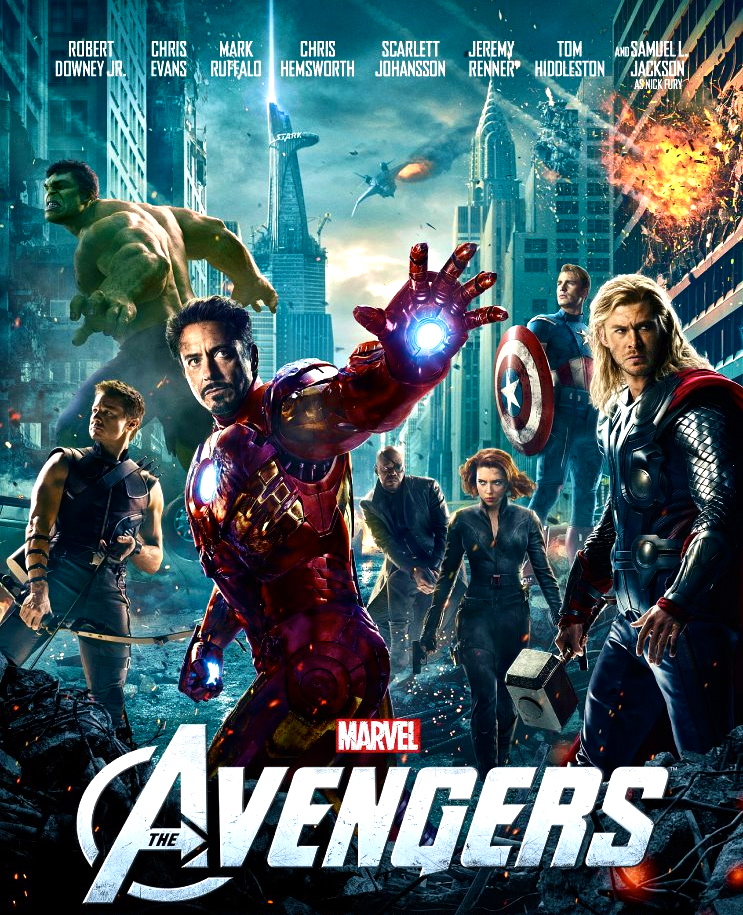
Movie review: "The Avengers"

This weekend my girlfriend and I went to movies to watch "The Avengers". Not her first choice, but neither she was really against it. I intentionally did not want to go last weekend, hoping to avoid the biggest crowds. In the end, we were both satisfied. I have been following "The Avengers" hype for some time, although passively - I like super-hero franchises, but I am not really a fan. So I knew what to expect of the movie and it turned out I was pretty realistic in my expectations.


"The Avengers" is a movie that combines and continues several movies starring super-heroes: Iron-Man (watched both and liked), Thor (watched and liked), Captain America (didn't watch, heard it was not good), Hulk (didn't watch) and Black Widows and Hawkeye (don't have movies). It also features the agency S.H.I.E.L.D., which was mentioned and played parts in mentioned movies. The plot is pretty simple: S.H.I.E.L.D. has been tampering with some alien artifact called Teserakt and accidentally freed Loki (a villain from "Thor" movie), with a little bit of help from his new allies, Chitauri. He steals the Teserakt, abducts some scientist and agents and escapes in unknown direction with nothing good on his mind. In reaction, S.H.I.E.L.D. gathers restarts the Avengers initiative, which has a goal of centering all Earth's superheroes and ally them against common foe. They are later joined with Thor who comes to Earth to put his brother Loki to order. Considering their strength, the Avengers should not have any trouble defeating Loki, except two tinny problems: they have to find out what Loki's plan is, and they have to overcome their own differences (which are pretty big).

This movie takes after "Iron Man 2" in atmosphere - flashy, fast, lots of high-tech gadgets, much of ironic banter. As I said, it is not a plot-driven movie. Although it lasts more than two hours, it is all about characters, and some about the setting. This means that it is mostly oriented to those who like the franchises and will be able to disregard weak plot. To me, it also looked like they wanted to introduce the setting and prepare the field for the second Avengers movie or other connected movies. Characters were interesting enough, and humor was quite good and successful.

In my opinion, the only flaw of the movie was the weakness of the enemies. Loki was more of a daze and confuse mind-bending player, so it OK if he is physically week (even though he is a god). But I really expected much more from the Chitauri, considering how they were announced and referenced. Also, the ending reminded me much of "The Transformers 3" trailer I saw (didn't see the movie, yet).

All in all, "The Avengers" is a standard super-hero movie multiple several times (considering all the big-name super-heroes). If you like such movies, you will love it. Even if you don't, the movie has a bit of everything to offer: humor, action, Scarlett Johansson for guys, Chris Hemsworth for girls... Just don't expect some plot-heavy intelligent drama, and you will not be disappointed - because this is THE super-hero movie.