Showing posts with label realistic setting. Show all posts

Monday, June 24, 2013

Anime review: "Bakuman", third season

Few days ago I finished watching third and last season of "Bakuman", adapted from manga about drawing manga.


This season continues "Bakuman" plot where it left in previous season. Mashiro and Takagi have finally made a manga they are satisfied with (PCP - Perfect Crime Party) and they struggle to make it better not to lose their place in Shounen Jack. They have not lost their dream of getting an anime adaptation, so Mashiro can marry his love Miho (a condition set in middle school). Takagi is supported by his wife Kaya (also met in middle school), while two of them compete against other manga-artist present in Shounen Jack, most of them familiar from previous seasons, but with some additions.

This season if a bit different from previous two (if I remember correctly) by being more episodic - there are several arcs that are almost independent between them (especially Nanaime's). But by and large, there are no much changes from first and second seasons, so if you are a fan of "Bakuman", you will be more that satisfied with it.

I cannot be sure because I haven't read manga, but it feels a bit rushed in places, like they had to squeeze too much material in it. But at least the pace is good and there is no dragging... Ending is as expected, but very solid. And I like how it is clearly showed that Mashiro and Takagi won't lose their motivation, even though they fulfilled their dreams. It is interesting how the author succeeded in having an shounen battle-anime feel when the story couldn't be less apart from such.

Characters stay the best part of "Bakuman". As I said, there are no many new additions, but we got to know older ones much more, and there are some changes in their relationships. Niizuma, who is on one hand very funny, improbable and exaggerated character, is shown to be very dedicated and consistent. I like how Hiramaru gets more serious, even though he is still hilarious - and Joshida makes him a great pairing. Also, we got a bit of romance, spread throughout the anime. Rest of the characters are also solid (Fukuda, Aoki, etc.).

It was very nice to see some modern mobile phones, and android references, too. But that can be expected since this anime was finished a year ago and is set in present.

The worst part of "Bakuman" is really bad and old-looking style of characters and drawings. Thankfully, this is character- and story-driven anime, so it doesn't matter much. Interesting how we have very poor art, but it becomes good (or at least more detailed) when it comes to manga they are drawing. Voice acting and music is solid, but nothing to praise much. There are 25 episodes in total.

In short, "Bakuman" continues with style and spirit of previous seasons, so if you liked it before, you will like it here also. I would recommend this series to everybody who likes otaku-stuff and daily-life anime, and fans of "Genshiken".

Sunday, May 5, 2013

Anime review: "Hyouge Mono"

I don't really remember how or when it started, but I know that I have been eagerly waiting for this show to be subbed for months, maybe even more than a year. I always had a liking for historical-based items (be it books, movies or anime) and "Hyouge Mono" looked like one. On the other hand, I had some similar expectations from "Sengoku Basara" (which disappointed me very, very much) and even more so from "Souten Kouro" (which took a completely different direction than I expected). But "Hyouge Mono" fitted those expectations perfectly: a complex and deeply historical anime with a bunch of characters and realistic details.


"Hyouge Mono" is set on the eve of Sengoku period in Japan, starting somewhere in last years of rule of Oda Nobunaga. In the anime we follow the important events in Japan's history for next ten years, including the wars, politics and cultural life. This is seen primary from the eyes of Furuta Sasuke, who starts as a lowly vassal to Oda Nobunaga. What differentiates Furuta from bunch of other warriors and vassals is that he is actually more of an aesthete than a warrior. But to enjoy life of an aesthete, one needs to have money. Luckily for him, aesthetes, especially those interested in the way of tea, are on the rise in this time...

Sengoku period is a very turbulent time for Japan, a time of constant warring before final unification of Japan. Of course, such times gave rise to many popular warriors and leaders, like Oda Nobunaga, Toyotomi Hideyoshi and Tokugawa Ieyasu (to name the most prominent). And as such, it is a ripe pool of ideas for anime.

There are several obvious and important aspects that make this anime different from your usual one. First one is that Furuta is in no way the main character - the show doesn't actually have one. Furuta is only the means through which we follow the events, plot and other characters. He is not even an important man, especially at the beginning of the show, and he has to bend toward the will of others. In the end, he is just a conveniently placed close to important people with small influence on the events. This is a somewhat common occurrence in books (let's only mention Guy Gavriel Kay, who use it all the time), but I don't remember seeing it in anime much (maybe in few josei anime). Actually, there is even less focus of Furuta in later parts of anime.

Secondly, it cannot be said that this anime has a plot in classical sense. We are suddenly immersed in an ongoing world full of events, we follow it for some time (10 years and 39 episodes) and then we leave it without the feel on conclusion you have when some show is finished. At one time, somewhere around 25th episode, I have made a note "totally don't know where the plot is going", because I expected first part to be the introduction and second the real revelation of the story, but I was wrong.


And third, the biggest difference is the level of historical accuracy and details. In my 200+ anime that I have watched, I don't remember ever watching such anime. I can't say that I am a student of Japanese history, since most that I know about it came from common knowledge, anime, Wikipedia and articles on Internet and magazines. There is even a warning at the start of every episode that this is a work of fiction. But on the other hand, every character, important event and even things and concepts can be found on Wikipedia or other online encyclopedia. Yes, a lots of events, or better said, reasons behind events are made more dramatic or romantic (not in sense of love), but nevertheless, the amount of accurate historical details is astounding. Interesting, characters even speak with slightly archaic speech, and subtitles that I had reflected that.

Of course, the theme of anime is strange also: the Japanese tea ceremony. I never encountered this before, and I thought it to be completely fabricated. I was very surprised when I went to Wikipedia and found out that it isn't. This gives the anime a somewhat slow and serious, but at the same time funny aspect. Furuta's tea-obsession looks ridiculous from our perspective, but I see it was a serious business at the time. There is a lot of details about tea ceremonies and talk about elegance and aesthetics. If there is a message that this anime wants to convey, then it is something like: "Always do your best in everything, but never fret about it - be elegant and relaxed". This is evident for Furuta's character that is, as I said, obsessed, pretentious and overeager to become famous as aesthete, even contrary to his sincere liking of the way of tea. Later he grows much and becomes more relaxed and enjoys the tea and beauty for itself.

This brings us to another topic: characters. There is really a bunch of them and it takes time to become familiar with them (especially since lot of them change - this is war, after all). It helps if you are familiar with the Sengoku period. They change appearance, clothes, hairstyles. But more important, they really change during the anime. Furuta, Rikyu, Hashiba - at the end, they are very different people from those who they were when we met them. I even like them more in the second part of the show, when they are more mature and relaxed...


Even though "Hyouge Mono" is a serious and historical anime, there is really a lot of humor. A lots of it steam from Furuta's obsession for art pieces, and the faces he makes (I was delightful to see that Troll-face in episode 16, during the shrimp-mongering dance). Also, it is funny when someone pricks his bubble of self-importance. But it is interesting that there is some humor that is not intended toward viewer (so that we laugh at characters), but it is more the humor between the characters so the viewer can laugh with them (like when Furuta steals the tea-jar lid). On the other hand, it is easily to forget that this funny little man is actually a warrior and veteran but we are reminded of that on few occasions.

The ending was really something. It was a slow rise during few episodes to a glorious culmination - a powerful and emotional ending. It was delighted to see that mange that anime is based upon is still ongoing - which means I can hope for eventual sequel.

I was a bit disappointed by Date Masamune's appearance and mannerism, who looks like he escaped from "Sengoku Basara". On the other hand, he was very funny, and in the end did fit with the rest of characters.

Animation and colors in nothing over the top, but it is very good. Design of characters and care for details (I mention clothes and hairstyles) are on the other hand superb. As is the voice-acting.

It's been a long time since I gave some anime 10 on AniDB (I gave them all around when I was younger), but "Hyouge Mono" definitely deserves it: complex and detailed, historically based with realistic characters, no good guys, no main character, almost a slice-of-life in turbulent times - this really an unique seinen anime. Unfortunately, I don't think it will be deservedly appreciated because it will be too hard for majority of viewers. But if you consider yourself a fan of seinen or historical anime, give this a try.

Sunday, October 28, 2012

The Wheel of Time reread: "The Great Hunt" by Robert Jordan

Well, I am progressing fine with my WoT reread, even somewhat better than expected. I finished "The Great Hunt" somewhere around last Wednesday, but I didn't have the time to write my post about it, so here it is.


"The Great Hunt" is where the real thing starts. In "The Eye of the World", Jordan was still playing safe, between an encompassed single book and start of a big new series, but here he kicks it off with a bang. After finding the Eye of the World in last book and Rand's "defeat" of the Dark One (and his discovery that he can channel and that he is possibly the Dragon Reborn), here we learn that things are not so much done, as only started. Stealing of the Horn of Valere, the ascension of Padan Fain as a major player, introduction of Senchan, Aiel and Ogier, elaboration of Aes Sedai, Darkfriends, there is really much going on. A major portion is of the book is dedicated exactly to this: introduction and elaboration. Here the WoT becomes a really detailed and complex series as we know it.

This book contains a lot of my favorite chapters: Aes Sedai discussion of the dark prophecy in Shienar, Rand's introduction to the Amrylin Seat, politicking and the Great Game in Cairhen, travel via Portal Stones and the parallel worlds (a major favorite, this one!)... I usually adored the chapter at the end when Rand fights Turak - I was surprised with my lack of excitement. Well, this was at least partially due the fact that I read this chapter very late in the night after a busy day.

As with the notions and concepts of setting, a list of characters also gets a main expansion: Verin, "Selene", Siuan Sanche, Hurin... The list is a big one. But we also get to know "old" characters better, especially Rand and Egwene. A big part of the book is about Rand's struggle to accept what he is - a struggle that really ended only recently in "The Gathering Storm", the 12th book in series! It is also curious how Mat is still not a POV character yet - we have POVs from Rand and Egwene, of course, but also from Perrin and Nyneve. Of course, this will change in next book, "The Dragon Reborn": a happy moment for most fans, I think.

There is not much else to say about "The Great Hunt", except again that this is one great book, one that really started the success of "The Wheel of Time" series.

Sunday, July 8, 2012

TV show review: "Game of Thrones", second season

I didn't mention it before, at least I think, but I have been watching the second season of "Game of Thrones" as episodes were coming out, so I wanted to make a few short notes about it.


This season was adapted from "A Clash of Kings", a second book in "A Song of Ice and Fire" series by George R. R. Martin. But contrary to the first season, which followed "A Game of Thrones" book quite faithfully (with reduction necessary to transform 800+ pages book to 10 hours show), this wasn't true for the new season. Yes, in general it is the same content, but plot, structure and characters have been changed - the degree is of this change is negotiable. To me, who have read aCoK half a dozen times and consider myself a fan of ASoIaF, this change was too large. I presume for a causal read, someone that read it once and had no big interest in the series, this was not so important. But I spent most of my time bitching how they changed this thing or that...

On the other hand, although I can't be a real objective observer, for a TV show, it is a good stuff. A large cast backed up with good acting, interesting and complex plot, unique setting (for a TV)... I think that everyone how doesn't have anything particular against fantasy can enjoy this show. Most of the people who I talked to about "Game of Thrones" liked it, except for those few who didn't like it because it was fantasy. But these same people didn't like "Lord of the Rings" or "Star Wars"...

I didn't like how Tyrion was softened, but they made it up for him with last episodes - and that explosion was really something! On the other hand, they made a success with making Joffrey look as the ultimate prick. Arya's plot was OK, but it was a bit over-the-top mixing it with Tywin's. Daenery's parts were a complete disaster, in my opinion. Jon's part was good, although it lacked complexity it has in book. They destroyed Bran's part, but I think they did it OK with Theon's. Although I am not sure what to think about him, after "A Dance with Dragons".

I am curious what will they do with the third book, which is quite longer that first two - split it into two season, rise the number of episodes or reduce the book content...

For conclusion, although I can't say I really liked this show, I think that second season of "Game of Thrones" is a good and enjoyable show. I am planning on watching the third season - and probably complaining all the way..

Friday, June 29, 2012

Book review: "Aristoi" by Walter Jon Williams

As I mentioned few times already, I used to read both fantasy and SF, especially throughout high-school and first years of college. But as I was closing to receiving my college degree, I also started working. Sick of rereading same books all the time (I've read first three books of aSoIaF more than 5 times, LotR more than 10, whole Vorkosian series couple maybe 5 times... You get the picture) and finally with some stable income, I decided to order books from Amazon, but I also realized that I have neither time nor money to indulge in books too much. So I restricted myself on buying one book monthly (mass market paperback, at first), with rereads the rest of time and anime in between. And I also oriented myself purely on fantasy, since I really like, and there was a shortage of fantasy books in Croatia. But since I bought Kindle, the price of books halved for me. Also, there was a shortage of anime that attract me for the last few seasons, so I don't have any big plans on that side. And additionally, currently there is only two unfinished series with published books out there, "Deepgate Codex" and "Shadows of the Apt", while all others are on waiting for next installment (WoT, aSoIaF, "The Kingkiller Chronicle", "The Stormlight Archive"...)...


After this lengthy introduction, let me get to the point, which is that I plan to occasionally indulge myself with some SF hits once in a while. First of such books was "Aristoi" by Walter Jon Williams. I found the first mention of it in a post by Jo Waltonon Tor.com blog. I usually (but not always) respect her opinion on books quite much, so I put it on my wis-hlist. And last week, while I was looking for what book to buy, I decided for it: less than 400 pages (I was looking for some quick read), a single work (didn't want to start a new series), and only 5$. Now, after finish it, I can only say that I fortified my decision to read SF occasionally.


"Aristoi" takes place in far future. After losing Earth in nano-technology induced accident, humanity has spread between the starts. They have AI, relatively safe nano-technology, Faster-Than-Light travel, perfect virtual reality and direct connection between mind and computer. They also conquered majority of diseases, live in largely free societies and don't lack much. And also very important, they reached a major advance in psychology by understanding and waking up hidden parts of their unconscious mind. All this progress is led by Aristoi. After successfully passing long and extensive exams, Aristos or Arista are given a solar system, and complete freedom in it (adhering to some common rules), with goal of benevolently ruling and advancing humanity in it (important to understand: common people can freely move to wherever they chose). So, in this blissful utopia we are introduced to Gabriel, moderately young Ariostos, talented, sensitive, especially oriented on architecture, art and design. One day, after having an unexpected and worrying conversation with not-particularly friendly Arista, he suddenly realizes that not everything is as certain as he believes - after this Arista dies in accident. Is this really and accident, or masterfully devised plot?


Let's first mention setting. I was looking for something leaning toward hard science fiction, but this was even better. Maybe some would say that "Aristoi" fundamentally is not hard-SF because it doesn't stress enough on how things work, but it has enough high-tech terms which sound plausible and believable to mask as one. For example, nano-technology: it is used, there are some brief mentions on technical details, and much on (realistic) dangers of it, but there are no extensive technical description of it. Or Hyperlogos (virtual reality/super-Internet): there is mention how it needs large (moon-large) data banks, some mentions of programming and algorithms but that's it. But every mentioned technology (including psychology) was consistent and believable - and impressive and though-provoking.


So, instead on exhaustive descriptions of setting (which is nonetheless), this book instead concentrates on plot and characters. It is thriller SF, I would say (hidden plot, investigation, trial...), but I changes to quasi-fantasy adventure in one part. This was the only turn-down of this book for me - not that it was boring or weak, but I expected something grander (epic) from it. It does have some clever and funny tricks. Plot is a bit predictable, although not much - it stays intriguing and interesting, but it lets you feel smart when you guess some detail in advance. There is a lot of humor, some sex, some art... a pleasant mix, all considered.  I must confess that I didn't like first few pages, until all clicked in its place and things got going.


Gabriel is clearly main character and we follow everything from his point of view, except some encyclopedic passages. He is a very complex and realized characters - and our view of him changes throughout the book. At first, he is very impressing person, fully in control of himself and his surroundings. But as the plot progress, we realize that all this self-confidence is only in his head and he looks quite naive. An in the end.... well, let's just say that he is not so tough any more, but he gets even more impressive despite of it. Other characters are not so deep, and some even few more like symbols than real characters. But this is OK, our focus is on Gabriel, after all. 

A quick thought: I just realized that this book reminds me much to Zelazny's "Lord of Light". It has a combination of high technology with religion, war between advanced humans that to non-advanced people look like fight between gods, air of mystery, influence by East...

In the end, I was very satisfied after reading "Aristoi" - it was a great read, interesting, fun and full of new ideas. I did expect more epic story, but it was great nevertheless. I would recommend this book to everybody who doesn't have aversion to science-fiction.

Saturday, May 26, 2012

Anime review: "Bakuman", second season

So, quite fast after fighting against and then succumbing to the first season, I watched the second season of "Bakuman". The good news is that third season (last one, I think) is following this fall. I am looking forward to it. Only thing I can object about it is that is was so good that I watched 20 episodes in one day (Sunday), which resulted in 4 hours of sleep that night and a very sleepy morning at work next day.


As I wrote in my review of the first season, "Bakuman" is a shounen anime flirting with seinen. This is even more notable than in first season. Mashiro "Saiko" Moritaka and Takagi Akito continue struggling to fulfill their dream of becoming the first-rate manga-ka for Shounen Jack, so Saiko can marry Miho (whom he had seen one or twice since their middle school). I know: a typical senseless shounen plot. But for some reason, it works great. In this season even their relationship become a bit more realistic (but still a far away from normal).

In the first season the duo succeeded in getting a serialization of their manga. This made their goal seem quite reachable, but it also brought one shortfall - instead their genius editor Hattori, they are now transferred to a junior editor Miura. Will the new editor be show good enough to support them? And more important, will they first manga prove to be enough to get an anime adaptation?

This biggest plot starts at the beginning, and is resolved toward the end, but there are few side-roads taken around the middle. This is a good thing, because this side plots are used to evolve the characters (I almost used the word setting, but this is a character-centered anime, setting is irrelevant), the new one and the old one. Cast is widened so much that it would be a trouble to remember everybody, if they were not so unique and unforgettable. I didn't expect such evolution of what I thought to be side-characters - there is much character development in this anime. Characters are also more mature. I think that focus of this season is removed from creation of manga toward relationship between them, although manga stay the center that everything revolves. All in all, I think that this season was composed nicely - nice pace, not too slow, but neither too fast; and always interesting.

I read some comments that anime adaptation rushes through the manga, which means that there is probably more material there. This series is completed, so I would like to read the manga original, although after the fiasco with "Black Lagoon", I am somewhat weary. I will keep this one on mind, but not for the close future. Anyway, this season takes around three or four years (in anime time)!

The humor is simply great. There are lots of gags, and it kept me smiling most of the time. But the funniest character of the series so far was Hiaimaru. And to believe that he was introduced so sinister in the first season... I think that I laughed in every scene featuring him. Otters...

There is not much to say about audio or visual side - they are mostly mediocre. I wanted to said that unique design of characters follows more from authors' (Obha Tsugumi  and Obata Takeshi) weak skill that from intention. But I then checked Wikipedia and saw that they are responsible for "Death Note", which was drawn much better, so maybe I am wrong. There are 25 episodes, again.

For conclusion, I think that it is enough to say that second season of "Bakuman" is even better than the first. A nice catch for those who like slice-of-life or comedy anime. Special recommendation for the fans of "Genshiken".

Wednesday, March 28, 2012

Just started a re-read of "A Song of Ice and Fire" by George R. R. Martin

I finally decided to read "A Dance with Dragons", fifth book in what is probably currently most famous fantasy series around: "A Song of Ice and Fire". My initial plan was to wait for the paper-back edition to come out, since I didn't want to buy a hard-cover. I was also in process of buying first four books, and bought "A Game of Thrones" and "A Clash of Kings". But as I recently bought Amazon Kindle, this made me change it since now I don't have to wait for anything.


Anyway, before reading "A Dance with Dragons", I will be doing a reread of whole series so far, to refresh my memory. ASoIaF is one of my favorite series, and I have read first few books many times. But I haven't read them since I stopped going to library (some 4-5 years, now) and this will be the first time to read them in English.

I plan to make a post for each book.

Sunday, March 4, 2012

Book review: "The Dragon's Path" by Daniel Abraham

First I would like to say that recently I have finally bought Amazon Kindle. I was playing with the idea for some time, but my initial decision was to wait a year or two for this technology settle properly. What made my change my decision was very mundane: a lack of space for books. I am still living at my parent's house and have a relatively small room with only two bookshelves on the wall. So when I recently come close to filling them fully, I realized that I will have to invest in a new one, but I was already tight with space. This also made me thinking, what will I do when I move out (probably to some apartment): bring all my 100+ book with me? So I decided to make thins investment -which turned out to be much smaller than I thought will be. I decided to take the basic version, even without 3G (only WiFi), because I have a good smartphone I can use for Internet (Samsung Galaxy S II). Now, after completing my first book I am very satisfied. I was able to read without any problem, even easier that with real book - you can choose font-size you like, "paper" was not too bright and there was no gloss. You can change pages easily and move between chapters. Built-in dictionary is also useful. Device itself fits very nicely in hand, and in lap, which I important to me because I like to read when I am eating. Only drawback was that I wasn't able to see all details on the map in book. But all in all, I am more than satisfied with Kindle and I don't plan to buy any more paper books, except in case where there is no Kindle edition.

So, first book that I read on my Kindle was "The Dragon's Path" by Daniel Abraham. I have read his probably most famous work for now - "The Long Price Quartet". I think these are exceptionally well written books, but although I had enjoyed them, I can't say they were among my favorites and I haven't made any special connection to the setting or characters. After "The Dragon's Path" was published last year, I read some very good reviews about it, telling how Abraham retained his quality but wrote much more classical epic fantasy work. I concur with these reviews, because I found it extremely enjoyable, a kind of book you try to read in one sitting. I hope this will be a start of great series, one called "The Dagger and the Coin Quintet".


There are four main characters in "The Dragon's Path" and story is told from their point of view (in third-person narration), although two more characters get each a small chapter or two. Captain Marcus Wester was a famous captain and warrior, but after a jealous betrayal by his lord, he found his place as a leader of caravan guards, a mere mercenary usually leading half a dozen men. His latest job is to take one of the last caravans from Vanai, a soon to be besieged trading town, one of Free Cities neighboring the Antea Kindgom. Cithrin is a young girl of seventeen years, who lost her parents at four years and since has been a ward of Medean Bank in Vanai, living there and learning to be a banker one day. But because of closing siege and pressure from ruling Prince, a leader of this branch of bank decides to move its riches secretly. After the murder of person who was supposed to take it from the town, Cithrin is forced to take his place masked as Tag the Carter, a place in caravan guarded by Captain Wester. Geder Palliako is a knight in army that is coming to conquer Vanai. He is a good and likable guy, a minor noble, but because of this goodness and his social awkwardness he is often bullied and teased by his peers. After one such joke, where his superior burn his favorite book, the firmly decides to take his revenge on him. Last one is Lord Dawson Kalliam, one of the strongest and most important nobles in Antea, now a man in his middle years with grown up children. His constant feuding with one of his peers will take him to discover a possible plot against his King - first only by reducing King's power by installing a farmer's council, but later with much worse consequences.

The setting Abraham came up for his new series, "The Dagger and the Coin Quintet", is one that fantasy fans will find more familiar then in "The Long Price" quartet, but on the other hand, one with enough originality to not be a common one. But the best part is that Abraham is very scarce with details and although he made a very believable and realistic setting with so few, he left much more for fans to explore in next books.  Few thousand years ago all land was united in the Dragon Empire, one literary ruled by dragons. Thirteen races of humanity were then designed and created by dragons, with Firstbloods (regular humans) as first. Other races are also human, but with specific traits (some are larger, some are smaller, some have reptilian features, and so on). Due to infighting between dragons, their Empire collapsed and the only that is left from then are the Dragon Roads, indestructible jade roads that connect new kingdoms and cities. Technology is classic medieval, but commerce plays a big role. There is magic which is wide known and taken for normal, but it is rare and weak (cunning-men can heal minor wounds, make some weak physical effects like calling the wind, and so on).

But what make this book exceptional are the characters. Marcus and Cithrin present the lower side, common people. They are both realistically written and both are neither perfect nor plane. Marcus is troubled by death of his wife and daughter, and during book his decision are influenced by the fact that Cithrin remind him to his daughter. As his companion ask him: does he do things because Cithrin remind him of her, or does he act differently in spite of it. Cithrin is a classical young character thrown into circumstances over her head. She is spiteful, sometimes weak and sometimes full of herself, but always interesting to read - there are few big turns and surprises with her story. I read some reviews that say that her part was too full of boring economics, but I didn't found it so - at the contrary, I found the realism of it very refreshing.

So, Marcus and Cithrin are great characters, but Geder and Dawon are above this - two really thought-provoking characters. Geder is one character many will be sympathetic for, even find connection to. He is thoughtful and oversensitive, likes books and reading - although he is nice guy, he is a target of teasing by his companions. It makes you forget that he is a knight, trained in killing people, and even though he is only minor nobility and not very rich, he had a protected and easy childhood - not so much compared to his peers, but miles above common people. And what he will do during this book... We can't call it really evil because there were no evil intentions and he does it from naivety, but I don't think he would fare well on the International Court of Justice in Haag! And as for Dawson... He is intelligent but wise, sure in himself but not too demanding of others. He is rich, powerful and loyal - a lord everyone decent could look up to without jealousy. He likes dogs and you just cannot dislike him. But at the same time, he is racist, chauvinist and elitist. He thinks about other races as slaves and less than animals - common people he regards maybe some better than animals. When you read his talk about raising pig-headers, you are disgraced that you are both humans. But what is much worse, he sound very convincing and sensible! Abraham did a great job with him - it's like Abraham is using Dawson to invite and challenge you to prove him wrong and to prove yourself better than him.

Other characters that we meet though book are also interesting. The acting troupe for some reason reminded me much to "Tigana" by Guy Gavriel Kay, although without any specific reason.

Book is some 600 pages long and is really easy to read. It is well rounded and has a completing ending. But you have to have in mind that this is only first book in series and that will have at least four more. What it does is introduce the setting and some players - real action will only follow. Threat of the Spider Goddess is only indicated, but I am looking forward reading more about it.

In many ways "The Dragon's Path" reminded me to "The Darkness That Comes Before" by R. Scott Bakker - original setting with history and realism, interesting and flowing story, amazing and provocative characters, combined with great writing. If sequels retain this quality, this series deserves to be placed among the best fantasy series out there now.

Thursday, February 2, 2012

Movie review: "The Girl with the Dragon Tattoo"

I have been quite busy for the last two weeks, so wasn't able to find a free afternoon to write this post, even though I watched "The Girl with the Dragon Tattoo" the weekend before last. I have seen the trailer for it when I went to movies to watch "Contagion" (I think), so I talked my girlfriend into watching it.

I knew few facts about the movie before watching it, and few of my friends watched the Swedish version of the movies and judged them good. Curiously, I have had a page-marker with praises for the Croatian translation of the "Millennium" trilogy by Stieg Larsson for couple of years now, but I didn't make the connection with the movie because they kept the original names in translation (the original name of the book is "Men who hate Women"). More so, the marker contained praises for the books, but they were written by one "famous" Croatian poet which I don't like (don't like his taste in books), so I stupidly dismissed the books. But now, after watching the movie, I think I will read them in future.


"The Girl with the Dragon Tattoo" is a thriller dealing with some old murders in Swedish aristocratic family. Plot is quite good. Movie lasts more than two and a half hours so they took their time and used it good - main action doesn't start immediately, but it takes some time to introduce characters. There are two main characters: Mikael Blomkvist and Lisbeth Salander; their plots start separately and run in parallel, but are connected somewhere in the middle of the movie. Mikael is a middle-aged famous journalist in the magazine called "Millennium" who targets a rich industrialist and writes an article depicting him as a criminal - but after some of his claims are proved false, his whole article is the taken as nothing more than slander and he loses credibility. Since he wants to move from public eye for some time, he accepts an assignation by another rich old man, Henrig Vanger. He task up front is writing Henrik's biography, but in truth he is trying to solve the disappearance of his niece some forty years ago. Another complication is that someone from his family is probably to blame - even worse, Henrik's whole family lives on isolated island so Mikael is maybe living next door the possible murdered. On the other side of Sweden, Lisbeth, a 23 year old is trying to sort her life. She was a problematic child, always different from others - abused by her father and blessed/cursed with photographic memory. She is officially under care of decent social-worker who treats her well; without his knowledge she does some investigation work for highly-expensive detective company. But after her caretaker suffers a stroke, she is put under care of sadistic Bjurman...

As I said, plot is quite good and also done pretty well. Two independent plots are not very usual, but this worked very well because this was you never know what is coming up next. Another good point of the movie is that induces the audience to participate in the movie. Claim that the culprit is someone from Vanger family is given quite early in the movie, so you just have to try to guess who of them could be the one.

Characters are also interesting. Mikael is played by Daniel Craig, and he is very convincing in the role of intelligent journalist who is at first dismissive of this case, but later gets sucked in by its curiousness. Lisbeth is played by mostly unknown (at least to me) Rooney Mara, but she also does a great job with this demanding role.

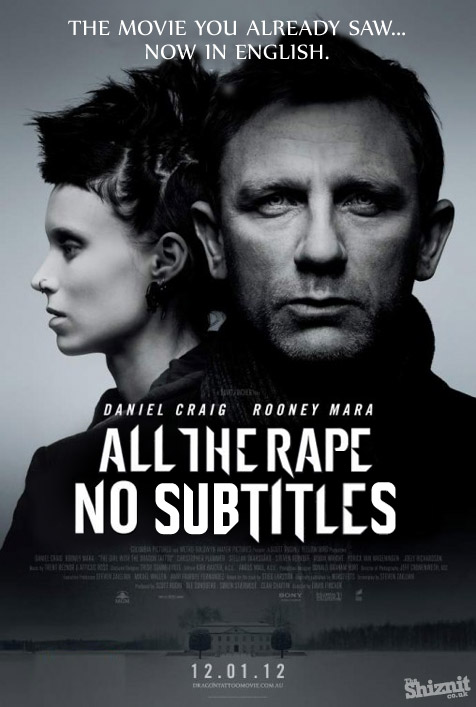
Demanding, because without the character of Lisbeth, this movie would still be a very good thriller, but it would lose much of its impact. And this impact is acquired by unusual amount of brutality and violence, both physical and psychological. So, although "all the rape" is not strictly necessary for the plot, it is what separates this movie from others. So, be warned, this movie contains quite few shocking scenes, and they are done very visual and explicit. This is not your usual Hollywood movie, which probably didn't return much in money, but it paid off in respect.

"The Girl with the Dragon Tattoo" is one of the best movies I watched in last couple of years. It contains much violence, and its dark atmosphere will not be suitable for anyone; but if you like high-budget thrillers and don't have aversion to explicit scenes, this could be a movie for you.

Thursday, January 5, 2012

Anime review: "Bakuman"

Today I finished watching "Bakuman". Most of the time I give myself a few days of rest before posting a review, but since I am still on vacation and have some free time on my hands, I decided to do it today.

"Bakuman" has been on my wish-list for some time now, based on its high marks, but only on moderate importance. I was feeling a kind of dread whenever I thought about watching it - just look at that image! Especially on the upper-left corner! Include to this words like "middle-school", "marriage", "becoming a mangaka" - how could this be a good anime? Well, it turned out that I was pretty much wrong and this is a great anime!


Mashiro Moritaka is a typical middle-school kid, moderately good student, but without any particular dream or purpose. One day he loses a notebook where has was secretly making drawings of Azuki Miho, a girl who he likes. After coming to school to retrieve it he is confronted by another kid from his class, Takagi Akito, who has found his notebook. On the basis of drawings from there, Takagi tries to force Mashiro to become his partner in drawing manga. Since Mashiro has some bad experience regarding manga (his uncle was an unsuccessful one and died from overexertion), he initially declines. But Takagi tries again, this time in front of Miho (who incidentally, aspires to become a voice-actor), and this time Mashiro accepts - but even more surprising, Mashiro proposes to Miho. Even more surprising, Miho accepts - to become married after they realize they dreams and she plays a role in anime made after his manga.

This anime combines some realistic approach and themes with ridiculous stuff typical for shounen anime - but in perfect combination. For example, the plot: basically, this is a show about two kids who aspire to become mangaka. I obviously can't know what really happens on a road to becoming one, and I presume there is much more than showed in here, but everything that was presented sounded logical and realistic. Our protagonists have troubles in coordinating school, working on manga and private lives; they have to fight prejudice for being too young for this enterprise; they have to deliver their mangas to editors, have to discuss it and remade it; these editors have their bosses to respond to, have to take care of things like pools, formats and schedules; and myriad other small things that make this (in my humble opinion) a realistic representation of young manga authors' life. On the other side, we have a such plot elements that can be found only in shounen anime: the reason why all this is happening is because a 15 year old kid wants to marry when he is 18 (!!); they have friendly rivals who will give everything they have to become mangaka; there is even a genius high-school mangaka who draws them like a machine... But even with all this simplifications and jokes, this anime's first and foremost subject is about what it takes to become a mangaka.

Characters are great, simply said. Mashiro and Takagi are obviously mostly developed, but most of other got a pretty good realization. Mashiro gets a bit more coverage, especially his inner thoughts, than Takagi, which is little unfair because they are both equally good characters. On the other hand, Takagi has an actual girlfriend, Miyoshi (Miho's best friend) - very normal and realistic relationship for a shounen anime. Mahsiro's and Miho's relationship is anything but normal and realistic - they exchange maybe three sentences in whole season - but this IS a shounen anime so there is no room for complaining - actually they move toward normal at the end. Niizuma Eiji (guy from the upper left part of the picture) is the before mentioned "high-school genius", but he is also very good characters - he grows, realizes mistakes, accept advice and so on. Hattori is another character that fooled me - considering his design I thought he will be one-shot character - is another good and fully-realized character - a grown-up editor in manga-magazine. There is another 10-15 named characters. Interesting and laudable is the fact that some characters come and go - for example Iwase has some importance in first part of the show when they are still in middle-school, but disappears later when they enter high-school.

All characters do a lot of growing up: they learn from their mistake, don't always act rashly, and think about past and future. This is to be expected, since show takes almost two years of their time. Another their property worth mentioning is that they are not frustrating, which is often occurring, especially in shounen romance anime.

Jokes are pretty good and I chuckled at loud at least once in every episode. Kudos for jokes where they make fun of themselves ("Doesn't anyone have a fiancée?")! Also there are lots of references to real-life manga and anime: "Dragon Ball", "Naruto", "Bleach", "One Piece"... Actually, a magazine where they are submitting their works is called "Weekly Shounen Jack", which is an obvious reference to "Weekly Shounen Jump".

One thing that got me confused was Miho's anime. If she works only as voice-actor, why does the character she gives voice to looks like her? I can't get it whether this is a mistake or only simplification...

From technical side, anime has 25 episodes, all original, no fillers or recaps. Animation and design is good, but nothing over-the-top. Characters wear different clothes (although restricted number of sets) - I always notice this and find it laudable where it is so. Music I didn't like much, but voice-acting was very good. I especially liked Takagi's voice (done by Hino Satoshi).

I am happy to say that "Bakuman" was a very pleasant surprise. It doesn't belong to the best anime ever, but it is very good and especially enjoyable. Recommendation too all, except to those who watch exclusively action anime. I just hope that next two seasons will be good as this one.

Monday, November 21, 2011

Book review: "Under Heaven" by Guy Gavriel Kay

I haven't read Guy Gavriel Kay for several years now, since I singed out of library. Before, I used to re-read one of his books every few months, resulting in reading his opus (6 books in library) every couple of years. You can say that he is one of my favorite writers, although I don't count him in Big n (n being 3, 5 or some similar number of favorite writers) for simple reason of him not writing long epic series. He recently (last year) published another of his novels (he published some urban fantasy novel and a collection of poetry, but I don't like urban fantasy and can't read poetry, so I don't count them) and I was somewhat unsatisfied because buying it didn't fit in my schedule. But my local bookstore has a promotional month(s) when you get three books for two, so I decided to treat myself with this.

Although Kay dislikes branding of his books as "historical fantasy", I don't know how else this should be labeled. I allow that it is mostly historical fiction, but there is a touch of fantasy and for me this is a definition of historical fantasy. This is true for this "Under Heaven", too. Actually, "Under Heaven" is a typical Kay book. We have a historical setting and real historic event as theme (An Shi Rebellion, which I didn't know first thing about). We have larger-than-life characters (most of them male, but females are in no way withhold), with unreal levels of honor, cunning and passion that feel real nevertheless. We have a meandering story, with lots of jumps in time and space, short POVs from characters that will never be seen again, changes between POV and narration types. And at last, we have a main character who is a smart and able guy, suddenly finding himself in highest circles (royalty) where he feels inadequate, but actually acts marvelously and then ends removed from important events and future.


In "Under Heaven" this is Shen Tai, second son of famous, now passed away, General Shen Gao. Since their customs obligate sons to mourn their father for two years (except if they are members of army), Shen has chosen something unorthodox (but not forbidden): to spend next two years in isolation, burying the bones of soldiers fallen at Kuala Nor (site of many battles between Kitai and Tagur). Shen's intentions were sincere and innocent, but his actions have now attracted the attention of royalty: one of wives of Taguran Emperor, daughter of Emperor of Kitai, has given him an extravagant gift of 200 Sardian horses (equivalent of Bill Gates giving you 100 million dollars - not big money for him, but you are suddenly in everyone's focus). Now Tai has to find a way of dealing with horses without shaming his family or offending the Emperor or anybody powerful, avoiding machinations of his ambitious brother and enmity of First Minister (whose newest concubine was once Tai's favorite courtesan) - all this in rigid and custom-obsessed society on a brink of rebellion... Of course, this is not all, but if this is not enough to attract you, nothing more will.

As I said, this is a typical book for Kay. We are following one important, but not the most important, character during turbulent times, based on some historical epoch. In this case this is 8th century China: not my favorite history topic, nor one I know much about. Since I don't know much about it, I have to trust that Kay was not making all this up; based on his previous book, I think the setting was truthful as much as possible. The same cannot be said for his characters: they are always too ideal, whether as good or as bad guys. But this make them fun to read about. His storytelling is also specific: a chapter starts with present events, then we a transfer to completely (seemingly) irrelevant time or POV and then this two lines connect. But he does it so good that it feels natural and simple.

About this book particularly: I liked most of the book, but ending was a bit rushed. His books are not usually overly long (relatively), but I think this was a shorter one (560 pages). He does a great beginning: introduction to setting and characters, acceleration of main plot. But then things end too fast. I can't say that ending is unsatisfactory or doesn't feel closed, but I think a hundred more pages of plot development would be a bad thing.

As those who have read his previous books, there are always some fantastic elements present there that don't make much worldwide impact (except in "Tigana"), but make a tremendous personal impact of main characters. It is also present here, and I must say I was surprised how direct it was.

Different people like different Kay's books. My favorite book is "The Lions of Al-Rassan", while I find his most ambitious work to be "The Sarantine Mosaic", and I also adore "Tigana". I less like "A Song for Arbonne" and "The Last Light of the Sun". For some people is the other way around. I found "Under Heaven" better than these last two, but not good as my favorite. Kay's fans will notice that I didn't mention "Fionavar Tapestry": I read only the first one ("The Summer Tree") and I hated it - I really don't connect this book to Kay.

Nonetheless, I would recommend "Under Heaven" to every Kay's fan or anybody who like historical fantasy or is a sucker for romance. Realistic setting, great characters and enjoyable plot make this a very good read!