I've been hearing lots of good things about John Scalzi for some time now, but I haven't read anything by him yet. I know his is famous for over Internet for his opinions and blog, and that he wrote mostly SF. So when I decided to occasionally buy SF, I added one of his books, "The God Engines", on my Amazon wish list. I have some plans for my reading this fall and winter, which I will announce in one of my next posts, so I decided to read something stand-alone last week and I picked this.
I've been surprised how "The God Engines" is similar to "The Hundred Thousand Kingdoms" (which I read not so long ago) in premise. In both books we have gods who are chained by one other god and forced to serve humans as tools and weapons. Here, gods are literally chained, in hulls of space-ships, and used are their primary source of power. As long as the crew maintains its faith, they have nothing to fear and the god can be punished into submission. But when Captain Tephe and his crew is sent on a secret mission, they will find their faith in question, and who can then say what will happen next...
My second surprise was the shortness of this book: with 136 pages this is only a novella. But it is my own fault for not reading more about what I was buying. I am more attracted to longer books, and I was able to finish this book in two days, reading only few hours each.
But the book is pretty good and I can see why Scalzi is famous. It is a type of novellas that I used to read in collection that were published few years ago in Croatia, gathering a lot of older SF hits (Clarke, Haldeman, Hamilton...). The setting is very imaginative, and although we don't see much of it, looks pretty solid. It has a curios mix of high technology and religious dominance (something like in later books of "Hyperion Cantos" by Dan Simmons). The story is also very good, but I was delighted by the ending: I really didn't see it coming.
On the other hand, I am wishing it had a bit more meat, because the last part feels a bit rushed.
"The God Engines" is a very good novella and I would recommend it to everyone, SF fan or not. But I wouldn't recommend buying it: borrow it or buy it in some larger collection.
On this blog I write my impressions about books and manga I've read and anime and movies I've watched. Also, I occasionally post some random thoughts regarding this subjects. I try to be objective, or even when not, to state some bad sides of contest I describe (if I can see them). I presume that my first posts will be somewhat raw or confusing (especially since English is not my first language), but I hope that in time I will get better in sharing my thoughts.
Showing posts with label sex. Show all posts
Saturday, October 6, 2012
Sunday, August 19, 2012
Anime review: "Seitokai Yakuindomo"
After finishing "Daily Lives of High-School Boys" several weeks ago, I noticed several comments recommending "Seitokai Yakuindomo" to those who liked the former. They also warned that it was an anime with high amount of sexual jokes, some of them pretty heavy, so it was not appropriate for those easily offended. Since there are currently no other anime I have set my eyes upon (except "Hyouge Mono", but nobody is doing the translation!!!), I decided to give it a try.
Identically to "Daily Lives of High-School Boys", "Seitokai Yakuindomo" is anime composing of several scenes/sketches per episode, something apparently called 4-koma style. Here we follow Tsuda Takatoshi who is just entering a high-school. The school he picked (because it was closest) was until this year all-girls school, so he is one of few boys there. On the first day he is selected by a presumptuous President of Student Council to be a new member, which will define the rest of his first-year. The Council consists of three other girls: President Amakusa Shino (presumptuous and full of misconceptions about boys), Secretary Schichijou Aria (rich and ditzy, fond of perverted jokes) and Treasurer Hagimura Suzu (genius trapped in a child's body).
There is no real plot, but the show has some form of time-continuity, and we follow our characters in whole-years school events: exams, excursion, sport-festival, art-festival. There is also the unavoidable trip to beach with overnight stay at the hot-springs. The jokes are heavy (they include talks about sexual toys, extreme sex, bondage...), but they stay jokes - they are neither crass nor erotic. This is not ecchi anime, and there is almost none fanservices. The jokes cleverly originate between girl's misconceptions about teen boys (who are seen as masturbating perverted freaks), intentional shameless desire to make Tsuda uncomfortable (he is pretty normal - actually a bit too reserved for a rare boy in girl-school) and some originally perverted streaks of few characters (Shino is obsessed with bondage, Aria owns several vibrators...). But there is nothing explicit in this series, and most jokes are presented orally (no pun intended). Oh, yes, there is also a lot of slapstick and pun-based jokes.
Whether you will find these jokes funny depends mostly on yourself. I found jokes funny, but not much. I think that authors intended the jokes to be more shocking, so I you are not easily shocked by sexual content, these jokes lose much of their impact. Still, there are some genuinely funny jokes, and it is always funny to see Tsuda's antics focused on Shino.
Interesting, there is even some innocent romance in this series. I actually got warmed up to the characters toward the end. Except the main four characters, there are some half a dozen supporting characters, like Hata (member of newspaper club that likes to take improper pictures to sell them on the Internet), Igarashi (female member of Discipline Comity that is chronically scared of boys), Naruko (teacher attracted to younger males)...
The graphical side of the anime is not impressive. Design of characters is especially generic and bland, but I appreciate it that they are not in the school uniform all the time and possess more than one set of clothes. There is some nice OP and ED. Music in between is intentionally made sleazy. There are 12 episodes total, but there are two more sequels with few more OVAs.
But in the end, "Seitokai Yukaindomo" is not really an anime to recommend. There are funnier high-school comedies out there ("School Rumble" for example). And for the jokes the work you would have to be not easily offended, but easily shocked by the sexual content at the same time. But on the other hand, if you like high-school comedies and don't have anything other to watch, this is not a bad anime.
Identically to "Daily Lives of High-School Boys", "Seitokai Yakuindomo" is anime composing of several scenes/sketches per episode, something apparently called 4-koma style. Here we follow Tsuda Takatoshi who is just entering a high-school. The school he picked (because it was closest) was until this year all-girls school, so he is one of few boys there. On the first day he is selected by a presumptuous President of Student Council to be a new member, which will define the rest of his first-year. The Council consists of three other girls: President Amakusa Shino (presumptuous and full of misconceptions about boys), Secretary Schichijou Aria (rich and ditzy, fond of perverted jokes) and Treasurer Hagimura Suzu (genius trapped in a child's body).
There is no real plot, but the show has some form of time-continuity, and we follow our characters in whole-years school events: exams, excursion, sport-festival, art-festival. There is also the unavoidable trip to beach with overnight stay at the hot-springs. The jokes are heavy (they include talks about sexual toys, extreme sex, bondage...), but they stay jokes - they are neither crass nor erotic. This is not ecchi anime, and there is almost none fanservices. The jokes cleverly originate between girl's misconceptions about teen boys (who are seen as masturbating perverted freaks), intentional shameless desire to make Tsuda uncomfortable (he is pretty normal - actually a bit too reserved for a rare boy in girl-school) and some originally perverted streaks of few characters (Shino is obsessed with bondage, Aria owns several vibrators...). But there is nothing explicit in this series, and most jokes are presented orally (no pun intended). Oh, yes, there is also a lot of slapstick and pun-based jokes.
Whether you will find these jokes funny depends mostly on yourself. I found jokes funny, but not much. I think that authors intended the jokes to be more shocking, so I you are not easily shocked by sexual content, these jokes lose much of their impact. Still, there are some genuinely funny jokes, and it is always funny to see Tsuda's antics focused on Shino.
Interesting, there is even some innocent romance in this series. I actually got warmed up to the characters toward the end. Except the main four characters, there are some half a dozen supporting characters, like Hata (member of newspaper club that likes to take improper pictures to sell them on the Internet), Igarashi (female member of Discipline Comity that is chronically scared of boys), Naruko (teacher attracted to younger males)...
The graphical side of the anime is not impressive. Design of characters is especially generic and bland, but I appreciate it that they are not in the school uniform all the time and possess more than one set of clothes. There is some nice OP and ED. Music in between is intentionally made sleazy. There are 12 episodes total, but there are two more sequels with few more OVAs.
But in the end, "Seitokai Yukaindomo" is not really an anime to recommend. There are funnier high-school comedies out there ("School Rumble" for example). And for the jokes the work you would have to be not easily offended, but easily shocked by the sexual content at the same time. But on the other hand, if you like high-school comedies and don't have anything other to watch, this is not a bad anime.
Labels:
anime,
comedy,
daily life,
fun,
funny,
gags,
good,
high school,
sex,
slapstick
Friday, June 29, 2012
Book review: "Aristoi" by Walter Jon Williams
As I mentioned few times already, I used to read both fantasy and SF, especially throughout high-school and first years of college. But as I was closing to receiving my college degree, I also started working. Sick of rereading same books all the time (I've read first three books of aSoIaF more than 5 times, LotR more than 10, whole Vorkosian series couple maybe 5 times... You get the picture) and finally with some stable income, I decided to order books from Amazon, but I also realized that I have neither time nor money to indulge in books too much. So I restricted myself on buying one book monthly (mass market paperback, at first), with rereads the rest of time and anime in between. And I also oriented myself purely on fantasy, since I really like, and there was a shortage of fantasy books in Croatia. But since I bought Kindle, the price of books halved for me. Also, there was a shortage of anime that attract me for the last few seasons, so I don't have any big plans on that side. And additionally, currently there is only two unfinished series with published books out there, "Deepgate Codex" and "Shadows of the Apt", while all others are on waiting for next installment (WoT, aSoIaF, "The Kingkiller Chronicle", "The Stormlight Archive"...)...
After this lengthy introduction, let me get to the point, which is that I plan to occasionally indulge myself with some SF hits once in a while. First of such books was "Aristoi" by Walter Jon Williams. I found the first mention of it in a post by Jo Walton, on Tor.com blog. I usually (but not always) respect her opinion on books quite much, so I put it on my wis-hlist. And last week, while I was looking for what book to buy, I decided for it: less than 400 pages (I was looking for some quick read), a single work (didn't want to start a new series), and only 5$. Now, after finish it, I can only say that I fortified my decision to read SF occasionally.
"Aristoi" takes place in far future. After losing Earth in nano-technology induced accident, humanity has spread between the starts. They have AI, relatively safe nano-technology, Faster-Than-Light travel, perfect virtual reality and direct connection between mind and computer. They also conquered majority of diseases, live in largely free societies and don't lack much. And also very important, they reached a major advance in psychology by understanding and waking up hidden parts of their unconscious mind. All this progress is led by Aristoi. After successfully passing long and extensive exams, Aristos or Arista are given a solar system, and complete freedom in it (adhering to some common rules), with goal of benevolently ruling and advancing humanity in it (important to understand: common people can freely move to wherever they chose). So, in this blissful utopia we are introduced to Gabriel, moderately young Ariostos, talented, sensitive, especially oriented on architecture, art and design. One day, after having an unexpected and worrying conversation with not-particularly friendly Arista, he suddenly realizes that not everything is as certain as he believes - after this Arista dies in accident. Is this really and accident, or masterfully devised plot?
Let's first mention setting. I was looking for something leaning toward hard science fiction, but this was even better. Maybe some would say that "Aristoi" fundamentally is not hard-SF because it doesn't stress enough on how things work, but it has enough high-tech terms which sound plausible and believable to mask as one. For example, nano-technology: it is used, there are some brief mentions on technical details, and much on (realistic) dangers of it, but there are no extensive technical description of it. Or Hyperlogos (virtual reality/super-Internet): there is mention how it needs large (moon-large) data banks, some mentions of programming and algorithms but that's it. But every mentioned technology (including psychology) was consistent and believable - and impressive and though-provoking.
So, instead on exhaustive descriptions of setting (which is nonetheless), this book instead concentrates on plot and characters. It is thriller SF, I would say (hidden plot, investigation, trial...), but I changes to quasi-fantasy adventure in one part. This was the only turn-down of this book for me - not that it was boring or weak, but I expected something grander (epic) from it. It does have some clever and funny tricks. Plot is a bit predictable, although not much - it stays intriguing and interesting, but it lets you feel smart when you guess some detail in advance. There is a lot of humor, some sex, some art... a pleasant mix, all considered. I must confess that I didn't like first few pages, until all clicked in its place and things got going.
Gabriel is clearly main character and we follow everything from his point of view, except some encyclopedic passages. He is a very complex and realized characters - and our view of him changes throughout the book. At first, he is very impressing person, fully in control of himself and his surroundings. But as the plot progress, we realize that all this self-confidence is only in his head and he looks quite naive. An in the end.... well, let's just say that he is not so tough any more, but he gets even more impressive despite of it. Other characters are not so deep, and some even few more like symbols than real characters. But this is OK, our focus is on Gabriel, after all.
A quick thought: I just realized that this book reminds me much to Zelazny's "Lord of Light". It has a combination of high technology with religion, war between advanced humans that to non-advanced people look like fight between gods, air of mystery, influence by East...
In the end, I was very satisfied after reading "Aristoi" - it was a great read, interesting, fun and full of new ideas. I did expect more epic story, but it was great nevertheless. I would recommend this book to everybody who doesn't have aversion to science-fiction.
After this lengthy introduction, let me get to the point, which is that I plan to occasionally indulge myself with some SF hits once in a while. First of such books was "Aristoi" by Walter Jon Williams. I found the first mention of it in a post by Jo Walton, on Tor.com blog. I usually (but not always) respect her opinion on books quite much, so I put it on my wis-hlist. And last week, while I was looking for what book to buy, I decided for it: less than 400 pages (I was looking for some quick read), a single work (didn't want to start a new series), and only 5$. Now, after finish it, I can only say that I fortified my decision to read SF occasionally.
"Aristoi" takes place in far future. After losing Earth in nano-technology induced accident, humanity has spread between the starts. They have AI, relatively safe nano-technology, Faster-Than-Light travel, perfect virtual reality and direct connection between mind and computer. They also conquered majority of diseases, live in largely free societies and don't lack much. And also very important, they reached a major advance in psychology by understanding and waking up hidden parts of their unconscious mind. All this progress is led by Aristoi. After successfully passing long and extensive exams, Aristos or Arista are given a solar system, and complete freedom in it (adhering to some common rules), with goal of benevolently ruling and advancing humanity in it (important to understand: common people can freely move to wherever they chose). So, in this blissful utopia we are introduced to Gabriel, moderately young Ariostos, talented, sensitive, especially oriented on architecture, art and design. One day, after having an unexpected and worrying conversation with not-particularly friendly Arista, he suddenly realizes that not everything is as certain as he believes - after this Arista dies in accident. Is this really and accident, or masterfully devised plot?
Let's first mention setting. I was looking for something leaning toward hard science fiction, but this was even better. Maybe some would say that "Aristoi" fundamentally is not hard-SF because it doesn't stress enough on how things work, but it has enough high-tech terms which sound plausible and believable to mask as one. For example, nano-technology: it is used, there are some brief mentions on technical details, and much on (realistic) dangers of it, but there are no extensive technical description of it. Or Hyperlogos (virtual reality/super-Internet): there is mention how it needs large (moon-large) data banks, some mentions of programming and algorithms but that's it. But every mentioned technology (including psychology) was consistent and believable - and impressive and though-provoking.
So, instead on exhaustive descriptions of setting (which is nonetheless), this book instead concentrates on plot and characters. It is thriller SF, I would say (hidden plot, investigation, trial...), but I changes to quasi-fantasy adventure in one part. This was the only turn-down of this book for me - not that it was boring or weak, but I expected something grander (epic) from it. It does have some clever and funny tricks. Plot is a bit predictable, although not much - it stays intriguing and interesting, but it lets you feel smart when you guess some detail in advance. There is a lot of humor, some sex, some art... a pleasant mix, all considered. I must confess that I didn't like first few pages, until all clicked in its place and things got going.
Gabriel is clearly main character and we follow everything from his point of view, except some encyclopedic passages. He is a very complex and realized characters - and our view of him changes throughout the book. At first, he is very impressing person, fully in control of himself and his surroundings. But as the plot progress, we realize that all this self-confidence is only in his head and he looks quite naive. An in the end.... well, let's just say that he is not so tough any more, but he gets even more impressive despite of it. Other characters are not so deep, and some even few more like symbols than real characters. But this is OK, our focus is on Gabriel, after all.
A quick thought: I just realized that this book reminds me much to Zelazny's "Lord of Light". It has a combination of high technology with religion, war between advanced humans that to non-advanced people look like fight between gods, air of mystery, influence by East...
In the end, I was very satisfied after reading "Aristoi" - it was a great read, interesting, fun and full of new ideas. I did expect more epic story, but it was great nevertheless. I would recommend this book to everybody who doesn't have aversion to science-fiction.
Labels:
action,
book,
fun,
future,
good characters,
great,
hard-sf,
intelligent,
Jon Walter Williams,
murder,
mystery,
no spoilers,
realistic setting,
science fiction,
sex,
technology
Tuesday, May 8, 2012
Book review: "A Dance with Dragons" by George R. R. Martin
Well, I finally finished reading "A Dance with Dragons", right after read the first four books in "A Song of Ice and Fire" series by George R. R. Martin. I can say that this book and series really wear me out. Since I had a lot of work while reading these books, my sleep and college tasks were suffering; I am quite thankful that I can finally get a good night sleep. Since the last book in "The Wheel of Time" series is coming out sometime after New Year, I was planning to a reread of complete series before it. But I don't think I will be capable of doing that, except if I somehow found myself with few weeks of free time - which is not very probable. So I will probably read only last three books (from "Knife of Dreams" onward). And now, I will be taking a few weeks hiatus of reading. I will watch few anime, maybe read some manga. After this complaints, let me just say that aDwD is a terrific book! Although, when I look back at first three books, I would have never guessed where the events will take us.
Without getting into spoilers (well, I expect that you have read first four books), this book focus on what we expected (since Martin announced it in "A Feast for Crows"): the events of the Wall and those around Daenerys. There is more, actually. First part of the book revolves exclusively around the Wall and the East, focusing on characters like Jon, Daenerys and Tyrion (as we expected it), but also on some new and some old characters that were a surprise to me. And in second part, characters from "A Feast for Crows" reemerge, meaning that the time span of this book reaches after aFfC.
As I said, there will be no spoilers. I liked the plot really much, mostly because it was quite surprising: fast in few places I would expect it to linger longer, while slow in parts that I didn't see lasting more than a chapter or two. This is a long book, almost as "A Storm of Swords", so there is a lot happening. I would say that there is more of the Norths in first parts, while the second is focused on East, especially toward the end. Tyrion's parts were most surprising for me. For some reason, at the beginning I decided that one thing "must" happen to him, so every chapter that this didn't happen in was infuriating to me (but in good way, somehow). Daenerys' POV was also unexpected - I didn't expect her to develop in such way and she felt almost like a stranger to me. But ending brought her to a more familiar track. And Jon's part... Well, somehow his part was most linear, expected and predictable. Not in any way bad, but familiar enough to lull you in. But don't become too relaxed, because you are in for biggest shock and cliffhanger in this complete series so far!!! I this was anybody else, I would have an inkling what is following, but since this is Martin, anything (and really, anything) is possible. Well, I have few theories of my own...
My strongest impression about this book is that it is not a book that will give you fun. Oh, this is a great book, beautifully written, complex and intelligent, no doubt about it. But it is really no fun - it left me weary and tired, and in serious doubt of humanity (as collection of humans) and humanity (a human trait) of George R. R. Martin. "The Riftwar Cycle", by Feist, is my favorite example of books that are not really so good, but are immensely enjoyable and you can have a lot of fun with them. "Malazan Book of the Fallen" is completely different, a big, ultra-complex series full of philosophy and suffering - but it is also an optimistic, enjoyable and funny. "A Dance with Dragons" is neither: it is dark, violent, stark and bloody. I thought that Abercrombie and Morgan are gritty, but Martin surpassed them both. Again, make no mistake, this is a great book. But when you encounter a fun chapter (these mostly involve Tyrion), be glad because of it, because you are in a long read until the next one. I don't think there is a more than few characters for which you can say that their situation improved in this book (I can remember only two): for big majority this book saw them downgraded, killed or jumping from pan to fire.
Another thing I noticed was how East was developed here. Until now, each book would give some of the details (aGoT dothraki, aCoK Quarth, aSoS Slaver's Bay), but this is a first time that we have such encompassed description. Also, I got a feeling that with these parts Martin approached some more common fantasy tropes. Well, at least was my feeling in the beginning, later all my predictions broke on the crags of Martin's imagination. Anyway, setting in the series got a lot broader than before.
I would now write how this book is not really a complete entity, but rather just a part of the big story, but Jo Walton said it better here. Also, I really can't see how Martin plans to finish it in two books.
So in conclusion, I can say that "A Dance with Dragons" brought ASoIaF back to greatness (contrary to "A Feast for Crows") and that is one superb book, although I don't think it will be one of my favorite ones. And remember one thing: from now on, I wouldn't put anything off for conclusion of this series, including the unhappy ending. I can just imagine Martin doing this to us, with laughter and dry-washing hands (just joking).
Without getting into spoilers (well, I expect that you have read first four books), this book focus on what we expected (since Martin announced it in "A Feast for Crows"): the events of the Wall and those around Daenerys. There is more, actually. First part of the book revolves exclusively around the Wall and the East, focusing on characters like Jon, Daenerys and Tyrion (as we expected it), but also on some new and some old characters that were a surprise to me. And in second part, characters from "A Feast for Crows" reemerge, meaning that the time span of this book reaches after aFfC.
As I said, there will be no spoilers. I liked the plot really much, mostly because it was quite surprising: fast in few places I would expect it to linger longer, while slow in parts that I didn't see lasting more than a chapter or two. This is a long book, almost as "A Storm of Swords", so there is a lot happening. I would say that there is more of the Norths in first parts, while the second is focused on East, especially toward the end. Tyrion's parts were most surprising for me. For some reason, at the beginning I decided that one thing "must" happen to him, so every chapter that this didn't happen in was infuriating to me (but in good way, somehow). Daenerys' POV was also unexpected - I didn't expect her to develop in such way and she felt almost like a stranger to me. But ending brought her to a more familiar track. And Jon's part... Well, somehow his part was most linear, expected and predictable. Not in any way bad, but familiar enough to lull you in. But don't become too relaxed, because you are in for biggest shock and cliffhanger in this complete series so far!!! I this was anybody else, I would have an inkling what is following, but since this is Martin, anything (and really, anything) is possible. Well, I have few theories of my own...
My strongest impression about this book is that it is not a book that will give you fun. Oh, this is a great book, beautifully written, complex and intelligent, no doubt about it. But it is really no fun - it left me weary and tired, and in serious doubt of humanity (as collection of humans) and humanity (a human trait) of George R. R. Martin. "The Riftwar Cycle", by Feist, is my favorite example of books that are not really so good, but are immensely enjoyable and you can have a lot of fun with them. "Malazan Book of the Fallen" is completely different, a big, ultra-complex series full of philosophy and suffering - but it is also an optimistic, enjoyable and funny. "A Dance with Dragons" is neither: it is dark, violent, stark and bloody. I thought that Abercrombie and Morgan are gritty, but Martin surpassed them both. Again, make no mistake, this is a great book. But when you encounter a fun chapter (these mostly involve Tyrion), be glad because of it, because you are in a long read until the next one. I don't think there is a more than few characters for which you can say that their situation improved in this book (I can remember only two): for big majority this book saw them downgraded, killed or jumping from pan to fire.
Another thing I noticed was how East was developed here. Until now, each book would give some of the details (aGoT dothraki, aCoK Quarth, aSoS Slaver's Bay), but this is a first time that we have such encompassed description. Also, I got a feeling that with these parts Martin approached some more common fantasy tropes. Well, at least was my feeling in the beginning, later all my predictions broke on the crags of Martin's imagination. Anyway, setting in the series got a lot broader than before.
I would now write how this book is not really a complete entity, but rather just a part of the big story, but Jo Walton said it better here. Also, I really can't see how Martin plans to finish it in two books.
So in conclusion, I can say that "A Dance with Dragons" brought ASoIaF back to greatness (contrary to "A Feast for Crows") and that is one superb book, although I don't think it will be one of my favorite ones. And remember one thing: from now on, I wouldn't put anything off for conclusion of this series, including the unhappy ending. I can just imagine Martin doing this to us, with laughter and dry-washing hands (just joking).
Labels:
A Dance with Dragons,
action,
ASoIaF,
best books,
blood,
book,
complex,
epic,
fantasy,
George R. R. Marting,
great,
gritty,
intelligent,
magic,
medieval,
no spoilers,
not fun,
sex,
violent
Tuesday, March 27, 2012
Anime review: "Nisemonogatari"
Huh, I just checked, it was more than two years since I have watched "Bakemonogatari". I thought I was last year... Anyway, "Bakemonogatari" - one of my favorite anime. I was, of course, thrilled when I read that a sequel, "Nisemonogatari", is coming out. But, recently, just few weeks ago, I read a discussion on AniDB where people compared BMG and NMG, and many complained that the latter was too much ecchi?!?! I didn't like this, but I hoped for the best.
Now, after finally watching "Nisemonogatari", I must say I that this is one strange anime, even stranger that "Bakemonogatari", and I am not sure I can express my opinion of it coherently. Actually, I am not really sure even what my full opinion is. But on the other hand, let it be noted that I enjoyed it very much and I gave it 9 out of 10 on AniDB.
Anyway, in topic there are no much differences between BMG and NMG. We still follow Araragi Koyomi helping different people (well, girls), overcome their problems connected to supernatural creatures from Japanese and other mythology. As before, this anime consist 95% of talking, whether in dialog or monolog. It is like BMG just took a hiatus from airing and now continued. It has two cases/stories, both involving Koyomi's sisters, Karen and Tsukihi. And this time, difference between real and fake makes a large deal. Thus the name: Bakemonogatari = Ghost Story; Nisemonogatari = Story about pretending (or something close).
As with BMG, where we were plunged into setting without much explanation who is who and what happened previously (and some things obviously did happen before), some events have happened between BMG and NBM that are often referenced but not really explained. Oshino is gone somewhere and Shinobu plays a much, much larger role (and a great one). From one side, I hate not knowing what is going on here, but on the other hand, I really like this way of delivering information - here are the references and you pick what you can. It really entices me to watch new sequels just to find more references, although I will probably end up with more questions than answers (kind of like "Malazan Book of the Fallen"). What I should have done was to watch BMG again before I started watching this sequel, although this is not guarantee that my sense of confusion would me weaker.
So, you are now probably wondering where the strange part is. Well, I am pretty much sure that "Bakemonogatari" didn't revolve around sex as much as "Nisemonogatari". And while my memory regarding this can be somewhat faulty, I am positive that it didn't include any incest. Well, this is not hentai and there is no real incest, but innuendo is quite strong. And not only incest, anime plays with other fetishes like lolicon and harem. There is also lots of fanservice. But all this doesn't feel like ecchi anime, but more like the anime mock it. I am not really sure how to explain this. Also, I presume that this all would sound strange to someone not into anime, so don't even try to tackle this anime if you are a beginner.
There are few things I would like to highlight. First, I would like to see more of Senjougahara. I found her character fascinating in first season - this time she felt much subdued. On the other hand, Shinobu, who played a marginal role in BMG, was the top character for me this time. And I especially liked the ending...
There is not really much I can say in conclusion. Even if you loved "Bakemonogatari", there is no guarantee that you will like "Nisemonogatari" (contrary is true - if you hated BMG, you will hate NMG, too). High quality is still here, just that it have taken some new, strange routes - only for those with acquired taste.
Some time later...
Well, it turns out I was wrong: there are people who hated BMG, and liked NMG. I just read the recommendations on AniDB page of "Nisemonogatari" and there are no two opinions alike. Some hate it because it's too much like BMG; others love it because of it. Some love it because it's not like BMG; others hate it because of it?! To some it's too ecchi, to other it's not enough... As I said, a strange anime.
Now, after finally watching "Nisemonogatari", I must say I that this is one strange anime, even stranger that "Bakemonogatari", and I am not sure I can express my opinion of it coherently. Actually, I am not really sure even what my full opinion is. But on the other hand, let it be noted that I enjoyed it very much and I gave it 9 out of 10 on AniDB.
Anyway, in topic there are no much differences between BMG and NMG. We still follow Araragi Koyomi helping different people (well, girls), overcome their problems connected to supernatural creatures from Japanese and other mythology. As before, this anime consist 95% of talking, whether in dialog or monolog. It is like BMG just took a hiatus from airing and now continued. It has two cases/stories, both involving Koyomi's sisters, Karen and Tsukihi. And this time, difference between real and fake makes a large deal. Thus the name: Bakemonogatari = Ghost Story; Nisemonogatari = Story about pretending (or something close).
As with BMG, where we were plunged into setting without much explanation who is who and what happened previously (and some things obviously did happen before), some events have happened between BMG and NBM that are often referenced but not really explained. Oshino is gone somewhere and Shinobu plays a much, much larger role (and a great one). From one side, I hate not knowing what is going on here, but on the other hand, I really like this way of delivering information - here are the references and you pick what you can. It really entices me to watch new sequels just to find more references, although I will probably end up with more questions than answers (kind of like "Malazan Book of the Fallen"). What I should have done was to watch BMG again before I started watching this sequel, although this is not guarantee that my sense of confusion would me weaker.
So, you are now probably wondering where the strange part is. Well, I am pretty much sure that "Bakemonogatari" didn't revolve around sex as much as "Nisemonogatari". And while my memory regarding this can be somewhat faulty, I am positive that it didn't include any incest. Well, this is not hentai and there is no real incest, but innuendo is quite strong. And not only incest, anime plays with other fetishes like lolicon and harem. There is also lots of fanservice. But all this doesn't feel like ecchi anime, but more like the anime mock it. I am not really sure how to explain this. Also, I presume that this all would sound strange to someone not into anime, so don't even try to tackle this anime if you are a beginner.
There are few things I would like to highlight. First, I would like to see more of Senjougahara. I found her character fascinating in first season - this time she felt much subdued. On the other hand, Shinobu, who played a marginal role in BMG, was the top character for me this time. And I especially liked the ending...
There is not really much I can say in conclusion. Even if you loved "Bakemonogatari", there is no guarantee that you will like "Nisemonogatari" (contrary is true - if you hated BMG, you will hate NMG, too). High quality is still here, just that it have taken some new, strange routes - only for those with acquired taste.
Some time later...
Well, it turns out I was wrong: there are people who hated BMG, and liked NMG. I just read the recommendations on AniDB page of "Nisemonogatari" and there are no two opinions alike. Some hate it because it's too much like BMG; others love it because of it. Some love it because it's not like BMG; others hate it because of it?! To some it's too ecchi, to other it's not enough... As I said, a strange anime.
Labels:
anime,
Bakemonogatari,
complex,
contemporary,
fanservice,
fantasy,
fun,
great,
hero,
high school,
intelligent,
mystery,
Nisemonogatari,
no spoilers,
nudity,
paranormal,
seinen,
sex,
supernatural,
vampires
Monday, March 26, 2012
Book review: "The Cold Commands" by Richard Morgan
I have read "The Steel Remains", first in "A Land fit for Heroes" by Richard Morgan almost a year ago and I liked the book very much. My only objection was ending, which didn't make much impact nor was epic as expected from building up. I know this sounds conflicting, because ending is what usually make the biggest impression, but this just wasn't such a book. It had a great characters and world-building, was very gritty and violent and I liked it because of that. If its story wasn't epic enough, it was nevertheless a great enjoyment to read through it.
While I was buying its sequel, "The Cold Commands" (I bought a Kindle edition), I encountered some poor reviews of it, which made me think I made a bad investment. But these reviews, with my experience from first book, actually made this book better for me, because I knew not to expect an epic fantasy.
I am not sure that this book has a real, overall plot. Instead, we follow our three main characters, Ringil, Archet and Egar, in another set of adventures that in the end make them gather once again. Since last book, Ringil Eskiath, a League noble-man, war hero and exiled homosexual, has set himself to self-proclaimed war against slavery. But after he angers enough people, he will be forced to flee and abandon his efforts. Egar Dragon, a Majak barbarian with taste for pleasures of the city has decided to abandon his steppes and once again enjoy in decadence of Imperial City of Yhelteth. There he "acts" as bodyguard of lady kir-Archet Indamaninarmal (wrote it properly in only two attempts), but actually does much and grows bored. Archet herself, as senior adviser of Yhelteth Empereor and last Kiriath on this world, has gotten a mission to wait for some kind of messenger. The meandering stream of events will lead these threes friend together and they will once again be forced to confront the menace from last book, the dwenda.
OK, I know this "sounds" like a plot, but trust me, it is not in real sense of the word. "The Cold Commands" serves as a classical transitional book, from introductory and world-building first one, to closing third one. So, instead on plot, it focuses on characters and world-building, with fascinating results. We learn new information, about now finished war against lizards, about dragons, dwenda, Kiriath, Grey Places, and so on. I really like how Morgan made this sound like some strange mix of SF and fantasy, with references like "The cat is nor dead or alive", and with the concept of Helmsmen. He also succeeded with making Grey Places a very confusing and intriguing place.
Characters are also on high level. Ringil is this time described as bad-ass anti-hero ("Ringil Eskiath. Faggot dragonslayer."). If you like to read about tough guys spitting in the face of the world and authority, this is you book - Rambo (in first part) looks like a kitten compared to him. But you have to give him the credit; he doesn't do it without any reason or purely out of spite (although spite does make large portion of it), but because loyalty and his own sense of honor. Egar is done much better than in last book. His plot-line unfortunately doesn't hold much meaning, but he is a very fun and intense character to read about. Archet felt very subdued throughout whole book and not as competent as she was described previously, but I presume that forcing yourself off from very addictive drug makes you like that. Well, there is another reason for her anxiety, and I must admit that I didn't understand it until the very end.
Again, I have an objection regarding the ending. This time, I found it somewhat confusing and I didn't get it completely how Ringil did what he did. But this is only a small objection, and I think that a reread would help me with understanding. Not a real complaint, but more of an observation - don't expect some artistic writing and language. This book is very down-to-earth and gritty.
Well, since I am mentioning grittiness, I have to warn you: this is one of the most violent and gritty books I have ever read. Close description of gang-rape, sex, detailed memories of very war, very bloody and violent description of fighting... Also, if you have something against scenes of gay and lesbian sex, this is not a book for you.
But, I you like action-packed books about ass-kicking anti-heroes, with really clever world-building and gritty characters, then "The Cold Commands" IS a book for you. I really enjoyed it and am looking forward to the sequel and last book in trilogy.
While I was buying its sequel, "The Cold Commands" (I bought a Kindle edition), I encountered some poor reviews of it, which made me think I made a bad investment. But these reviews, with my experience from first book, actually made this book better for me, because I knew not to expect an epic fantasy.
I am not sure that this book has a real, overall plot. Instead, we follow our three main characters, Ringil, Archet and Egar, in another set of adventures that in the end make them gather once again. Since last book, Ringil Eskiath, a League noble-man, war hero and exiled homosexual, has set himself to self-proclaimed war against slavery. But after he angers enough people, he will be forced to flee and abandon his efforts. Egar Dragon, a Majak barbarian with taste for pleasures of the city has decided to abandon his steppes and once again enjoy in decadence of Imperial City of Yhelteth. There he "acts" as bodyguard of lady kir-Archet Indamaninarmal (wrote it properly in only two attempts), but actually does much and grows bored. Archet herself, as senior adviser of Yhelteth Empereor and last Kiriath on this world, has gotten a mission to wait for some kind of messenger. The meandering stream of events will lead these threes friend together and they will once again be forced to confront the menace from last book, the dwenda.
OK, I know this "sounds" like a plot, but trust me, it is not in real sense of the word. "The Cold Commands" serves as a classical transitional book, from introductory and world-building first one, to closing third one. So, instead on plot, it focuses on characters and world-building, with fascinating results. We learn new information, about now finished war against lizards, about dragons, dwenda, Kiriath, Grey Places, and so on. I really like how Morgan made this sound like some strange mix of SF and fantasy, with references like "The cat is nor dead or alive", and with the concept of Helmsmen. He also succeeded with making Grey Places a very confusing and intriguing place.
Characters are also on high level. Ringil is this time described as bad-ass anti-hero ("Ringil Eskiath. Faggot dragonslayer."). If you like to read about tough guys spitting in the face of the world and authority, this is you book - Rambo (in first part) looks like a kitten compared to him. But you have to give him the credit; he doesn't do it without any reason or purely out of spite (although spite does make large portion of it), but because loyalty and his own sense of honor. Egar is done much better than in last book. His plot-line unfortunately doesn't hold much meaning, but he is a very fun and intense character to read about. Archet felt very subdued throughout whole book and not as competent as she was described previously, but I presume that forcing yourself off from very addictive drug makes you like that. Well, there is another reason for her anxiety, and I must admit that I didn't understand it until the very end.
Again, I have an objection regarding the ending. This time, I found it somewhat confusing and I didn't get it completely how Ringil did what he did. But this is only a small objection, and I think that a reread would help me with understanding. Not a real complaint, but more of an observation - don't expect some artistic writing and language. This book is very down-to-earth and gritty.
Well, since I am mentioning grittiness, I have to warn you: this is one of the most violent and gritty books I have ever read. Close description of gang-rape, sex, detailed memories of very war, very bloody and violent description of fighting... Also, if you have something against scenes of gay and lesbian sex, this is not a book for you.
But, I you like action-packed books about ass-kicking anti-heroes, with really clever world-building and gritty characters, then "The Cold Commands" IS a book for you. I really enjoyed it and am looking forward to the sequel and last book in trilogy.
Labels:
action,
anti-hero,
blood,
fantasy,
fun,
great,
gritty,
humor,
no spoilers,
Richard Morgan,
sex,
surreal,
The Steel Remains,
violent
Thursday, February 2, 2012
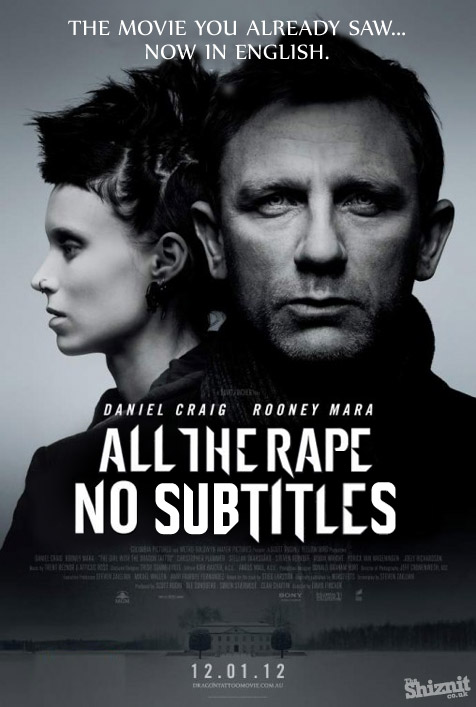
Movie review: "The Girl with the Dragon Tattoo"
I have been quite busy for the last two weeks, so wasn't able to find a free afternoon to write this post, even though I watched "The Girl with the Dragon Tattoo" the weekend before last. I have seen the trailer for it when I went to movies to watch "Contagion" (I think), so I talked my girlfriend into watching it.
I knew few facts about the movie before watching it, and few of my friends watched the Swedish version of the movies and judged them good. Curiously, I have had a page-marker with praises for the Croatian translation of the "Millennium" trilogy by Stieg Larsson for couple of years now, but I didn't make the connection with the movie because they kept the original names in translation (the original name of the book is "Men who hate Women"). More so, the marker contained praises for the books, but they were written by one "famous" Croatian poet which I don't like (don't like his taste in books), so I stupidly dismissed the books. But now, after watching the movie, I think I will read them in future.
"The Girl with the Dragon Tattoo" is a thriller dealing with some old murders in Swedish aristocratic family. Plot is quite good. Movie lasts more than two and a half hours so they took their time and used it good - main action doesn't start immediately, but it takes some time to introduce characters. There are two main characters: Mikael Blomkvist and Lisbeth Salander; their plots start separately and run in parallel, but are connected somewhere in the middle of the movie. Mikael is a middle-aged famous journalist in the magazine called "Millennium" who targets a rich industrialist and writes an article depicting him as a criminal - but after some of his claims are proved false, his whole article is the taken as nothing more than slander and he loses credibility. Since he wants to move from public eye for some time, he accepts an assignation by another rich old man, Henrig Vanger. He task up front is writing Henrik's biography, but in truth he is trying to solve the disappearance of his niece some forty years ago. Another complication is that someone from his family is probably to blame - even worse, Henrik's whole family lives on isolated island so Mikael is maybe living next door the possible murdered. On the other side of Sweden, Lisbeth, a 23 year old is trying to sort her life. She was a problematic child, always different from others - abused by her father and blessed/cursed with photographic memory. She is officially under care of decent social-worker who treats her well; without his knowledge she does some investigation work for highly-expensive detective company. But after her caretaker suffers a stroke, she is put under care of sadistic Bjurman...
As I said, plot is quite good and also done pretty well. Two independent plots are not very usual, but this worked very well because this was you never know what is coming up next. Another good point of the movie is that induces the audience to participate in the movie. Claim that the culprit is someone from Vanger family is given quite early in the movie, so you just have to try to guess who of them could be the one.
Characters are also interesting. Mikael is played by Daniel Craig, and he is very convincing in the role of intelligent journalist who is at first dismissive of this case, but later gets sucked in by its curiousness. Lisbeth is played by mostly unknown (at least to me) Rooney Mara, but she also does a great job with this demanding role.
Demanding, because without the character of Lisbeth, this movie would still be a very good thriller, but it would lose much of its impact. And this impact is acquired by unusual amount of brutality and violence, both physical and psychological. So, although "all the rape" is not strictly necessary for the plot, it is what separates this movie from others. So, be warned, this movie contains quite few shocking scenes, and they are done very visual and explicit. This is not your usual Hollywood movie, which probably didn't return much in money, but it paid off in respect.
"The Girl with the Dragon Tattoo" is one of the best movies I watched in last couple of years. It contains much violence, and its dark atmosphere will not be suitable for anyone; but if you like high-budget thrillers and don't have aversion to explicit scenes, this could be a movie for you.
I knew few facts about the movie before watching it, and few of my friends watched the Swedish version of the movies and judged them good. Curiously, I have had a page-marker with praises for the Croatian translation of the "Millennium" trilogy by Stieg Larsson for couple of years now, but I didn't make the connection with the movie because they kept the original names in translation (the original name of the book is "Men who hate Women"). More so, the marker contained praises for the books, but they were written by one "famous" Croatian poet which I don't like (don't like his taste in books), so I stupidly dismissed the books. But now, after watching the movie, I think I will read them in future.
"The Girl with the Dragon Tattoo" is a thriller dealing with some old murders in Swedish aristocratic family. Plot is quite good. Movie lasts more than two and a half hours so they took their time and used it good - main action doesn't start immediately, but it takes some time to introduce characters. There are two main characters: Mikael Blomkvist and Lisbeth Salander; their plots start separately and run in parallel, but are connected somewhere in the middle of the movie. Mikael is a middle-aged famous journalist in the magazine called "Millennium" who targets a rich industrialist and writes an article depicting him as a criminal - but after some of his claims are proved false, his whole article is the taken as nothing more than slander and he loses credibility. Since he wants to move from public eye for some time, he accepts an assignation by another rich old man, Henrig Vanger. He task up front is writing Henrik's biography, but in truth he is trying to solve the disappearance of his niece some forty years ago. Another complication is that someone from his family is probably to blame - even worse, Henrik's whole family lives on isolated island so Mikael is maybe living next door the possible murdered. On the other side of Sweden, Lisbeth, a 23 year old is trying to sort her life. She was a problematic child, always different from others - abused by her father and blessed/cursed with photographic memory. She is officially under care of decent social-worker who treats her well; without his knowledge she does some investigation work for highly-expensive detective company. But after her caretaker suffers a stroke, she is put under care of sadistic Bjurman...
As I said, plot is quite good and also done pretty well. Two independent plots are not very usual, but this worked very well because this was you never know what is coming up next. Another good point of the movie is that induces the audience to participate in the movie. Claim that the culprit is someone from Vanger family is given quite early in the movie, so you just have to try to guess who of them could be the one.
Characters are also interesting. Mikael is played by Daniel Craig, and he is very convincing in the role of intelligent journalist who is at first dismissive of this case, but later gets sucked in by its curiousness. Lisbeth is played by mostly unknown (at least to me) Rooney Mara, but she also does a great job with this demanding role.
Demanding, because without the character of Lisbeth, this movie would still be a very good thriller, but it would lose much of its impact. And this impact is acquired by unusual amount of brutality and violence, both physical and psychological. So, although "all the rape" is not strictly necessary for the plot, it is what separates this movie from others. So, be warned, this movie contains quite few shocking scenes, and they are done very visual and explicit. This is not your usual Hollywood movie, which probably didn't return much in money, but it paid off in respect.
"The Girl with the Dragon Tattoo" is one of the best movies I watched in last couple of years. It contains much violence, and its dark atmosphere will not be suitable for anyone; but if you like high-budget thrillers and don't have aversion to explicit scenes, this could be a movie for you.
Labels:
action,
blood,
complex,
contemporary,
great,
historical references,
humor,
intelligent,
movie review,
mystery,
no spoilers,
nudity,
realistic,
realistic setting,
sex,
thriller,
violent
Thursday, August 25, 2011
Movie review: "No Strings Attached"
Yesterday my girlfriend and I watched "No Strings Attached", a romantic comedy with Ashton Kutcher and Natalie Portman. We try to avoid sleazy teen comedies, so we pick only those with stars included. My friends, on the other hand, when they watch such movies (which is not often), don't use this "method of filtering", so results often vary much.
So, Ashton Kutchers play Adam, a young man, some kind of movie assistant, easygoing, cheerful and sensitive. Natalie Portman is Emma, a medical student with tight schedule and no liking for relationships. They have met briefly several times in past, always feeling something but never doing anything. Until one night when Adam gets drunk and accidentally ends sleeping in Emma's apartment. Since then they will start a purely sexual relationship, with rules made by Emma that will keep things simple. Of course, at first things go smoothly, but slowly Adam will find that he has more feelings for Emma. Emma, on the other hand, has fear of relationships, but she will also realize that she is not completely immune to Adam's care and happiness. But how long will he be able to fight against her fears...
Not to drag this, this is a typical romantic comedy. Introduction, happy part, sad part, happy ending, all crisscrossed with humor. I like this concept, and shorter the sad part, happier me. It has a nice kind of humor, based a lot on sexual jokes, but nothing crass and no nudity - a kind of humor you would expect from big stars that also act in serious films (well, this is true more for Portman than for Kutcher). It has weird, but funny friends, and even a bad guy. Acting is solid and movie actually gets more serious than I expected based on the beginning.
So, in short, "No Strings Attached" is a nice romantic comedy which will not disappoint if this is what you expect and want. A good evening watch that doesn't ask much of you.
So, Ashton Kutchers play Adam, a young man, some kind of movie assistant, easygoing, cheerful and sensitive. Natalie Portman is Emma, a medical student with tight schedule and no liking for relationships. They have met briefly several times in past, always feeling something but never doing anything. Until one night when Adam gets drunk and accidentally ends sleeping in Emma's apartment. Since then they will start a purely sexual relationship, with rules made by Emma that will keep things simple. Of course, at first things go smoothly, but slowly Adam will find that he has more feelings for Emma. Emma, on the other hand, has fear of relationships, but she will also realize that she is not completely immune to Adam's care and happiness. But how long will he be able to fight against her fears...
Not to drag this, this is a typical romantic comedy. Introduction, happy part, sad part, happy ending, all crisscrossed with humor. I like this concept, and shorter the sad part, happier me. It has a nice kind of humor, based a lot on sexual jokes, but nothing crass and no nudity - a kind of humor you would expect from big stars that also act in serious films (well, this is true more for Portman than for Kutcher). It has weird, but funny friends, and even a bad guy. Acting is solid and movie actually gets more serious than I expected based on the beginning.
So, in short, "No Strings Attached" is a nice romantic comedy which will not disappoint if this is what you expect and want. A good evening watch that doesn't ask much of you.
Sunday, May 8, 2011
Book review: "The Steel Remains" by Richard K. Morgan
I've been reading positive reviews about "The Steel Remains
" since it was out, so it has been in my wish list for a while. I've ordered it while I was rereading "Malazan Book of the Fallen" and it waited me for a month or two, and now it finally came its turn. Several years ago, while I had time to be a member if local library, I read one of Richard Morgan's hits, "Altered Carbon
". I remember it as a good book, a SF action-thriller, but since I've read it only once, I don't remember much detail.
I loved this book literally from the first sentence:
"When a men you know to be of sound mind tells you his recently deceased mother has just tried to climb in his bedroom window and eat him, you only have two basic options."
What a great way to start a book. From the very start I was remind of Joe Abercrombie's "The First Law Trilogy". It has the familiar combination of grittiness and humor, only with Morgan it is bit more of grittiness and little less of humor. Nevertheless, it has that same feel of fantasy that deals with real people; people who are weak, dirty, curse a lot, but manage to surprise you more than not. So don't expect clear differentiation on good and bad...
Story follows three main characters. Ringil is an ex-soldier, hero of last war, now fallen on lower branches of life. He's living in a small village, using remains of his glory to get drinks and room in local inn. You get first indication that Ringil was more than he is now when his mother, a member of one of most powerful noble families, comes to force him into finding their cousin, sold to slavery. Although he is reluctant of come back to capital, to people who betrayed him and life it disappointed him, his mother's wishes are hard to decline.
Two second main characters are Egar Dragonbane and Archeth. Egar is member of nomadic horse-warrior tribe Majak. In his youth he was a mercenary and also a war-hero. After returning to his tribe, he is now a rich leader, having everything that a man could wish for, but finds his life among almost-barbaric people too dull, especially compared to sophisticated life in neighboring Empire of Yhelteth. Archeth is one of most trusted advisors of Emperor of the same Empire, mainly because she is a last member of her race, advanced and long-living people of Kiriath. Her life will again become exciting as she is sent to investigate a strange attack on one of the coastal towns.
First, I liked the worldbuilding. Morgan has something of a Erikson's approach. He plunges you in the middle of a world and don't explain you much. You get brief references to the world throughout the book, and you do your best connected them to whole picture. For example, you get mentions of Lizard Folk and Kiriath, two inhuman races during the whole book, but even after reading it whole, you don't have a complete picture of who they really were and what happened to them. I like this approach because it gives you an impression of a solid world, one that has a life of its own. Also, I always like when fantasy mixes with SF; as with Erikson's K'Chain Che-Malle, so with Morgan's Kiriath.
Characters are great. Ringil is a main guy. At first he is described as just one old veteran, with one heroic act to single him from the mass. As book follows him to capital, you find out that he was, and still is, much more. He has one trait that forced him to abandon his rightful place as a son of powerful noble family: he is openly gay in a world that ostracizes homosexuality. And by ostracizing, I mean torture and death, except in case you happen to be rich and powerful. This hypocrisy, combined with what he considers a betrayal of his war efforts, left him disappointed in humanity, especially to higher classes. Egar is also great. He is a middle-aged warrior that had a touch of sophistication in big city capital and can't find his rest now when he is back to his people. And Acrheth is very interesting, since she is of different race. From her POV I think we get most facts about the world. Although that doesn't mean she is just an info-dump-machine.
Unfortunately, book is great only till last quarter or so. At one point, one all three main characters come together, it just starts to fall apart. Story is good until that point, but after it gets too predictable and uninteresting. It fails to give an impression of well-rounded conclusion and it lacks any exciting parts: it just falls into usual fantasy tropes. And worse than that, characters do the same. Egar, who is very insightful characters for the most of the book, becomes just a wise and friendly barbarian; Ringil a snarly but good commander and Archeth an elf. I was quite disappointed with this ending. But, considering how book was good until that point, and how good was worldbuilding, I have hopes for the sequel, "The Cold Commands
", and plan to order it soon.
As I mentioned, I have read "Altered Carbon
" only once, but I remember that main character's name was Takeshi Kovach. I wonder if name Takavach in "The Steel Remains
" is a hidden reference to it?
The book has quite graphical description of violence and sex. I noticed on some user reviews that some people were offended with such detailed depiction of sex between two men. So if this really bothers you, maybe you should skip this book.
"The Steel Reamins
" is one very innovating and gritty book, with exceptional worldbuilding and characters, but unfortunately with weak ending. Nevertheless, it is a great read for fans of darker fantasy, so I recommend it.
The sword on the cover has a cool mirror-effect
I loved this book literally from the first sentence:
"When a men you know to be of sound mind tells you his recently deceased mother has just tried to climb in his bedroom window and eat him, you only have two basic options."
What a great way to start a book. From the very start I was remind of Joe Abercrombie's "The First Law Trilogy". It has the familiar combination of grittiness and humor, only with Morgan it is bit more of grittiness and little less of humor. Nevertheless, it has that same feel of fantasy that deals with real people; people who are weak, dirty, curse a lot, but manage to surprise you more than not. So don't expect clear differentiation on good and bad...
Story follows three main characters. Ringil is an ex-soldier, hero of last war, now fallen on lower branches of life. He's living in a small village, using remains of his glory to get drinks and room in local inn. You get first indication that Ringil was more than he is now when his mother, a member of one of most powerful noble families, comes to force him into finding their cousin, sold to slavery. Although he is reluctant of come back to capital, to people who betrayed him and life it disappointed him, his mother's wishes are hard to decline.
Two second main characters are Egar Dragonbane and Archeth. Egar is member of nomadic horse-warrior tribe Majak. In his youth he was a mercenary and also a war-hero. After returning to his tribe, he is now a rich leader, having everything that a man could wish for, but finds his life among almost-barbaric people too dull, especially compared to sophisticated life in neighboring Empire of Yhelteth. Archeth is one of most trusted advisors of Emperor of the same Empire, mainly because she is a last member of her race, advanced and long-living people of Kiriath. Her life will again become exciting as she is sent to investigate a strange attack on one of the coastal towns.
First, I liked the worldbuilding. Morgan has something of a Erikson's approach. He plunges you in the middle of a world and don't explain you much. You get brief references to the world throughout the book, and you do your best connected them to whole picture. For example, you get mentions of Lizard Folk and Kiriath, two inhuman races during the whole book, but even after reading it whole, you don't have a complete picture of who they really were and what happened to them. I like this approach because it gives you an impression of a solid world, one that has a life of its own. Also, I always like when fantasy mixes with SF; as with Erikson's K'Chain Che-Malle, so with Morgan's Kiriath.
Characters are great. Ringil is a main guy. At first he is described as just one old veteran, with one heroic act to single him from the mass. As book follows him to capital, you find out that he was, and still is, much more. He has one trait that forced him to abandon his rightful place as a son of powerful noble family: he is openly gay in a world that ostracizes homosexuality. And by ostracizing, I mean torture and death, except in case you happen to be rich and powerful. This hypocrisy, combined with what he considers a betrayal of his war efforts, left him disappointed in humanity, especially to higher classes. Egar is also great. He is a middle-aged warrior that had a touch of sophistication in big city capital and can't find his rest now when he is back to his people. And Acrheth is very interesting, since she is of different race. From her POV I think we get most facts about the world. Although that doesn't mean she is just an info-dump-machine.
Unfortunately, book is great only till last quarter or so. At one point, one all three main characters come together, it just starts to fall apart. Story is good until that point, but after it gets too predictable and uninteresting. It fails to give an impression of well-rounded conclusion and it lacks any exciting parts: it just falls into usual fantasy tropes. And worse than that, characters do the same. Egar, who is very insightful characters for the most of the book, becomes just a wise and friendly barbarian; Ringil a snarly but good commander and Archeth an elf. I was quite disappointed with this ending. But, considering how book was good until that point, and how good was worldbuilding, I have hopes for the sequel, "The Cold Commands
As I mentioned, I have read "Altered Carbon
The book has quite graphical description of violence and sex. I noticed on some user reviews that some people were offended with such detailed depiction of sex between two men. So if this really bothers you, maybe you should skip this book.
"The Steel Reamins
Labels:
book,
fantasy,
good,
gritty,
high fantasy,
humor,
intelligent,
no spoilers,
review,
sex,
surreal,
The Steel Remains,
violent
Subscribe to:
Posts (Atom)