Showing posts with label great. Show all posts

Sunday, February 2, 2014

Book review: "The Scar" by China Miéville

Few months after finishing "Perdido Street Station", I tried the next book set in the same setting, "The Scar". I was wondering will Miéville be able to pull it again.


"The Scar" is, as "Perdido Street Station", set in setting of Bas-Lag, but this time we are far from New Crobuzon. In the book we follow a New Crobuzon refuge Bellis Coldwine. After some problems back at home (connected to Isaac Dan der Grimnebulin and the events in PSS), she is running away, traveling by ship, with destination of New Esperium, a colony established by New Crobuzon. But during the voyage, her ship is taken by mysterious Armada, a floating city made of connected ships, whose existence was kept a secret for more than a thousand years. Struggling to find some way to escape, she is dragged into experiment whose goal is to summon an avanc, a gigantic otherworldly being. But as things go further, she realizes that the avanc in only a first step in plan made my one of Armada's rulers, the Lovers.

So, we are back to Miéville's imagination. I must admit that he did very well - he managed to expand the setting of PSS, introduce a bunch of new elements, one more bizarre than another, and without being inconsistent. As before, I noticed again a wink at "The Dying Earth", with seawyrms used for pulling and some other examples. Maybe I'm wrong, but "Perdido Street Station" felt much more technologically advanced than the "The Scar" - even though they have analytical engines and guns here, but too much swords, pistols and muskets. But I presume that Miéville wanted to go this book more piratical feel, which he certainly did. This pseudo-science he writes about is very interesting. Although , some of his descriptions are a bit too grotesque and too-much-information, especially about the Remade.

PSS was also full of implied places and organizations, but here, the setting feels much more expanded through time and space: The Gengris, High Cromlech, The Ghosthead Empire, The Malarial Queendom... Even the names are great.

The main character is Bellis Coldwine, but she is more an observer that doer. Oh, she does some important deeds, but she is mostly manipulated into doing them: by Sillas Fenec and by Uther Doul. I liked how all our misconceptions about the both of them were broken till the end of the book. The second main character was Tanner Sack. Even though he was well written and his sections were interesting, I just didn't felt any respect for him - he started and ended as victim.

The plot was very good but not as strange as were the setting and the characters. It had enough small surprises to feel interested the whole way, but neither is this the book written for the plot. Then ending will some consider a cheating, but I kind of liked it: it is one of those uncertain endings with ability to modify the whole book, depending on will you believe it or not.

As I hoped, "The Scar" ended being a similar book to "Perdido Street Station" in style, but with completely new elements that enabled it to feel fresh and original. I would recommend it to anybody who liked "Perdido Street Station".

Sunday, January 19, 2014

Anime review: "Monogatari Series: Second Season"

I've been eagerly waiting for next season of "Monogatari" series since first seeing early announcement for it. I like a lot of anime and genre, but if I had to pick, this kind of weird-humor series would be my first choice (like "Durarara!!", "Baccano!", "Tatami Galaxy", "Sayonara Zetsubou Sensei"). So I felt unreasonable joy and expectation before watching the last season!

I first waited for all episodes to come out - I didn't want to be forced to wait. And before watching "Monogatari Series: Second Season", I did a rewatch of all previous shows, in order they came out: "Bakemonogatari", "Nisemonogatari", "Nekomonogatari (Kuro)". First, it was a good thing I did it, because I really did miss two episodes in first season, because they were released as specials. And second, it really put me in the mood for fresh season.


The new season, "Monogatari Series: Second Season" consist of five arcs. Surprisingly, all these arcs deal with previous girls, while I expected introduction of new characters. But don't take me wrong - this is a superb show and there is no feel of recycling old themes. It's hard to write a one-paragraph blurb since all arcs are very different, but if you liked old seasons (especially if you like original "Bakemonogatari") you will love this one!

First arc came as a surprise. First, there is no Araragi - he is absent and is only mentioned. This means that we see story first time from other people's eyes and it give us a different perspective, especially on Senjougahara and Hanekawa. And Senjougahara is very funny here.

I was again reminded how this show greatly uses nonlinear storytelling. We see (or they are mentioned) a bunch of new characters and previous events that we know nothing about, but everybody talks about them as they were shown. And later when they really are displayed, they came out completely different that we expected. Like constant mentions of first meeting between Araragi and Shinobi (which should be shown in announced movie "Kizumonogatari"). Also, a lots of stories remain unresolved (I hope they are saving it for later). This first arc uses another dirty trick by those missing Black Hanekawa scenes - you will know what I am talking about, believe me.

Another trait of this season is that it the show lost much of it cuteness and became more morbid, serious and violent. It always did have these elements, but they were not so evident mixed with playfulness and fanservice. This is so evident that even the faces changed - Tsukihi is much more rugged than in "Nisemonogatari".

Second arc is good, but not as epic as other ones. I didn't expect a time-travel/zombies story - it didn't really fit in my idea of "Monogatari". But it was quite good in the end. I especially liked Oshino's letter to Araragi.

Next comes the third arc, with introduction of that ominous Oshino Ougi and with Sengoku Nadeko. I never liked her in previous shows, but I really didn't expect what happened here. It is another arc that is not told from Araragi's POV and where he is almost nonexistent.

Fourth arc is similar to second one - not so epic, but good in its own way. We learn much about Shinobu's past, which was a surprise to me. We also spent more time with two new characters. Well, Ononogi Yotsugi was introduced before, but only shortly. She was a great character in this season, especially with her strange ways of talking. The other one was Gaen Izuko - very mysterious characters who adds several layer of confusion to all that has happened. We will see more of the in the future, mark me. Also, this arc is a pretty sad one.

And then came the last arc, the masterpiece! It is told from point of view of Kaiki Deishuu! Yes, him. The one man I would never expect to told a story, especially concerning how he lies to everybody including himself. Add to that the fact that this arc is told in by-the-book noir style (including the raincoat), it is really something. I was swept with last two episodes (especially the cliffhanger in penultimate one).

It reveals some unexpected facts, about relationship between Senjougahara and Kaiki. I was surprised how Araragi was made to look like a child in last episode - let an adult resolve the situation! I later realized that this arc had not one ecchi or fanservice scene. Anyway, now they have to make a sequel, they can't be so cruel not to reveal further story.


Now, little bit about technical side. There are 26 episodes in this season, but episodes 6, 11 and 16 are just recaps, so feel free to skip them. The visual side of anime is on the standard level for this series, maybe somewhat darker and rugged. There are several OPs and EDs, of which I really liked only one. Be careful, because there is sometimes more story after ED and sometimes there isn't. Oh, and I didn't like the short haircuts.

Well, in the end, there is not much to say that I consider "Monogatari Series: Second Season" the best anime of 2013 (with "Shingeki no Kyojin" on second place). Even better than the original "Bakemonogatari"!

Tuesday, December 17, 2013

Anime review: "Shingeki no Kyojin"

Well, this hasn't happened in a long time: that I finished an anime season in a day. I watched first two episodes at Friday evening, and spent whole Saturday watching until I finished all 25 episodes!


"Shingeki no Kyojin" (or officially "Attack on Titan", which doesn't make sense) is a shounen action anime. The story places as in future, where humanity has been reduced to medieval level by appearance of non-sentient, human-eating humanoid giants called Titans (imagine giant nude zombies). Humanity is currently behind tall walls place in several concentric rings, enjoying relative safety for last hundred years. It all changes with appearance of a Colossal Titan and an Armored Titan, that together are able to penetrate the walls at one place and release other Titans at people. During this fatal defeat, we are focused Eren, Mikasa and Armin, three kids living in town where the breach happens. After managing to stay alive, but witnessing Eren's mother being eaten alive, Eren vows to slay all the Titans. This brings the three of them to join the training for the Survey Corps, only people that still fight against Titans on their own territory...

My first impression was that good, because I like vivid and strong colors in anime. Next I thought how the anime was a bit over the top with imagination and not very consistent (flesh-eating giants, 100 years of solitude). I was especially off-put with the claim about walls being set in circle with 250km diameter, when you could obviously see the other side of the wall! But then things started to unravel slowly, and I was hooked.

So, even though "Shingeki no Kyojin" is primary an action anime, it has a large dose of mystery. And not the type where character finds solutions which no one would ever realize, they solve them gradually by getting more information. Also, the setting reveals very gradually (there are some info-dumps, but not too clumsy), so almost every episode you learn something new. There was a few surprising reveals (especially the last one!), but they were done nicely and consistently. What I did dislike were too long intros and recaps of last episode at the start of each.


There is really a bunch of characters and you will sometimes have trouble to know who is who. They are typically shounen, so don't expect miracles, but they are pretty solid and interesting. The good thing is that they grow much during the show. I really liked how the author was not afraid to kill them.

And this brings us to the atmosphere of "Shingeki no Kyojin", which is the best part of it. This is a very brutal anime, with lots of tragedy, death and sorrow. I didn't expect so much pain in shounen anime. There are nice changes between fast action pace and slow reminiscence and melancholy. It is compared much to "Claymore" - I agree with this comparison, even though the anime is original enough. Action is pretty good, if you can suspend your sense of mechanic. There is even some comedy, and pretty good one (I really liked Sasha).

I've read some comments about this show having horrible design and animation, but I disagree. I admit that it is simple and not beautiful, but I think it goes great with the atmosphere. I really like the discrepancy between Titan's look and behavior. Voice acting and sound were OK, but OPs were terrible. I didn't even try to listen EDs.

All in all, I really enjoyed "Shingeki no Kyojin". It simple enough for shounen fans, but with enough details for other to enjoy, with great dark and violent atmosphere and lots of mystery. I can't wait for the next season.


Book review: "War Master's Gate" by Adrian Tchaikovsky

Well, I am going onward with "Shadows of the Apt" series by Adrian Tchaikovsky. I finished the ninth and so-far last book in series, "War Master's Gate", which means that for the first time I have to wait for sequel to come out. This is too bad, because the series became great in last few books!


"War Master's Gate" is the first book in series that breaks the usual pattern, but the things have come to a level where everything is epic and you can't separate magic and technology storylines. It continues the events immediately after last book, "The Air War". This means that the war for Lowlands and Collegium continues where it stopped, minus the focus on air duels - even though they still play a large role in this book. General Tynan tries for the second time to conquer the Collegium, but Warmaster Stenwold Maker has his own trick to throw at them, and this time, the air supremacy in on Bettles' side. Up north, General Roder was on a way to attack Sarn, but he is stopped by direct order and appearance of Empress Seda, who has personal interest in the forest that hides the Mantis holds Etheryon and Nethyon. Sarn also has a new Tactician, who will prove a menace for both Sarnesh enemies and allies. And in the forest itself, Cheerwell and Seda confront directly, in race to conquer the old and dark power, not suspecting that this power is there to guard something even more terrifying...

It's good thing that I read the previous book not so long ago, because the series has progressed so far that you really need to be familiar with rich setting and large cast of characters. Even so, some references to past events were blurry to me. As I said, the book continues immediately after the events in the last one, and it feels very much like it. Again we have a big focus on military, sieges, defense, air machines and so on. There are no much new inventions, but Tchaikovsky uses marvelously what he brought so far, and makes a very consistent and unique setting. On the side of magic, here we have as large upgrade as we had with technology in "The Air War". We learn much about history, see some direct uses of Moth and other magic, and see first evidences of a new player to come.

Plot is very complex, mostly because it is shown from so many POVs. Constant jumps are maybe a bit tiring, combined with short chapters - but at the same time it forces one to read on. There were lots of surprises throughout the book, especially because they came as surprises to the characters themselves (the Hornets, for example; or Empress' orders for Spiders). The book ends in several cliffhangers, like the fate of Che and Seda. Similar is with Stenwold Maker - his part look a bit obvious, but maybe it is the exact opposite. The ending is very strong and emotive; especially between Tynan and Mycella, and Eujen and Straessa. A great part of the book is the epilogue, with afterlife in Collegium, and first appearance of the Worm.

Characters are also phenomenal, both old and new. We actually don't spend much time with most of them, but because of fast POV changes it feels like we do. The number of character in series has grown much, even the important characters. At the beginning of the book we have a superb scene with Che, her first impact on the Ants, Mantids and rest. Tchaikovsky became great in presenting all sides of the conflict without playing favorites. When the fight is told form Wasp's POV, you are rooting for Waps; but when the same battle is told from Collegium's POV, then they are your favorite. Also, he is not afraid to really kill the characters. The fate of Mantis race was a very sad and powerful scene, and it was masterfully told from several side: the sadness, the anger, the fear! Also, again a nice moral ambiguity with Collegium and Sarn turning themselves to Wasps to defend from Wasps.

I can honestly said that with last few books, and especially with "War Master's Gate", this series became one of my favorites. Great battle scenes, both technological and magical; powerful and emotive scenes from both sides of conflict; and revelation that will shake the plot so far. An excellent book.

Saturday, November 2, 2013

Book review: "Perdido Street Station" by China Miéville

I have finished reading China Miéville's "Perdido Street Station" almost two weeks ago, but I had so hectic last two week that I didn't have time to blog about it. I actually read this book a long time ago once, borrowing from the library. I had a notion that I remember this book quite well so I was reluctant to buy it, but I wanted to reread it before going to next two books ("The Scar" and "Iron Council"). So I decided to buy it after all - and ended quite surprised how much actually I have forgotten!


"Perdido Street Station" is one of those books that are really hard to describe, especially their plot. Whatever I write, I will miss the point. But here is a try... "Perdido Street Station" tells a story set in very imaginative setting, the City of New Crobuzon, which includes magic, alchemy, science, science fiction, insect races, magical races, demons, spider-gods, cyborgs, artificial intelligence, flying people, oppression, horror, religion and education, among a bunch of other things. In the midst of it is Isaac, a underground scientist who, working on another project, happens to free a strange breed of gigantic moths that feed on people's conscience. Moths start to terrorize the whole City and Isaac becomes target to both the totalitarian regime the rules the City and by a drug-lord that was making money by moths, which forces him to try to catch the moths on his own...

I haven't read much books by Chine Miéville (only this one and "The City and The City"), but even I know that he is famous by his imaginativeness. And this is quite obvious here, especially in the first part. First part of the book especially, but also the book in whole is written in "look at my beautiful garden" form (I borrowed this from Jo Walton and her review of "Aristoi"), where Miéville plays and shows off his imagination. But this is a good thing because he builds a great setting - the list I mention in previous paragraph is only a part of it, notions I could describe in one word. He sometimes goes quite deep in details, like with descriptions of khepri's society, or with the handlingers. But here is also the problem of this book. Even to me, who like this kind of stuff, this wild and weird setting managed to become too tiresome on occasions. Imagination is good, but there has to be some boundaries. Luckily, this happened only few times while reading the book, so it can be forgiven.

It would take too much time to mention all great ides Miéville shows, but I have to note the Weaver and the daemons. I am really curious what more can he think of in the next two books with same setting to keep this level of freshness...

As with the setting, there is a bunch of characters in the book, but only two of them can be said to be main characters. Isaac is one, of course. He is an eccentric, a genius dropping out of college, hanging out with artist and working for the criminals. On the other hand, he is fat, clumsy, and not really someone you could look upon to. This is what makes him such a lovable and aspiring main characters. The other one is Yagharek. We don't get much from him, and I don't want to reveal spoilers, but those short intrusions with his POVs were really impressing. Miéville succeeded in giving him a very powerful voice, for all his tacitness. As I said, there is bunch of other characters, but with the exception of maybe Lin and Derkhan, they are not too important. But you can be sure that they are written in detail and flamboyant as the rest of this book.

His writing is very good. Although he can become tedious with the details, it can be forgiven. The book is violent, dark and graphic. And after finishing it, I realized that it is maybe a bit too depressing, with no happy end too much pain. Also, the book has a lot of morally questionable or rightly unfair decisions. A big example is with the sick old man in the end. The government, who is in the beginning described as comically evil, turns out to be the real villain.

Another thing I wanted to mention is my surprise with how much of this book I have forgot. When I started reading it, I had a misconception that I know it from the beginning to end, especially the plot. First I was surprised by the quantity of details I really had no recollection about. But the real surprise came when I finished two thirds of the book and realized that I have no idea how the book ends! The moth-hunting, I had no idea about it. I felt like I was reading a different version of the book, with the same beginning but a different ending. And to thing how much pride I put on my memory...

So, if you like weird books, a lot of details and imagination large as an ocean, "Perdido Street Station" is a book for you. You can think about China Miéville as a dark and gritty version of Terry Prachet, having fun on the tropes. Not a book I would recommend to exclusive fans of classical fantasy a la Tolkien.

Sunday, October 13, 2013

"Vorkosigan Saga" reread: "The Vor Game" by Lois McMaster Bujold

I am going forward with my reread of the "Vorkosigan Saga" by Lois McMaster Bujold, so last week I finished "The Vor Game", the second book featuring adventures of Miles Vorkosigan.


"The Vor Game" takes place few years after "The Warrior's Apprentice". Miles has spent last three years in the Imperial Academy, training to become a normal (as he can be) Barrayaran officer. After finishing it successfully, he gets another test before being let to proceed with his career - a 6-month post on Kyril Island, one of most extreme and stressful bases on Barrarayar. After almost managing to avoid any troubles, he is forced to choose between his career and his conscience, which again lands him in political troubles. All this is just a prelude into his new adventures that will once again join him with his Dendarian Fleet. Miles will be forced to manipulate both his friends and his enemies. But this time, much more depends on Miles - life of his Emperor, and fate of several planets.

Even though "The Vor Game" was written after several other books in the same setting, it is not such a smooth read as was "The Warrior's Apprentice", at least in the beginning. Bujold introduces a lot of expansions on the setting and throws in a lot of unfamiliar terms (fast-penta, galactic history and relationships, and so on...). Nevertheless, this doesn't damage the enjoyment of reading this book. Again, Bujold was able to make a SF setting far in the future without disclosing the technology behind it - instead focusing on characters and the plot. Again, the book is darker than I remembered it.

There are lot of similarities between plots of "The Vor Game" and its prequel, but as I said before, this one is for bigger stakes. First part of the book (one third, maybe) is focused more on Barrayar, and it brings it much closer that the first part had. But as the book goes forward, so the plots becomes much faster and risks bigger. My favorite part of it is the head-to-head negotiation between Miles and Commander Cavilo near the end - some really good fast-talk. It is funny and thrilling at the same time.

Characters are Bujold's forte, starting with Miles. You can see he has grown, but he became more solid and thicker in the frames that were set in "The Warrior's Apprentice". Other characters are also great. In this book we are first time really introduced to Simon Illyan who will have a large role in series, as one of most important reference points for Miles. If I have to point one thing that I didn't like, that was the easy shortcut that Bujold took with Admiral Oser.

"The Vor Game" continues and expands the formula Bujold wrote with "The Warrior's Apprentice" - a thrilling and rushing military SF. Except if you are a really hard-core hard SF fan, this is a book and series I would recommend to anybody

Monday, September 30, 2013

Book review: "The Air War" by Adrian Tchaikovsky

Last week I finished another book in "Shadows of the Apt" series by Adrian Tchaikovsky.Again I must say, this series keeps getting better and better...


Following its usual cycle, which I mentioned in my review of "Heirs of the Blade", "The Air War" is a larger-scope book, as expected from even-numbered books. And this one really has a big scope: an all-out invasion of Lowlands and environs by the Wasp Empire! We see that all the preparations in previous books has come to fore and it is again time for war. Two armies are set for the Collegium, from two different directions. But this time it is also another kind of war: the air war, the war of technology and machines... But at the same time, the world that has been focused on advance and science for the last centuries, the Apt, is on the brink of reversal. The Wasp Empress Seda targets another throne: the Queen of old magic, and to reach her goal she won't hesitate to wake an old darkness...

"The Air War"  doesn't just feel like a large and long book (like its predecessor), it really is. To fully enjoy the book, you should be fairly familiar with the setting. So if you haven't had a reread, now would be fine time to have one. The book has a very military setting - Tchaikovsky really make a good tension of preparation for war, with logistics, numerous characters and jumping around the world to show how Wasp Empire affects everything and everyone. The book was superb from the beginning and I just couldn't stop reading. There really is no point to getting deeper into details of plot - it is what you could expect from Tchaikovsky's previous works: war, espionage, command chain, old vs. new, etc.

There are quite a few new characters introduced here, and they don't feel at all forced. They successfully freshen up the cast. The book doesn't focus on Stenwold, even though it is in essence his book, but more on little characters. Presenting both sides of the conflict, Tchaikovsky made a great ambiguity - who to cheer for? Seda, Stenwold, Laslo, Totho, those Fly-bombers,...??? But it is more complicated than just two sides; when you add Rekef, other secret intelligence, and other involved parties, you get a pretty mess of morality. There was a scene that with a big moral question in the book (the murder of that Fly) - will Collegium become like Wasps if they defend themselves successfully or will they manage to retain their ethics?

When the series started, it always had just enough magic in it to be properly called fantasy. But it usually focused more on technology, thus belonging more to steam-punk. So I was surprised when this series became so explicit with magic. And as Tchaikovsky was inventive with his technology, like torsion engines, compressed-air guns and so on, so original he is with his magic. And I think he has even bigger surprises for us in later books. On the other hand, the technology gets a large upgrade. He was obviously inspired by World War I air-battles.


There is a great and intense big battle in the end of the book. It is simultaneously displayed from many different POVs with fast changes, which makes it very exciting and intense. The book ends in a cliff-hanger - not a big one, but certainly nothing is resolved yet.

With "The Air War", Tchaikovsky had reached a level of quality that I haven't expected from this series when I first started with it. He mixes an original setting with a set of quality characters, all set in an interesting and intense plot. Again, a recommendation to all fans of his previous books!

Sunday, August 18, 2013

"Vorkosigan Saga" reread: "The Warrior's Apprentice" by Lois McMaster Bujold

When I was in high-school and library was my only source of books, and very limited one, "Vorkosigan Saga" by Lois McMaster Bujold was one of the series that I would read every year or so, including also ASoIaF, "The Lord of the Rings", "Hyperion Cantos" and few others. Since I refocused myself on buying new books I haven't reread these books, which means some 10 years. But Bujold has published two new books in series recently and before reading them, I decided to reread all previous books. This is not going to be a classical reread when I read all books in one go, but instead an occasional reread, one book every few months. Also, I mean to include only the main books in sequence


In "The Warrior's Apprentice" we start the story of Miles Vorkosigan, the main protagonist of the series. A victim of unsuccessful assassination attempt on his parents, Miles was left physically deformed and undeveloped, which is considered a great shame and disadvantage on his planet Barrayar. Barrayar is very strict society, based I would say partly on Soviet Russia and partly on Medieval Europe, and quite militaristic. They have a feudal system and until few dozen years they lived as in medieval times (consequence of prolonged isolation from other human cultures), but recently they again acquired means to interact with other planets. This, of course, caused many changes on their culture which is now a mix a feudal society and high technology democracy (swords and spaceships). It is understandable that as a freak and invalid Miles is feeling awkward in his surrounding, especially as heir of famous noble family, distinguished by its past victories. Additionally, Miles' father is former Regent of Barrayar Empire and current Prime-Minister. After failing to join the Imperial military academy (both his and his father's and grandfather's dream), Miles is feeling like having no reasons for life anymore. To past the time and to help his childhood friend to see some of the world (universe), they travel to Beta Colony, his mother's home-planet, where they will more or less blindly wander into an adventure including space mercenaries and civil war on another planet...

Books in this series always have interesting plots, even though they are driven primarily by Miles' characters. Such is this one: after using his cunning and intelligence to pull himself and his followers from one trouble, Miles usually manages to entangle to another, more dangerous one. Add to this his basically chivalrous nature (especially toward women and weak) and the fact that his family is one of the crucial members of his culture, you can surmise that these plots are pretty vivid. Nevertheless, Bujold's writing makes all this feel natural and consistent. 

Point of view is third-person, but it reveals much of Miles inner working, which is probably one of the biggest appeals of the series. It relies very much on his hyperactive behavior and his byzantine plots. Other character will get more (much more) place in further books, but in this one we focus mostly on Miles and more-or-less only superficially get to know other characters. Miles presents a very interesting plot, with his physical deformities but great mind. His motivations are also very intriguing - even though his society hates or dismisses him, all his life he tried to become a part of it. This will prove even more the focal point of series in later books.

As I mentioned, setting is SF, with advanced military technology, worm-holes for space traveling and other wonders. On the other hand, we have Barrayar, which is such an antique society (it is considered almost barbaric by others). Later we will get to know other, even more quaint places. Bujold made a very successful mix, drawing both fans of SF for the setting, and fans of fantasy for the plots and characters. Because, in essence, replace technology with magic and you get a classical fantasy book. Technology never gets much background explanation and this makes it still feel fresh (even though some of the books were written 20 years ago).

I remember these books as very easy and fun read. So I was left a bit surprised how dark this first book actually is - and further books are even darker. Sure, we get a happy end (or a kind) in every book, but main characters do die or suffer irreparable damage. And they deal with it. Innocent and weak also suffer and our protagonist is not always able to save everybody. So, a pretty realistic books - not gritty but not sunny also.

So, as a start of the series, "The Warrior's Apprentice" is a very good book. Interesting, with flamboyant main character but also with a dose of realism, with solid setting, it is a book I would recommend to anybody, not just fans of specific genre. One of my favorites...

Tuesday, August 13, 2013

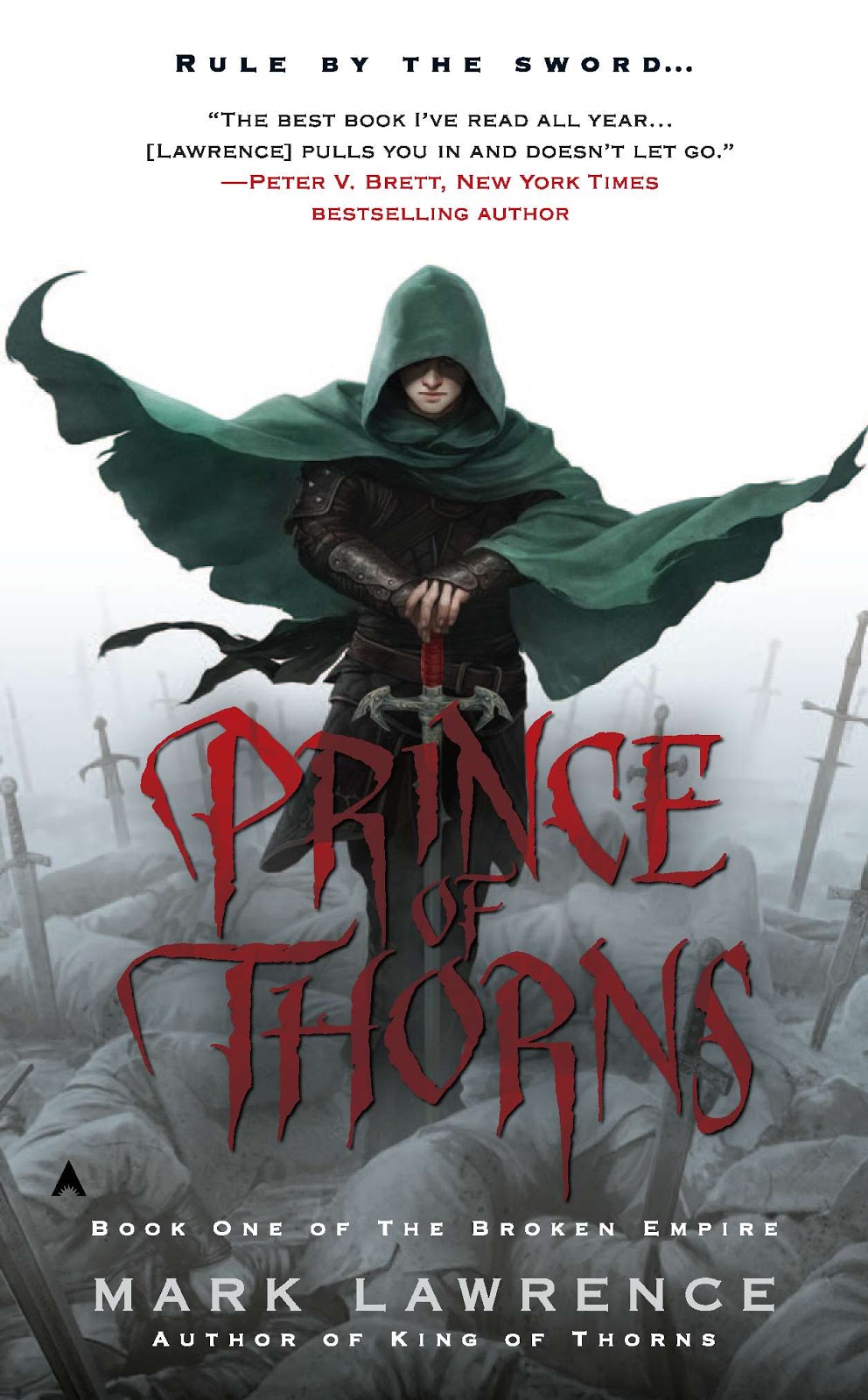
Book review: "Emperor of Thorns" by Mark Lawrence

I don't usually read sequelling books immediately one after another, but like to spread them over some time, maybe insert a reread now or then. But after reading "Prince of Thorns", I just couldn't resist reading "King of Thorns", as I also couldn't resist reading "Emperor of Thorns" immediately it was published last week. With this, I finished "The Broken Empire" trilogy by Mark Lawrence.


"Emperor of Thorns", similarly to KoT, has three plots-lines. The main one, the present, is happening two years after Jorg Ancrath's defeat of Prince of Arrow and becoming a King of seven nations, instead of just one. As the book starts, Jorg is just preparing for a journey to the Congression, a meeting of rulers that happens every four years and on which the Emperor can be chosen. Jorg is going there pretty sure he will be selected Emperor, because if he is not, he will pretty upset... Second plot continues immediately his adventures at Horse Coast, expanding them eventually to continent of Afrique. And while in KoT we had Katherine's story, here we have Chella's story, a POV by character opposite to Jorg from the first book.

If you have read first two books in "The Broken Empire" trilogy, you know what to expect: blood and violence. In my review of "King of Thorns", I said one or twice that Jorg felt softer than in "Prince of Thorns", not killing or maiming people randomly. This is also true here; as Jorg says, he has overgrown killing people on whim, but it doesn't mean that he will balk of anything necessary to protect those he cares about. And people, Jorg actually openly cares for somebody in this book. This makes him at the same time softer and harder than before. Softer, as I said, because he is not a loose cannon anymore; but harder, because he will not stop at anything defending what is his.

I really have to congratulate Mark Lawrence for making Jorg develop so much, but making it feel so natural. And also for successfully making such brutal and unique character, more evil than villains in some books, a protagonist and a person to root for. Because, it is quite impossible not to root for Jorg. And if you have any liking for anti-heroes, gray-morality or for gritty literature, you will just adore this book.

I see that I am not lonely in this sentiment, because my e-book edition had more highlights than last 10 books I read together. And consider that the book was out only few days when I have read it... This will be one of the top books of this year.

The plot is pretty interesting, especially the main one. As the book was coming to close, I kept wondering how Lawrence will be able to resolve all the started threads, but I have to admit that he did it magnificently. This book and trilogy has just a great ending - it leaves just enough questions unanswered, but gives a decent resolution of the story. Jorg keeps pulling rabbits out of his hat, but rarely it feels like something forced - Lawrence makes him pretty believable and consistent. The pace if constantly intense and there is not time for leisure. There are just so many powerful and memorable scenes in the book.

A small objection could be raised that the identity of the main villain is revealed pretty early in the book. Not openly revealed, but there are enough clues to guess it almost at the start. But this doesn't hurt the story much. Also, the plotline dealing with events in Afrique belittles the events in "King of Thorns" a bit, revealing Jorg knew about future more than enough to fix a score...

Setting was vastly expended in KoT, compared to PoT, and in "Emperor of Thorns" it gets filled decently. As I said, enough questions are with no answers to keep us waiting for more, but there are no inconsistencies. When I started reading this series, I would never be able to guess how perfect blend of SF and fantasy it would turn out to be in the end.


Again, I have to repeat my opinion that "Emperor of Thorns" will be one of the top books of this year: thrilling plot, superb main character, with unique and gritty way of presenting the story. A big recommendation for this book and the trilogy to anybody who likes dark stories!

Monday, August 12, 2013

Book review: "Colours in the Steel" by K. J. Parker

This is the first book I have read by K. J. Parker, and my reaction is: why haven't I found about him before? I can't say I was familiar with him prior to this book, but I noticed this name here and there, mostly good references and comparisons.


"Colours in the Steel" is the first book in "The Fencer Trilogy" by K. J. Parker. The story introduces as to the wondrous City of Perimadeia, a commercial and technological center of the world. Except these two things, another thing differentiates this city from the others: its unique legal systems, based on fencers (advocates) who duel to death to resolve the cases. Bardas Loredan is an advocate with quite a few years in the profession (over 10, which is very long for this kind of job), but not especially successful or known for it. A routine case of commercial law and fight with a newcomer will lead to unexpected turn of events: a deadly curse from newcomer's cousin, friendship with highest leader of magicians, and responsibility for defense of so-far-undefeated City against savage (at least until now) barbarian hordes led by young new chief Temrai...

First, I knew I was going to like Parker after reading first few pages. The writing was superb, full of light humor throughout all narration, subtle instead of forceful. I like this very much in books. It is a great fun to read "Colours in the Steel", even though the theme of it is not - imagine style of Erikson's short stories about Bauchelain and Korbal Broach, expanded to a real, serious book. As I said, there is nothing evidently extraordinary, but writing is actually superb and makes you expect more and more of this book. Another thing that reminded me on Erikson is how Parker uses the same trick of introducing a totally unimportant character, focusing on in for few pages and then discarding it. The book is not grimdark, but it isn't exactly shy of grittiness.

Setting is unique. I understand that all Parker's books are set in this same setting, only different parts of it. This book focuses exclusively on City of Perimadeia, with only few mentions of neighboring countries. But you get the feel that setting is competently imagined and consistent. It is based on classical medieval setting, but a lot of focus is put on commerce, technology and society. Actually, Parker even sometimes gets too technical with descriptions of technology. It's not boring, and you can see that he understands what he is talking about, but it can be tedious to read through. Setting is also humorous - like the Holy Pirates, and so on. I will enjoy discovering other part of the setting in next books.

There is no widespread use of magic in the setting, even though already-mentioned Order and its Patriarch Alexius play a great role. Instead of magic, you have (at least for now, we'll see in next books) only the Principle, which encompasses the nature and everything, and sometimes can be used to work wonders... Like the curse over Bardas.

Plot is good, but it is secondary to this book. It is used mostly as a mean to introduce the setting and the characters. And the characters are simply great. Bardas Loredan is perfect anti-hero: not young any more, prone to wine, lazy, not really honorable, cynic. It is really a pleasure to read about him and see the world through his eyes. Other POV characters, Alexius, Temrai, others... are all also great. Especially Temrai, who constantly wonders about his choices - which are sometimes morally questionable, so it is good that he wonders. The plot is pretty simple and predictable, but this didn't damage my joy in reading this book. If you are expecting a happy end and laugh after it, don't - this is not that kind of book. I appreciate how sometimes we skip weeks or months and characters have their own life in the meantime. Also, even though the book finishes the started plot, there is lot to discover behind it - and I wonder where this will take us to.

As I said, I am somewhat disappointed in myself for not discovering Parker before. But if sequels of "Colours in the Steel" prove as half as good as this one, it means that I have a dozen good books to read in future. I recommend this book to all fans of darker and anti-heroic fantasy.

Monday, July 1, 2013

Book review: "King of Thorns" by Mark Lawrence

Since I was at vacation the Monday I finished "Prince of Thorns" by Mark Lawrence, Tuesday next day, I continued with reading its sequel "King of Thorns". I must say that it's been long since I have read with such enthusiasm, leaving everything else besides! I was able to finish it at Tuesday after noon.


After getting his revenge in "Prince of Thorns" and becoming a King of Renar Highlands (one of the smaller and poorer regions in the neighborhood), Jorg is still not peaceful because there is another his unfulfilled ambition: becoming the Emperor (of the World, just to mention it).Four years after and he is sitting in his (only) castle, waiting for his future bride (whom he never met) and slowly becoming surrounded by army ten times bigger than the one he has. And to his greater chagrin, this army is led by Prince Orrin of Arrow, favorite by people and nations (for being good and caring ruler), descendant of last Emperor (while Jorg's line descends only from his Steward), and most important, favorite of all magicians and soothsayer (the real power behind thrones). So, what does a person in Jorg's position does? He attacks, of course...

"King of Thorns" is a different book from its prequel. First, it's longer: around 500 pages, where PoT was some 300 pages. While PoT had two timelines (the main one, and one four years ago describing how Jorg becomes what he is), KoT has three. First, there is again the main one, which I described in last paragraph. Curiously, this line of events get only sporadic chapter, at least until the end, when it really hits. Again, there is one happening four years ago, describing what Jorg did after coming to Renar Highlands and what lead to his "quarrel" with Prince Orrin. I was very surprised with this part, because after PoT, I didn't expect to find a classical fantasy quest/journey, where Jorg travels around the country, meeting new and old people, and does some "training". And third, a minor plot-line is a collection of excerpts from private diary of Katherine, who Jorg met in last book and who become his object of... Well, we'll not call it love, so call it obsession. I like it when storytelling is nonlinear and there is lot of wandering during it. So, definitely a plus.

Another thing that differs this book from previous part is that it is much softer. While "Prince of Thorns" was full of raping, murder and torture, "King of Thorns" is much lighter. Jorg is still cynical, dark and "practical", but he doesn't even meaninglessly kill anybody in this book (well, there's maybe that part with the lion...). His band of Brothers is still here, even though much smaller, but they also grew accustomed to some other principles. One could say that this is a complete reversal, but Lawrence wrote it so well that is feels very natural. On the other hand, there are still lots of graphical descriptions and not-so-honorable acts (hello Miana) that we all like so much.

Even so, Jorg is much softer. Not only in his conduct (he in now just a political psychopath, instead of a literal one), but is his skill also. While in PoT there was no task impossible for him, here we see some of his limits. But don't worry, Jorg is a resourceful one. Now he plays for larger scales that just revenge: strength of his country and army, position in game of thrones, even seeking alliances. This book is full of his retrospectives and memories of childhood. Even a happier childhood, in some instances...

As I said, I liked the traveling sequence, especially when he comes in the south - it reminded me to some other, more classical fantasy books when our hero trains to become a hero. If you gave only this few chapters to someone who haven't read "Prince of Thorns", he could have thought this a regular fantasy book... I also liked the part when they met the Circus.


One of strong-points of "Prince of Thorns" was its setting. "King of Thorns" tops it by a good margin. You can see it by map, which is much larger. But you also get more information about its history and present. Magic "system" also gets extended, and some new enemies have their introduction. I have never met Jack Vance's "The Dying Earth" stories, even though I hear much about them. I read some reviews mentioning that post-apocalyptic part of the setting is strongly influenced by this works, so I will definitely read them in future.

While "Prince of Thorns" was a great book, "King of Thorns" is even more so. I can sincerely say that it was one of best books I have read lately, in range of R. Scott Bakker, Joe Abercrombie's earlier books, Patrick Rothfuss. If "Emperor of Thorns", which is due for publishing very soon, be a book good as this one, "The Broken Empire" series will be one of the best ever! Definitely a recommendation to fans of first part, but also for all those who like a darker fantasy.

Sunday, June 30, 2013

Book review: "Prince of Thorns" by Mark Lawrence

I have noticed "Prince of Thorns" by Mark Lawrence immediately after it came out, even though I don't remember how (I think of Tor.com), and it's been sitting in my Amazon wish-list ever since. My initial enthusiasms dropped after reading few reviews describing it as grimdark and unnecessary gritty. But last Sunday I decided to give it a try - and finished it at Monday's morning...


"Prince of Thorns" is told from first point of view and narrated by Honorous Jorg Ancrath. When the story starts, he is fourteen years old and a leader of brutal and violent bunch of bandits called the Brotherhood. Killing a brother for challenging him as leader is a normal occurrence. Attacking villages, burning people and raping their women is what the Brotherhood do - and Jorg is a scariest of them. But Jorg is a more than a simple bandit: Prince Jorg, the only heir of kingdom of Ancrath. Jorg was always a precocious child and had the best of tutors. But when he was 10 years old, his beloved younger brother and mother will brutally killed in front of his eyes. Thrown in the bush of briars, he accidentally survives, but something has snapped in his mind... After his father the King decides not to seek vengeance against Count Renar and accepting some material amends, Jorg escapes from home in seek of revenge, but as the book progresses, it will turns out that there are more complex game being played around...

First, if you want to enjoy this book, you just have to accept that Jorg is fourteen and leader of bandit gang. We could now discuss psychological and physical problems of a teenager leading bunch of big old men, but this is out of the point - it is fantasy after all. If you can accept it, you are ready for one hell of a ride.

This book is really grimdark - very brutal and graphically violent. Killing and burning people, raping and visiting whorehouses, unstable relationships in families - you have it all. But after you finish the book, you can notice that most (but not all) of this brutal stuff is in first part of book. Like Lawrence wanted to make a state about this being a gritty book and wished to make an impact. He succeeds in both point very well, and I noticed that "Prince of Thorns" is very successful book, so you can presume that people very hungry for it. Hype for "Game of Thrones" and ASoIaF proves it, as it does the success of Joe Abercrombie's "First Law" series and its sequels, and Richard Morgan's "A Land fit for Heroes" series.

This is not just the story of revenge. It first starts as it, but as it goes on, you will notice that Jorg has other goals of just revenging himself against Count Renar. He wants to prove himself to his father (who is maybe even bigger psychopath than Jorg, in class of Tywin Lannister), but more than that he wants to "win the game" and become the Emperor (we will get back to it later). But he is not the only with a larger agenda, especially when you meet Sageous. The story in general becomes much wider after they return to the Tall Castle. Another interesting thing is the parallel story of four years ago, that explains what happened after Jorg's brother and mother were killed, how he escaped and how he met the band. It also gives more background and explains how Jorg became the man (he is definitely no child anymore) he is.

The characters are also very deep. Since it is told from first POV, you get to know Jorg the best. He is just a crazy and violent psychopath at first, but you will soon see that there is more to him... You know that typical young fantasy hero, who is strong and tall good with sword, has natural affinity to magic, and it is also intelligent, outspoken and charming? Well, Jorg is exactly like that, only he is the anti-hero, using all this traits for getting his goals through, never mind who gets killed or injured along the way. He is terrible, but you have to root for him on account of his gutsiness and "never bend" attitude. Nevertheless, Lawrence is smart enough writer and makes him have some weaknesses, not to make him irritating. It reminds me much on Richard Morgan, whose Ringil is also so confident, but you see him afraid and insecure sometimes. Other characters are interesting and have several shades to them, but Jorg is the star of the book. I liked the short descriptions of Brothers before chapters - they were quite funny (in gristly sort of way). There was also a touch of Black Company camaraderie and Croaker's humor in Jorg's descriptions of his fellows.


Another surprise is the setting. In the beginning, Ancrath is just a typical medieval kingdom, and so it the world. Sure, there are some ghosts and some, let's say magicians, but this is typical fantasy at first. But as the book advances, you realize that this is actually a post-apocalyptic world!! The story takes place in Europe, castles are actually skyscrapers, and some of the magic is actually technology. I liked this turn of events very much. There is some really magic here also, but it fits very well.

Lawrence writing was very easy to read, without being too simple, and the book has very fast pace. Unfortunately, it is quite short - only 350 pages. But, at least is very intense read. Another small objection I have is that Jorg is sometimes just too lucky, even for a fantasy-story protagonist.

So, it can definitely be said that "Prince of Thorns" is not just a "gritty-book". It starts very violently and simply, but it expands in every way: story, characters, setting. For fans of Martin, Abercrombie and Richard Morgan...

Monday, June 24, 2013

Anime review: "Bakuman", third season

Few days ago I finished watching third and last season of "Bakuman", adapted from manga about drawing manga.


This season continues "Bakuman" plot where it left in previous season. Mashiro and Takagi have finally made a manga they are satisfied with (PCP - Perfect Crime Party) and they struggle to make it better not to lose their place in Shounen Jack. They have not lost their dream of getting an anime adaptation, so Mashiro can marry his love Miho (a condition set in middle school). Takagi is supported by his wife Kaya (also met in middle school), while two of them compete against other manga-artist present in Shounen Jack, most of them familiar from previous seasons, but with some additions.

This season if a bit different from previous two (if I remember correctly) by being more episodic - there are several arcs that are almost independent between them (especially Nanaime's). But by and large, there are no much changes from first and second seasons, so if you are a fan of "Bakuman", you will be more that satisfied with it.

I cannot be sure because I haven't read manga, but it feels a bit rushed in places, like they had to squeeze too much material in it. But at least the pace is good and there is no dragging... Ending is as expected, but very solid. And I like how it is clearly showed that Mashiro and Takagi won't lose their motivation, even though they fulfilled their dreams. It is interesting how the author succeeded in having an shounen battle-anime feel when the story couldn't be less apart from such.

Characters stay the best part of "Bakuman". As I said, there are no many new additions, but we got to know older ones much more, and there are some changes in their relationships. Niizuma, who is on one hand very funny, improbable and exaggerated character, is shown to be very dedicated and consistent. I like how Hiramaru gets more serious, even though he is still hilarious - and Joshida makes him a great pairing. Also, we got a bit of romance, spread throughout the anime. Rest of the characters are also solid (Fukuda, Aoki, etc.).

It was very nice to see some modern mobile phones, and android references, too. But that can be expected since this anime was finished a year ago and is set in present.

The worst part of "Bakuman" is really bad and old-looking style of characters and drawings. Thankfully, this is character- and story-driven anime, so it doesn't matter much. Interesting how we have very poor art, but it becomes good (or at least more detailed) when it comes to manga they are drawing. Voice acting and music is solid, but nothing to praise much. There are 25 episodes in total.

In short, "Bakuman" continues with style and spirit of previous seasons, so if you liked it before, you will like it here also. I would recommend this series to everybody who likes otaku-stuff and daily-life anime, and fans of "Genshiken".

Sunday, May 19, 2013

Anime review: "Hyouka"

Few weeks ago AnimeReactor Community Awards were finally out. Most of the anime I watch I find and pick by myself, but I always check this yearly selection in case I miss some (I usually do). For last year, "Hyouka" won in three categories: Character Development, Male Lead and Slice-of-Life. I noticed "Hyouka" before, but I looked like a typical school comedy, probably based on some dating-sim or video-game, so I decided to skip it. But winning three categories made me change my mind, especially in these few weeks without any expected anime out.


"Hyouka" had a pretty uninformative and general description. Oreki Hotarou has just entered high-school. He is almost typical boy, except for his philosophy - he is an "energy-saving boy" and his motto is: "If I don't have to do something, I won't, but if I have to, I'll do it quickly.". Meaning, he avoid any unnecessary effort and obligation, even though he is not lazy. According to his life-style, he would avoid joining any high-school clubs, because it would ask for additional effort, but he is forced by his older sister to join Classic Literature Club. There he meets Chitanda Eru, also from his year, who is a very curious and dynamic girl - his complete opposite. Later they are joined by Fukube Satoshi, Oreki's best-friend, and Ibara Mayaka, a friend from their junior-high school.

Plot of "Hyouka" stems from Chitanda's curiosity (her phrase is "I can't stop thinking about it") and Oreki's uncanny ability to connect seemingly uncorrelated facts into a theory or explanation. It turns out that Oreki is a natural born detective - when he can be coerced to leave his usual low-energy state. There is no overall plot in this anime, only a bunch of standalone episodes and three mini-arcs made of two or three episode. At the beginning, I was wondering why this anime got an award in Slice-of-Life category when it was clearly a detective anime, but toward end focus shifts more to characters and their daily life than to plot.

Also, a word of advice. This anime has a pretty slow introduction, so give it some time to really start. It you like it when it reaches Seikitani Jun arc, things go only better from that point on.

From my description, you probably understand that I liked this anime, although it doesn't sound like anything extraordinary. And this is true, this anime is not extraordinary - but it is very, very good in every aspect. There is no big story here, but each episode and few arcs are very interesting, even if you don't like detective stories (I don't, really). Characters don't stand out, especially at the beginning, but they grow more complex and life-like whole time during this show. Animation and design also don't look anything special at first glance, but as you watch it, you will realize that a major effort is put in details and that everything fits right. There is also some romance, some comedy and much of light humor. Looking back now, this anime is like normalized (in sense that both high and low extremes are flatted out) "Haruhi Suzumiya" show. And I think that fans of it will also like "Hyouka". Despite slow and unimpressive start, this show ends as one really good anime.

The show doesn't have many characters. Except four main, there are only some recurring supporting characters, but they are all made good. Again, I stress that this anime really deservedly won first place in Character Development category (as both jury and community pick). This is most evident in Oreki, who quite grows in self-confidence and gradually changes his life-style.

There are some unexpected quirks in this anime. First, you rarely see a minor getting drunk in anime (even when it is accidentally). Secondly, it is not common that boy is attracted to girl only psychically (at least at first), except in ecchi anime. It usually involves unrealistic romance (e.g. Harima and Tenma from "School Rumble").


The show has 22 episodes, and there is one OVA which is actually a normal standalone episode. As I said, visually anime doesn't look much, but quality is actually pretty high and it stays that way whole time. There is really much care put into details: clothes, furniture, surroundings... It is obvious that anime had pretty good production.

All in all, even not extraordinary, "Hyouka" is quietly great anime and I would recommend it to anybody who doesn't require action from anime their watch. It is interesting, sometimes mysterious, lively and fun all the way.

Sunday, May 5, 2013

Anime review: "Hyouge Mono"

I don't really remember how or when it started, but I know that I have been eagerly waiting for this show to be subbed for months, maybe even more than a year. I always had a liking for historical-based items (be it books, movies or anime) and "Hyouge Mono" looked like one. On the other hand, I had some similar expectations from "Sengoku Basara" (which disappointed me very, very much) and even more so from "Souten Kouro" (which took a completely different direction than I expected). But "Hyouge Mono" fitted those expectations perfectly: a complex and deeply historical anime with a bunch of characters and realistic details.


"Hyouge Mono" is set on the eve of Sengoku period in Japan, starting somewhere in last years of rule of Oda Nobunaga. In the anime we follow the important events in Japan's history for next ten years, including the wars, politics and cultural life. This is seen primary from the eyes of Furuta Sasuke, who starts as a lowly vassal to Oda Nobunaga. What differentiates Furuta from bunch of other warriors and vassals is that he is actually more of an aesthete than a warrior. But to enjoy life of an aesthete, one needs to have money. Luckily for him, aesthetes, especially those interested in the way of tea, are on the rise in this time...

Sengoku period is a very turbulent time for Japan, a time of constant warring before final unification of Japan. Of course, such times gave rise to many popular warriors and leaders, like Oda Nobunaga, Toyotomi Hideyoshi and Tokugawa Ieyasu (to name the most prominent). And as such, it is a ripe pool of ideas for anime.

There are several obvious and important aspects that make this anime different from your usual one. First one is that Furuta is in no way the main character - the show doesn't actually have one. Furuta is only the means through which we follow the events, plot and other characters. He is not even an important man, especially at the beginning of the show, and he has to bend toward the will of others. In the end, he is just a conveniently placed close to important people with small influence on the events. This is a somewhat common occurrence in books (let's only mention Guy Gavriel Kay, who use it all the time), but I don't remember seeing it in anime much (maybe in few josei anime). Actually, there is even less focus of Furuta in later parts of anime.

Secondly, it cannot be said that this anime has a plot in classical sense. We are suddenly immersed in an ongoing world full of events, we follow it for some time (10 years and 39 episodes) and then we leave it without the feel on conclusion you have when some show is finished. At one time, somewhere around 25th episode, I have made a note "totally don't know where the plot is going", because I expected first part to be the introduction and second the real revelation of the story, but I was wrong.


And third, the biggest difference is the level of historical accuracy and details. In my 200+ anime that I have watched, I don't remember ever watching such anime. I can't say that I am a student of Japanese history, since most that I know about it came from common knowledge, anime, Wikipedia and articles on Internet and magazines. There is even a warning at the start of every episode that this is a work of fiction. But on the other hand, every character, important event and even things and concepts can be found on Wikipedia or other online encyclopedia. Yes, a lots of events, or better said, reasons behind events are made more dramatic or romantic (not in sense of love), but nevertheless, the amount of accurate historical details is astounding. Interesting, characters even speak with slightly archaic speech, and subtitles that I had reflected that.

Of course, the theme of anime is strange also: the Japanese tea ceremony. I never encountered this before, and I thought it to be completely fabricated. I was very surprised when I went to Wikipedia and found out that it isn't. This gives the anime a somewhat slow and serious, but at the same time funny aspect. Furuta's tea-obsession looks ridiculous from our perspective, but I see it was a serious business at the time. There is a lot of details about tea ceremonies and talk about elegance and aesthetics. If there is a message that this anime wants to convey, then it is something like: "Always do your best in everything, but never fret about it - be elegant and relaxed". This is evident for Furuta's character that is, as I said, obsessed, pretentious and overeager to become famous as aesthete, even contrary to his sincere liking of the way of tea. Later he grows much and becomes more relaxed and enjoys the tea and beauty for itself.

This brings us to another topic: characters. There is really a bunch of them and it takes time to become familiar with them (especially since lot of them change - this is war, after all). It helps if you are familiar with the Sengoku period. They change appearance, clothes, hairstyles. But more important, they really change during the anime. Furuta, Rikyu, Hashiba - at the end, they are very different people from those who they were when we met them. I even like them more in the second part of the show, when they are more mature and relaxed...


Even though "Hyouge Mono" is a serious and historical anime, there is really a lot of humor. A lots of it steam from Furuta's obsession for art pieces, and the faces he makes (I was delightful to see that Troll-face in episode 16, during the shrimp-mongering dance). Also, it is funny when someone pricks his bubble of self-importance. But it is interesting that there is some humor that is not intended toward viewer (so that we laugh at characters), but it is more the humor between the characters so the viewer can laugh with them (like when Furuta steals the tea-jar lid). On the other hand, it is easily to forget that this funny little man is actually a warrior and veteran but we are reminded of that on few occasions.

The ending was really something. It was a slow rise during few episodes to a glorious culmination - a powerful and emotional ending. It was delighted to see that mange that anime is based upon is still ongoing - which means I can hope for eventual sequel.

I was a bit disappointed by Date Masamune's appearance and mannerism, who looks like he escaped from "Sengoku Basara". On the other hand, he was very funny, and in the end did fit with the rest of characters.

Animation and colors in nothing over the top, but it is very good. Design of characters and care for details (I mention clothes and hairstyles) are on the other hand superb. As is the voice-acting.

It's been a long time since I gave some anime 10 on AniDB (I gave them all around when I was younger), but "Hyouge Mono" definitely deserves it: complex and detailed, historically based with realistic characters, no good guys, no main character, almost a slice-of-life in turbulent times - this really an unique seinen anime. Unfortunately, I don't think it will be deservedly appreciated because it will be too hard for majority of viewers. But if you consider yourself a fan of seinen or historical anime, give this a try.

Sunday, April 21, 2013

Book review: "The Half-Made World" by Felix Gilman

As can be seen on this blog, I am mostly dedicated to fantasy series, the longer the better. But I've been tried to broaden my horizon, so I occasionally buy some stand-alone novel, or even SF or something borderline. I first noticed "The Half-Made World" by Felix Gilman on Tor.com, the main fantasy and SF blog that I follow. It sounded interesting, so I put it on my wishlist and bought it few months ago, but read it only last week. My idea about it was as some blend between steam-punk and western.


"The Half-Made World" is set in a very interesting setting. In history and technology level it is akin to 19th century America, but geographically is very different. The East ("the Old East", I think it is referenced somewhere) is more similar to England: a land of peaceful prosperity, colleges and law. The West, divided from East by a large mounting range, has been "discovered" few centuries ago. Before, it was "uncreated" land, a chaos. Now the line of creation is traveling further west, so land between is being settled. It is full of small towns and coalitions, except the two major forces. The Line is ruled by Engines, strong "spirits" embodied in train-like machines, that rule its vast land and people as a perfect machine or bureaucracy: every part of it is replaceable and only a number on paper. The Gun is its complete opposite. It is also ruled by spirits, but these are wild spirits than possess a body of a gun. These guns are carried by the Agents of the Gun, and they give them superhuman abilities like vision in dark, superb sense of smell, great strength, endurance, and healing abilities. But there is a catch - Gun can force Agent to do his will, and since most of the Agents are individualist (meaning criminals, gamblers and other shady men and women), inevitably there comes a conflict between the Agent and Gun that rides him. Usual Agent's activities are kidnapping  blackmail and often murdering of innocent people (not mentioning killing the Linesmen), this chafes to even hardened criminal sooner or later. Just for a record, the Line and the Gun has been in state of constant war almost since Founding of first colonies in West.

In such world, we follow three main characters. Liv, or formally Dr. Lysvet Alverhuysen, is a professor on celebrated Koenigswald Academy in East, after recent death of her (much older) husband, embarks on a journey to West, to work in the House of Dolorous, a mental hospital for victims of war in West. John Creedmore is aged agent of the Gun, inactive for few years, spending his time with gambling and seducing young women (his specialty). Lowry, a relatively high-positioned member on army of the Line (meaning he is placed on top floor, in a small room with no windows - no distraction for his important work) is an ambitious Linesman (which he has to hide, because the system don't allow ambition), almost fanatical in his fight against the Gun. Creedmore and and Lowry are tasked with the same mission: to retrieve the supposedly death General Enver, founder of the Red Republic, the only entity that ever had some success in resisting both the Gun and the Line, who possibly has the weapon capable of destroying both the Line and the Gun. His current occupation and location: a patient in the House of Dolorous.

The book has a very interesting start and you are immediately drawn into its setting. At first, I was reminded to Susanna Clarke's "Jonathan Strange & Mr. Norrell", because of initial Liv's POV, but later I realized it is much more similar to China Miéville's New Crobuzon setting. Far from being its plagiarism, but it has the same feel. It is needless to say that I got hooked up after first three chapters.

Gilman makes his main characters also very interesting. You first feel for them, but as you read you start realizing that they are far from perfect. Lowry is conformist and fanatic, Liv is too-innocent and too above-all (pretentious even), while Creedmore is nice, but actually without conscience. Also, I was very surprised with death of one of the characters toward end of the book.

There is one part of setting that I forgot to mention in introduction: the Hillfolk. They are people of the unmade world, something like very thin Neanderthals. They are enslaved by people in West who use them for menial work. I found the part when Creedmore meets one of their shamans very interesting. For several reasons (connection with the dessert, the river, the old history), they reminded me much on Steven Erikson and his Eres'al.

The plot is interesting, but in some parts it is a bit predictable. For example, I found their first journey into unmade lands exactly as I expected. But in general, the book is interesting and I hope to learn more of its setting and character. Which I will be able, since there is sort of sequel, "The Rise of Ransom City".

All in all, "The Half-Made World" was a very interesting and exciting read. It was nice plot, very good characters and really excellent and original setting. I would recommend it to anybody, but especially to fans of China Miéville.