Tuesday, February 1, 2011

Movie review: "Constantine"

"Constantine" is one more in line of older movies I planned to watch. I knew it was based on comic, featuring guy fighting demons. Few friends recommended it as a good watch.


The movie definitely has that "comic-books" feel. I can't pinpoint it, but it has the same feel as older "Batman" movies. It features a contemporary world, but with difference that Hell, Heaven, angels and demons are real and are in constant war. Heaven and Hell made a pact about not directly involving themselves in this fight, so they efforts are realized by proxies. John Constantine (played by Keanu Reeves) is a private detective, specialized in fighting against demons; he was able to see them since he was a child. His main problem is that because of his visions he tried to kill himself; thus his soul is intended for hell. He is (unsuccessfully) trying to repent it by destroying demons, doing Heaven's dirty work. He will get involved with Angela Dodson, a police officer trying to solve her twin-sister's alleged suicide. This will take them in the middle of plot between Hell and Heaven...

First part of the movie is very good. Of course, you have to accept that this is a comic-book adaptation and know what to expect. Constantine is witty and dark bad-ass with a comic sidekick; there is a bar where demons and humans mingle together; Church get regular visits from angels; there is a nerd-guy selling dragon's breath... The usual stuff. Nevertheless, it is all well.

First part of the movie is focused on worldbuilding and this is the best part of the movie. Second half of the movie, focusing on Dodson-twins-plot is not so good. Things are rushed at moments and then dragged for unnecessary time. I completely lost interest about the fate of main characters during this time. I think that this setting has a potential, but decision to focus on this case was a wrong one. The ending is then again very good. It was totally predictable, but it was good anyway. A well-guessed combination of humor, drama and action.

In summary, "Constantine" is good-enough movie for fans of similar-movies, but it doesn't succeed in in fully utilizing this setting. I hope that there will be sequel, but better that this one. Other than that, it is an OK movie for spending an evening watching it.

Thursday, January 27, 2011

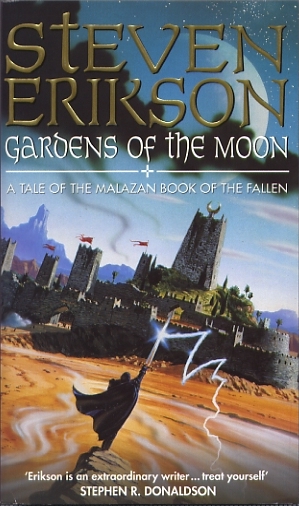
MBotF reread: "Gardens of the Moon" by Steven Erikson

It is almost a week since I finished "Gardens of the Moon", but I have been somewhat busy lately, so only now did I found time to write this post.

Following "Malazan Reread of the Fallen" on Tor.com is having one side-effect I haven't counted on. I felt like I have read this book only couple of months ago, so reading it again didn't have the same potency as usual. Thankfully, I am almost on the point of outrunning the Tor-reread, which is now somewhere after the beginning of second half of "Deadhouse Gates". I don't feel like doing a complete review of 12 years old book; there are countless good reviews out there. I will just note a few of my comments and opinions.

(First time seeing this cover)

This is the first book in the series and it was written almost 10 years before it was published, and it that time Erikson couldn't be sure this would be accepted as series. Nevertheless, book doesn't have the feel of being a stand-alone novel (contrary example: "Wizard's First Rule"; transition to its sequel doesn't feel natural at all and is very abrupt). Instead, thank to Erikson style, it give a feel of being plunged in the middle of long-running series. Erikson doesn't explain many things in the first run; he throws a bunch of information at readers, and then explains it layer by layer (and by layer and by layer).

This book, as whole series, is very complex, multi-layered and overwhelming book. It introduces few dozens of characters (I mean the important ones...), three continents, several human and non-human races, one of the most complex magic systems ever, real-life-like politics. But as I said, this if only the first book in series. Later books only get more complex and full. And the content of it: you name, you got it. Demons: checked. Sorcery and wizards: checked. Fighting and armies: checked. Gods and religion: checked. Mystery: double and triple checked...

I actually can't find anything bad to say about it. Only objection one could name about it, is that it can be too complicated for some readers. Not everybody likes their books this complex. But for those who like multiple plots and POVs, epic, gray-morality, etc. will be thrilled by this book. If you don't like it, don't even try its sequels; if anything, they are even more Malazan!

Saturday, January 22, 2011

Movie review: "Season of the Witch"

Last weekend girlfriend and I decided to go to cinema, and between "13" and "Season of the Witch" we picked the later. I don't usually like Nicholas Cage's movies, but it turns out this wasn't so bad after all.


First scene of the movie is very realistic and violent scene of hanging and drowning of three witches. During night, one of them comes back to life and kills the priest responsible for it. Then we are switched to a completely different scenery. In this movie, Cage plays Behmen and Ron Perlman plays Felson. They are buddy-buddy pair of knights, fighting infidels in the Crusades. After a massacre of civilians, they are sickened by war, and especially by Church which preaches the war as just and holy. They dessert and start a journey to their homes, but they get caught eventually, in a town besieged by plague. In fact, whole country is plagued. They are offered freedom in exchange for transporting a young women accused of being a witch and a source of the plague, to a remote monastery. Disappointed by Church, they decline at first. But Behmen thinks girl innocent and abused by Church, so he decides to escort her, hoping she will get a fairer trail in the monastery. A company is assembled and thus the journey starts...

First part of the movie is nothing exceptional, but it is done decently good. Cage and Perlman make a funny pair (I was reminded of Gibson-Glover relationship from "Lethal Weapon" series) and they don't look stupid at it. Atrocities of the war and its consequences are shown very solid and convincing. But journey, the middle part of the movies is really good! We are shown some very confronting facts and everything is left to audience's imagination. You can't be sure what is really going on and who is good and who bad. Very mysterious! There are few especially good and intense scenes (the maze, the bridge and the wolves). Until the end you are left to wonder...

...And then comes the end which leaves nothing to imagination, which sucks. It is not a bad ending; it is very emotional and intense. But after all those psychological games that left me in guessing what's going on, they reveal it all. And final bad guy feels a bit stupid and unimaginative. I would prefer ending being left undecided and mysterious, and then this would be really great movie. The positive side would be that ending is surprising; I don't think many persons would guess it.

In the end, "Season of the Witch" is a nice movie, with somewhat spoiled ending. But definitely a nice way to spend an evening, especially if you like fantasy.

Wednesday, January 19, 2011

Movie review: "V for Vendetta"

Few weeks ago I decided to watch some of the "older" movies (up to ten years old) that I missed. There are lots of them, so I am currently using IMDB USA box-office archive. This week I watched "V for Vendetta". I didn't know much about the movie prior to watching it. I know it was an adaptation of comic and that main character wears some crazy mask (I checked Wikipedia, they say it is Guy Fawkes' mask; I presume that scene at the beginning of the movie depicts Fawkes' dramatized "execution"). I believed this movie would be about French revolution or something like that.


But, it turns out this is actually contemporary, alternate-history SF-ish movie. It lasts two hours and it really has a lot of plot in it. First part of the movie is confusing and intriguing at the same time. It takes some time to start rolling. We first meet Evey, while she wanders through some streets after curfew. She almost gets raped by some under-cover policemen, but in the last moment she gets saved by a guy in black, wearing (my first association) a musketeer's mask and wielding swords and knives. Man introduces himself as "V" and in flourishing language invites her to watch a musical performance with her. It turns out that this "performance" is actually bombing of British parliament. This starts V's terrorist activity against fascist and repressing British government.

There are three things that are great in this movie. First, the world-building. It is near future England and it is very dystopian. After some nuclear war that USA was involved with, England isolated itself from rest of the world, lead by charismatic and autocratic leader Adam Sutler. Regime is very racist and homophobic; government strictly controls media (especially television, where Evey works) and secret police is almost almighty. Worst thing about it is that people have grown with this situation and they consider it normal. That is the ultimate goal of V's anarchism: changing people conscience about them.

Second is the plot. For a comic-book adaptation, plot is marvelous and quite believable. V almost doesn't have any special powers nor is he some genius. Plot is very surprising, shown from multiple POVs and it is never boring. There are many funny scenes, especially at the beginning. But the movie overall is very somber. I especially liked the ending; it was very emotional and epic, on more than one level.

Third, the characters. Three main characters are V, Evey and Finch, the police inspector on V's case. During the movie, we know almost nothing about V. We find out a bit about his history, but we never really get to know him, his motivations and such. But we instinctively know he is the good guy. A bit twisted guy, especially shown in his relationship with Evey, but good guy nevertheless. Definitely very interesting character; especially the fact that he never, ever shows his face! Evey has some very traumatic experiences and she does a lot of growing up. In some aspects, she is the actual protagonist of the story. Inspector Finch is also a good guy, albeit on the bad side. We follow him as he realizes that, while unsuccessfully trying to stop V. Rest of the cast is also done very well.

Interestingly, I think this is the rare case where the adopted material is better than the original. I cannot be sure, of course, because I haven't read the original comic-book, but I've read a synopsis of it and it looks much more flamboyant than the movie.

Just to mention, movie has almost none special effects; it counts more on the inner quality then the visuals (even though the production is not bad in any aspect). And I mean this as a compliment.

"V for Vendetta" is a great movie. A combination of SF, thriller and drama, it asks for concentrated audience. But my opinion is that the movie is worth of it. Definitely a recommendation!

Friday, January 14, 2011

Just started a re-read of the "Malazan Book of the Fallen" by Steven Erikson

Well, as the title says, I am announcing that I am planning to read The Malazan Book of The Fallen again and I am starting today. By MBotF, I mean Steven Erikson's books from "Gardens of the Moon" to "Dust of Dreams". Yeah, that's NINE books. Last book in the series, "The Crippled God" is coming out in late February, so I have to be ready. It's been more than a year (probably even two) since I've read earlier Malazan books. Now is the time to be sure in my knowledge of events and plots. For example, few months ago I boldly speculated that Karsa will not be appearing in the last book. Then few weeks ago I stumbled on some comments that made me realize I was wrong.


Well, nine books... If it takes a week for a book (and I am being very optimistic here), I will be done somewhere at the beginning of March. Hopefully, I will receive "The Crippled God" by then.

I am not sure how this will reflect on my posting regarding this re-read. I definitely plan to post something, but whether this will be detailed reviews of these books, or just collection of short thoughts, I haven't decided yet. If I watch any movie in the mean time, I will definitely write about it.

I also want to point out the MBotF re-read on Tor.com. I am having great time reading those posts. Mostly because Amanda, one of the reviewers, is reading these books for the first time! Her occasional mistakes are very funny. Unfortunately, they go by a pace of two-chapters/one post by week. Truth to say, post are very long and the comment queue even longer, so I don't complain.

Wednesday, January 12, 2011

Anime review: "Katanagatari"

I´ve noticed "Katanagatari" on AniDB calendar quite early, few months before it started to air. One look at the picture and I judged it a shounen anime for young kids and forgot about it. I browse the calendar quite regularly, so I once noticed two things: unusually high rating (over 8.5 at that time) and that is belongs to seinen category. But it really piqued my interest when I found out it is made by the same author that made "Bakemonogatari", Nishio Ishin.


"Katanagatari" is a surprising anime in many aspects. First a word of warning. This anime has a strong front of shounen anime, even though it is not. And if you watch it as shounen, it is not very good. Judging by comments over the Internet, to some people this anime just didn't sat right. Be of an open mind and watch two-or three episodes before dismissing it.

I won't go deep into the plot. At the beginning of "Katanagatari", an army strategist Togame arrives to an isolated island. This island is a home of last successor of Kyotoryou, a peculiar sword-style that uses no swords at all. He was a savior and a hero in the last rebellion against Shogunate some twenty years ago; he ended exiled on the island because Shogun started to consider him a threat. Instead of him, Togame finds his children Schichika and Nanami. Togame needs help of Kyotoryou to find twelve legendary swords made by Shikizaki Kiki, legendary swords of the Sengoku era. Swords have divine characteristics attributed to them and whoever collects them could present a threat to Shogunate. So Togame decided to preemptively collect them. Her previous helpers, ninja-village of Maniwa and samurai Sabi Hakuhei, both betrayed her when got a possession (or in a possession) of the swords. Although reluctant at the beginning, after being attacked by one Maniwa squad-head, Schichika decides to help Togame, while leaving Nanami of the island (she has weak constitution). This is the main plot; it stays the same one throughout the anime, but it changes many layers. I was thrilled with the plot because it was very surprising. And not in that wild way when author just throw concepts and events... Many things are nicely forshadowed and indicated. So, the plot gets the best grades!

As I said, at first look, anime looks very shounen, like something for younger kids. Animation is very simplified and childish: use of chibi-animation; characters from Naruto look like designed for some seinen drama compared to these ones. Maniwa-corp's members all look like half-human, half-animals; Togame is short girl with three-meter long white hair and Schichika a tall boy wearing only long pants... But I liked it at first sight. For some people, it just rubs the wrong way. The world-building was also very good; I especially liked special skills of Maniwa-corps and of the owners of the swords.

Characters are the best point of "Katanagatari"! At first, you expected to be one-dimensional and cliché. And they are most of the time. But every now and then, they will surprise you by their actual depth. Not revealing too much spoilers, let's just consider Schichika. He is a sword, with no feelings or remorse, killing everyone and anyone at Togame's request. He obeys Togame just because he decided she is appropriate person to command him. But, he is conscious of all this and questions his actions during the course of the show. But, contrary to shounen anime, he doesn't just decided "This is bad! I have to stop killing people". He thinks "Why is killing bad? Is it really wrong of me to use Togame as excuse for my actions? Maybe this is enough as a reason for an existence: being a sword for my owner?" and so on. This is just one example of philosophical questions analyzed in "Katanagatari". Most of the characters ask such questions about their motivations and morality. There was a strange variation of a love story between Togame/Schichika and it really had a unexpected course. Definitely not a shounen, this anime.

"Katanagatari" have some more faces. Humor is an important part of the series. It is achieved mostly partly through dialog, especially between Togame and Shichika.Partly it is done in overall design of the show: it is plainly ridiculous. Also, there are also puns and ecchi scenes, which were done very well. Even though this is a fighting anime, action is really simple and unimportant. Schichika has like seven moves and he shows them in first two episodes. But this is not a bother; action is second here to everything else.

Now, a bitter-sweet point: the fourth episode. If you don't like this episode, you will not like this whole series. This is the best episode of the show and has some really great author-solutions. I will not reveal anything, but after watching it you will be surprised, angry, delighted and scared, trust me! Be prepared to revelation of probably the best evil-character of the year! Even though, its real evilness is very questionable. The bad side of this is the fact that crescendo of the show is somewhere in the middle. And after it follows two somewhat weak episodes. They are not bad, but they are not on the level of those before it. Last few episodes are again good. And the end.... It is something special. I never saw that coming...

Oh, I almost forgot to mention that every episode lasts 50 minutes, so this is actually long as normal 24-episode anime.


My final words about "Katanagatari" are: try it! If you don't like it, I can understand it. But this is one of the best anime of the last year, and people how can appreciate it will be delighted by it. I could talk much more about it, but I wouldn't like to reveal anything, because each surprise (and there are many of them) is worth of it.

Sunday, January 9, 2011

Best SFF Novels of the Decade Readers Poll - on Tor.com

I would like to point your attention to Tor.com and their "Best SFF Novels of the Decade Readers Poll". Title says all. You can vote for as many book you want, only condition being they are published 2000 or after, and of course, being science fiction or fantasy.

These were my votes:

My first instinct was to go there and vote for "The Wheel of Time" and "Malazan Book of the Fallen", as dutiful fan. But then I stopped, thought about it a bit and decided to be more objective. So I went over the list of my rated books on Amazon, and then sifted this list. Here are the reason for my votes:

"The Blade Itself" was first book in Joe Abercrombie's "The First Law" trilogy. Book has a nice plot and well (but nothing exceptional) imagined world. What outshine it are the characters: its collection of gray, eccentric and witty characters is almost matched only by George R.R. Martin's. Later books in series and one stand-alone novel were very good, but not good as the original.

WoT had some great additions in last two years and I first wanted to note TGS and ToM as my candidates. But, after few minutes, I realized that, even the books were great, part of that greatness was caused by hyping them (Jordan's death, uncertain future, Sanderson's appearance). Golden times of WoT were the nineties. Even though TGS and ToM are in no perspective bad books and I enjoyed reading them, that enjoyment was greater with WH, CoT and KoD. Thus my vote.

Similar for MBoF. Whole series has great books, but I noted only those I enjoyed best. Objectively speaking, this is the best written series I have ever read.

"Storm of Sword" is a part of one of my three best series. Two books before it would also be on the list if they were published after 2000. Fourth book, "A Feast for Crows" is good, but not good as those, so I omitted it from the votes.

Unfortunately, I haven't read "Under Heaven" by Guy Gavriel Kay yet, for I am sure it would be among my votes, because I love his books (except "Fionavar Tapestry"). "The Last Light of the Sun" also came after 2000, but I enjoyed it slightly less the others, so it's also out (but for small margin).

All novels from "Vorkosigan Saga" would be on the list, but unfortunately most of them were written before 2000, and I still haven't read "Cryoburn". Even though not hard SF, they are nevertheless one of funniest and exciting books ever.

I like Terry Pratchet's books, but "The Amazing Maurice and his Educated Rodents" is the only of his later books I have read. I read his first 8-9 books, but they were all written long ago. His books are extremely imaginative, funny and true. This book looks like children-book at first glance, but it's very serious and dark book.

"The Years of Rice and Salt" by Kim Stanley Robinson is a very interesting book about alternate-history Earth. I recommend it to all, not just SFF readers.

While writing this, I also realized that I haven't read much SF after 2000. I would like not it to be so, but currently I barely have time for reading fantasy. Read other people's votes, I also realized that there are many more books to read!