Showing posts with label blog. Show all posts

Wednesday, March 28, 2012

Just started a re-read of "A Song of Ice and Fire" by George R. R. Martin

I finally decided to read "A Dance with Dragons", fifth book in what is probably currently most famous fantasy series around: "A Song of Ice and Fire". My initial plan was to wait for the paper-back edition to come out, since I didn't want to buy a hard-cover. I was also in process of buying first four books, and bought "A Game of Thrones" and "A Clash of Kings". But as I recently bought Amazon Kindle, this made me change it since now I don't have to wait for anything.


Anyway, before reading "A Dance with Dragons", I will be doing a reread of whole series so far, to refresh my memory. ASoIaF is one of my favorite series, and I have read first few books many times. But I haven't read them since I stopped going to library (some 4-5 years, now) and this will be the first time to read them in English.

I plan to make a post for each book.

Thursday, August 11, 2011

Several movie reviews: "Forgetting Sarah Marshall", "Cowboys & Aliens", "Bad Teacher", "The Lovely Bones"

In past weeks I watched several movies that I didn't have the time or was lazy to review. With this post I am making a compromise with myself and I will write a paragraph for each movie.


"Forgetting Sarah Marshall" is a light romantic comedy starring Jason Segel (never heard of him), Mila Kunis and Kristen Bell. Peter (Segel), after being left by his long-time girlfriend Sarah (Bell) decides to go to Hawaii to forget her. Unfortunately, she is also there, with her boyfriend, to make things worse. What follows is a typical for this kind of movies: fights, some romance, meeting crazy locals, some dirty scenes... All in all, I was very satisfied with this movie: jokes were very good, no shameful moment and it features a very good in-movie song. A recommendation for those who like romantic comedies.


"Cowboys & Aliens" was expected to be a hit of this summer, but I would skip this movie. Maybe if you are younger than 10 this movie could work for you. It features Daniel Craig and Harrison Ford, although I don't count this as a plus. I can't say much about this movie because I wasn't really concentrating on it and I left before the end.


"Bad Teacher" is on the other hand a straightforward comedy, starring Cameron Diaz, Justin Timberlake and Jason Segel (ha, I didn't notice before). I don't usually like Diaz, but she was actually good in this movie. She plays a young woman who, after being dumped by her fiancée, is forced to work in high-school. She is not very likeable: she likes men only because of money, she curses, smokes pot, steals from students... What you expect is that she changes toward the end and becomes a nice person. Well, this is only partially true. I liked this movie and I think it is a good evening watch for those who can stomach a teen-comedy.


"The Lovely Bones" is a hit from few years ago. It is a story of young girl who gets killed by a perverted serial killer. Instead going to Heaven, she gets stuck somewhere between because she is not ready to leave yet. So she follow the life of her family (dad is Mark Wahlberg and mum Rachel Weisz), her sister, her almost-boyfriend and her killer (Stanley Tucci) for few more years. It is a slow, hard movie, something between thriller and fantasy. I didn't like it after watching it whole. Thriller parts were OK, but there are better such movies (like "Zodiac Killer" I watched few months ago). Fantasy parts were mostly confusing, overlong and ultimately unnecessary. I ending was something of anticlimax. Even though I didn't like the end, I would recommend it to everybody who can concentrate for two hours.

Friday, July 29, 2011

Anime review: "Fullmetal Alchemist: Brotherhood"

It turned out this was one more of my false predictions, but I am very satisfied with it, because this version of "Fullmetal Alchemist" is one of the best anime I have stumbled on so . Definitely among first ten, at least!

Original FMA was one of the first anime I watched. It was impossible to avoid it at that time. Wherever I looked for recommendations, it was somewhere at the top. Also, comments were full of people discussing whether it was the best or only good. So I of course had to watch it. I quite liked it but I was one the side of those who deemed it only very good. It had some nice premise, good characters and was quite fun, but at that time I was watching only the greatest hits of that time ("Ghost in the Shell", "Berserk", "Cowboy Bebop", "Elfen Lied", "Claymore"...), it some somehow drowned in the mass of other good or great anime. I watched it, marked it as fine and moved on to another stuff completely releasing it out of my mind.

So, when couple of years ago they started releasing FMA:B, which was some alternate version of the same anime (or better said, different adaptation of the same manga) I wasn't exactly thrilled. My thoughts were somewhere on this track: "Oh no, another attempt to suck money with unoriginal idea. They probably just remastered old episodes, added some fillers and now are trying to sell it to new kids who were too young to watch the original". You know, the arrogant mindset of self-proclaimed connoisseur. Normally, I immediately decided not to watch it, since there are better, original anime for me to "waste" my time on.

But then I saw it won a really big bunch of awards. Also, I noticed it has a quite good rating on AniDB. Information that finally tipped me over was when I read somewhere that what I though was original FMA, was actually made much before original manga ended, so they had to make up the ending. On the other hand, FMA:B was supposed to be much closer to manga, which is always a plus in my book.

After I started watching it I was a bit disappointed because first few episodes are identical in regard to plot. Sure, animation is a bit modern and prettier, and characters looked a bit more serious and deeper, but these are not reasons good enough for me to re-watch 64 episodes. Then, were surfaced few details that confused me and made me unsure of my memory. Then, they introduced a few characters that I was pretty sure weren't present in FMA. And then, they went in completely different direction... Of course, by that time I was already hooked up and JUST COULDN'T STOP WATCHING... I think I watched some 30 episodes in two days; the rest I was forced to schedule more evenly on several more days.


"Fullmetal Alchemist: Brotherhood" features a very nicely setting. It is mostly based on first years of 20th century, somewhere around or after the First World War: guns are predominant, but soldiers still carry and use swords; there are many horses, but there are also cars. There are two distinguishing differences. The important one is the use of alchemy. It is in results similar to magic, but it is also based on science, it has many restrictions and it is not so widespread. The rules are not very strictly said and one could find inconsistencies if one would like, but it is nevertheless imagined so good that you don't feel the need to dismantle it; a perfectly guessed balance. The other thing is the use of automails, artificial metal prosthetic limbs, based on steampunk or something like that. Even though the anime could work perfectly without it, and I believe a reason for introducing it were either author personal preferences or desire to comply to bigger audience, it is also very nicely imagined and fits in plot and characters quite tightly. Setting is concentrated in land of Amestris, remotely based on that time Germany: led by Fuhrer President, militaristic and expansionistic.

The story is centered on two young alchemist, brothers Edward and Alphonse (15 and 13 years old, or something like that). After death of their mother from illness, being already abandoned by their father (who is at the beginning shown only as alchemist) they perform one of the greatest taboos of alchemy (also one of the hardest feats) and try to resurrect their mother. For that, they fail and meet the Truth; they are also punished, Edward with taking of his right arm, and Alphonse by taking of his whole body. Edward manages to bring back his brothers soul and affix to an empty armor suit, but they both suffer tremendously. When army learns about their exploits, it offers Edward to become a State Alchemist. Different to regular ones, they immediately receive a rank in army equal to colonel (I think), and more importantly, they have access to funds and extensive data for research; drawback is that they can be called to duty and forced to become human weapons during the war. Because of this they are called "dogs of military".

We join the Elric brothers during they search for Philosopher stone, a mythical substance that supposedly can help alchemist to ignore the laws of alchemy (like that one against raising of the dead or one that states they you can get something only for equal amount of matter/energy). It is only expected that not everybody would use this only for good purposes. And of course, it is an old maxim that power spoils the people... Through their adventure we are introduced to the army, which plays a bit part in politics of Amestris, to other alchemist, to the big enemy and so on. Plot is not a typical one-level, straightforward shounen story. The main story-line is from Edward's and Alphone's POV, but we have a large portions told from members of the army (Roy Mustang, Armstrong siblings, King Bradley...) and even from the "evil" side. There is of course lots of action and fighting, but this is not primary an action anime. I think that equal or even more importance was given to mystery, strategy and politics. I think that FMA had much more focus on action that it is the case for FMA:B. As I said, alchemy plays a great role, but more so on highest level, as plot device (ultimate ritual, sacrifice, etc.) that in everyday happenings. I think that there are lots of episode where alchemy doesn't even happen, or has no influence. It can be definitely said that I liked the plot: it was complex, consistent and quite surprising. This last statement is especially true if you watched FMA before; FMA:B takes you to a completely different direction and does it so in such a great way.

Third thing why this series is so good (other being the setting and plot) are the characters. There is quite large cast, but you won't have any troubles remembering who is who (although I must admit that I didn't even tried to remember the army ranking). Every character has depth and is very believable. I must especially emphasize the fact that even though the Elric brothers are main characters, not everything revolves around them. Other characters interact with them, but they also have their own agendas and don't wait for them at all. Also, not every other character's action is caused by them. For example, Roy Mustang (who is let's say in charge of Elric Brothers) actually interact with them only minimally in the run of show; he has its own plans and even though is willing to use them when they are available, you get the feeling that he would do thing even without them. All characters grow during the running of the show, which is always great. Especial compliments should go to the bad guys. They are pictured as regular flat bad-guys early at the beginning, but we spend much time with them and realize there is much more to them than only bluster and "evil". The destiny of Envy (one of most important bad guys) was one of the most emotional parts of whole series. They are also quite well and originally designed.

I could continue with complimenting it much longer, but I've been trying to give everything an objective review, so I should always mention flaws. Thankfully, there are no major ones, only a few minor. In my opinion, second part of the anime is a bit rushed. I haven't read manga so I don't know how closely did anime follow it (I read somewhere that it is very close), but I believe that additional 10 episodes would even more increase its quality. This is indirect praise, because it is not often that some anime can keep the same level of intrigue and interest for 64 episodes! Also, although I noticed it only later, in some episodes that ending song didn't mean that episode was finished so I missed some material (not much, but sometimes important). I also noticed that the author made all his female characters pretty and well endowed. It is not a real objection, just a remark that even with such a good anime the author or production staff felt they need additional (cheap) tricks to win audience.

Since I recently watched last episode of Harry Potter, I noticed several similar between these two. They are both pieces intended primary for younger audience, but enjoyable by adults with no problems. Harry Potter has magic, Fullmetal Alchemist has alchemy. Both have a large cast, and so on. Privately, I think that FMA:B is better that HP and I hope it will be at least as successful in anime as HP was in movies and books.

Well, to finish this review, I can only say that you should watch this great anime. Sure, there will be those who won't like it. There was an interesting poll on AniDB page for "Fullmetal Alchemist: Brotherhood" with question "Best anime ever?". Although I don't believe that everybody would say yes (neither would I), but I think that majority of people would answer "No, but should be in top ten!". So watch it!

Tuesday, July 19, 2011

Movie review: "Harry Potter and The Deathly Hallows", Part Two

This weekend I went to watch the last episode of one of most popular franchise, "Harry Potter and The Deathly Hallows: Part 2". I intentionally didn't want to go to premiere because I planned to avoid the rushes. Also, this was my first 3D projection. I didn't have any special desires for it, but all projections were in 3D so I didn't have the choice. After watching the movie, my opinion that 3D is not anything to make fuss about was confirmed. Although it did give few scenes a special spark, it wasn't especially impressive. I presume that in some CG heavy movie (e.g. the new "Transformers") its advantages would come more forward, but for this kind of movie it's completely unnecessary.


Not, let's get back to the movie. As with every ending, it is hard to give a decent review: those who liked it just need a confirmation that the movie is good as they hoped or not, and the others need to start with previous movies. With movies based on books it is even harder; most fans have already read the book so they know what to expect. And with this movie it is double-hard because the book was split to two movies... So I will avoid discussing about the plot, except in most general way. Anyway, it is obvious that movie is intended for those who watched previous episodes and know what is going on, since it offers no introduction or recap. I must say that I don't remember either book or previous episode so well, but even that didn't spoil my enjoyment.

Well, as expected, plot continues the events from previous movie. After destroying some of the horcruxes, Harry, Hermione and Ron still have a few to go. Contrary to the last movie, which was more oriented about displaying the doubts and fears main characters have, here we have a big turn. The decisions have been brought, time for doubts is over and friends are reunited. The last confrontation is looming and it is appropriate that it happens in the place where everything began: Hogwarts. Because of this, movie is mostly action-oriented. Sure, there is magic, info-dumps, some mystery. But all characters are already introduced, there is no need for more worldbuilding; all that is left is to get things done; this doesn't make it some magic-themed "Die Hard" movie, though.

Pacing is fast and good and there are few especially epic scenes (the big, glowing shield and whole last battle, for example). It is nice to see the fame shared with some other characters, instead focusing everything on the main trio. There is not much to say about the acting and characters; they are the same as in previous seven movies. Only objection was that some characters were only superficially touched, but that is just a restriction of the media: it is hard to fit such a big book in relatively short movie properly and with great number of details that wouldn't confuse the audience.

In the end, I can say just that I really liked last part of "Harry Potter". I mean, it is not a masterpiece of movie arts, but audience should know what to expect. It IS "Harry Potter" and it is very superbly done: tension, action and great conclusion. A great movie for both fans and general audience.

Monday, May 23, 2011

Book review: "The Way of Kings" by Brandon Sanderson

Last two weeks I've been reading "The Way of Kings" by Brandon Sanderson. I have to confess that I have been having prejudices before starting to read it. As most know, Sanderson is most famous for two things. One is his "Mistborn" trilogy, which I have read and like, but I don't hold it in any special regard. It is a very good trilogy, but there are better ones. The other thing, that probably made him famous, was that he was selected to finish "The Wheel of Time" series. WoT was for a long time by most favorite series (currently I would pick "Malazan Book of the Fallen", but I still adore WoT) and Sanderson did and is probably still doing a great job with it. Except that, he wrote "Elantris", which is a single-book fantasy with good reviews, although I didn't read it yet, and some other minor stuff.

So it's not like he has 20 master-pieces behind himself and that his name guarantees a hit. "The Way of Kings" was one of hits of last year in fantasy circles, but somehow I was thinking that it was because of large base of WoT fans (some convoluted idea of being famous by association; The Wheel of Time-Brandon Sanderson-The Way of Kings) and big promotional campaign (most prominently by Tor.com).

After reading it, I freely admit I was wrong. I was very impressed by this book. I can't say that fantasy books are my career or that I am some kind of professional reader or reviewer, but reading has been my most prominent hobby for more than 20 years; I own more than 70 fantasy books and I have read and reread probably few hundreds of books, most of that fantasy and lot SF. I am just saying this to prove that I am not very easily impressed and that I can make an objective opinion. I expect it would be more influenced by WoT (although Sanderson claimed to write it years before his involvement with WoT), only with more scientific and colder approach of Mistborn.


In WoK ("The Way of Kings") we have three protagonists. Most prominent one is Kalading, a young man who ended in slavery after being betrayed by his lighteye lord (lighteyes are kind of nobility in Alethkar, Kaladin's homeland). Kaladin is not exactly a typical innocent hero-to-be kid. I mean, this IS an epic fantasy novel, so we can expect some tropes, but Kaladin has seen some of the world. He was trained as a surgeon by his father, he has been a soldier and he has been betrayed. On the other hand, he is young and has not seen much of his world, nor does he know everything he is capable for. His main characteristic is that he always try to save people around himself, but his curse is always to fail. He will find himself in really unwelcome conditions: sentenced to be a figurative cannon-fodder in conflict on Shattered Plains, where high-princes of Alethkar wage war against barbaric Parshendi. In really inhuman conditions, surrounded by dredge of people, he will have to try hard not to succumb to circumstances and make his and his fellows life better.

Shallan, on the other hand, has very different life. A lighteyes of high status, she was pampered by her father and brothers, leading a life without much responsibilities. Now, after the death of her father and in danger of her family ending in ruin, she is now forced to commit herself in dangerous and desperate course of actions. She is sent by her brother to try to become a ward of notorious Princess Jasnah, famous heretic scholar and sister of King of Alethkar. When she is successful in that, she is to steal Jasnah Soulcaster, source of magical power they could use to restore her family's wealth. But she will find both parts of this plan very dangerous; not only because of circumstances, but because of her own morality.

Dalinar Kholin is one of most powerful people in world: high-prince and uncle to Alethkar King, warrior of great renown and owner of Shardblade and Shardplate, which make their carrier an unstoppable machine of war. But after death of his brother, previous King, he finds himself different than hot-headed warrior of his youth; he is now more concerned about future of Alethkar and his people. His has also become follower of strict and archaic Codes, which makes him unpopular between more easygoing fellow nobles. But his problems have become much greater lately: he is troubled by fits during the highstorms, during which he has strange visions and keeps being warned that the end of the world is coming: a true Desolation.

Although the book is not without flaws, in every aspect it is great. Let's start with worldbuilding. Although I don't think Sanderson took Erikson as a model (I don't even know if he ever read it), there is a similarity between two of the how them. Sanderson in this book reveals very little of his world in details, but he indicate much. We also don't have any wise counselor that is used to explain how things work, but we have to discover it by ourselves. I am not claiming that this book is in any way similar to Erikson's (I don't think it would be easy to mimic him, not in style, nor in scope and complexity), but I like this approach with both of them. I am looking forward to future books to find out more. And world itself is extremely unique and imaginative. It is not modeled about typical settings (like medieval, Middle East or oriental), but you realize how strange it is only after few hundred pages. At least it was like for me: I realized how different Roshar (the name of the world) only it was somewhere at quarter of the book. And we visited only a little part of the world. But the thing I appreciate most is that I am not sure if anything of this real. I am halfway expecting something like in "Tsubasa Chronicle" (can't remember any adequate literal example): our heroes arrive in medieval world only to later discover that this was a virtual game played by real people. It's not that I can give any proves to these claims or that I expect something exactly like that, but I feel there is something more to all of it.

Characters are also great. I already described three main ones. They are done very realistic and believable. There is more of supporting and important characters, several of we have POV perspective, but not as much as you would expect from book this large (1000) pages. Most of them are also done well, and as for world, I hope they will be described and explored more in later books. Also, I liked how we don't have any big-bads in this book. There are several characters that we see as negative ones, but they are not really evil. Nor there is any real evil being that tries to destroy the world or evil organization that helps it. We get only few indications in later parts of book, and few unexplained facts at the very end. I really don't know who the bad guys are or what is in stake, but I really like it this way.

As I said, there are several flaws. The world and characters are good, but there were few instances that felt too naive and trope-ish for me. The most prominent one was Rock and his Horneaters. They are described like something I would expect in some children book. The dynamic of the royal court could also be done much better; it was too simple in this instance. And the revelation who is behind Shin Truthless really didn't fit well for me (although I like the relative grayness it). But I admit a possibility that this will turn well in next books...

The style is not something I am very competent to judge, but I didn't have any problems with it. I've seen some complaints about relative slowness of the plot, but this is an advantage to me, I am patient. There is some very good visual art inside the book which helps to see what author is describing. There is no long internal monologs and over-lengthy descriptions some would find boring. The book consists mostly of action and dialogs, while explanations and descriptions fit nicely between them.

As single book, "The Way of Kings" works very well. It is a definite recommendation for everybody who like fantasy, and especially epic fantasy, and do not expect something experimental. It is a classical epic novel and a great start of new series. As for whole "The Stormlight Archive" series, I will have to wait for several more sequels to give it a final opinion. But judging from this book and Sanderson's integrity as a writer, I expect it to be a success.

Wednesday, May 4, 2011

Great review of "Malazan book of the Fallen" on SFsite

As the title says, there is a great review of "Malazan Book of the Fallen" on SF Site that I would recommend to all who plan to start it to read before. Author really succeeded on compiling everything imporant about the series on one article. Visit it here!

Tuesday, March 15, 2011

MBotF reread: "Midnight Tides" by Steven Erikson

Finally finished "Midnight Tides"! Because of work I haven't had the time for reading much, but that is now over (at least for few days). I finished MT and now am at TBH.


"Midnight Tides" was never one of my favorite books in the series, although to say that I don't like would be much too strong. First, there is an abrupt change of setting. After four books set in or close to Malazan Empire, we are now transferred to continent that (seemingly) doesn't have anything to do with the story. In retrospective, you know that this is not true, but first reading is the most important and it makes the greatest impact. Second, the book failed to make any emotional attachments to characters. OK, I like Tehol and Bugg; Shurq Ellale and Ublala Pung are hillarious; you can really admire Trull Sengar or Bry Beddict... But there are no characters that I really cared or was dreading about their fate. First three books have literally wagon-loads of such characters. "House of Chains" has Karsa at potential one, and also a bunch of Malazan soldiers that can grow on you. Also, it has a score of already established characters. Third, I never liked Rhuald. I never liked when people put him in the same category with Icarium and Karsa. Thankfully, he is not one of main characters, but he is a pivotal one.

This book also starts a new trend in Erikson's writing. Internal monologues, philosophical discussions and mussing about meaning were always a part of his style, but never so often and in such length. A good portion of readers don't like this facet of his writing. I never had problems with it, and I like it in later books, but for some reason it never grew on me in this book. I put some thought in it and I think it is because of Edur perspective. Trull and Udinaas, two main sources of these lengthy lectures are Edur and Edur's slave. Edur are by nature broody, proper and long-living (grey suits them fine). And being a slave doesn't contribute to your general optimism. So the two of them give a bit melancholic tone to this book.

Now, to the goodies. Setting is great as usual, and introducing a totally new continent (but not pulling it out of the air; it was foreshadowed few times) only contribute to it. Adding not-strictly-necessary bits and pieces that fortify the image of the world was always Erikson's specialty. Next, the story is great. It can be somewhat confusing, especially during first reading, but you will get to appreciate it when you reread it. Characters are also great. The comedy pair of Tehol and Bugg, with their support characters is just brilliant (although not enough to topple Iskaral from the throne).

To summarize it, in style it is a typical Erikson. Similarly to HoC, I consider it a kind of transitional book. This doesn't mean it is not good, just that is not so strong like most of the book in the series. Also, melancholic parts of it can be off-putting to some, but in retrospective, it is a worthy addition to Malazan Book of the Fallen.

Thursday, January 27, 2011

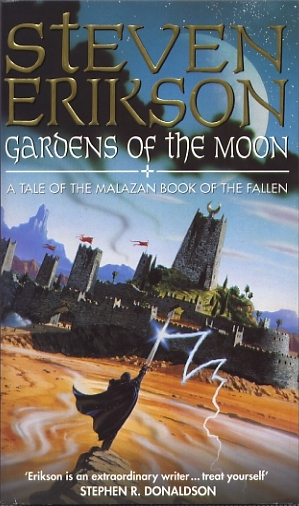
MBotF reread: "Gardens of the Moon" by Steven Erikson

It is almost a week since I finished "Gardens of the Moon", but I have been somewhat busy lately, so only now did I found time to write this post.

Following "Malazan Reread of the Fallen" on Tor.com is having one side-effect I haven't counted on. I felt like I have read this book only couple of months ago, so reading it again didn't have the same potency as usual. Thankfully, I am almost on the point of outrunning the Tor-reread, which is now somewhere after the beginning of second half of "Deadhouse Gates". I don't feel like doing a complete review of 12 years old book; there are countless good reviews out there. I will just note a few of my comments and opinions.

(First time seeing this cover)

This is the first book in the series and it was written almost 10 years before it was published, and it that time Erikson couldn't be sure this would be accepted as series. Nevertheless, book doesn't have the feel of being a stand-alone novel (contrary example: "Wizard's First Rule"; transition to its sequel doesn't feel natural at all and is very abrupt). Instead, thank to Erikson style, it give a feel of being plunged in the middle of long-running series. Erikson doesn't explain many things in the first run; he throws a bunch of information at readers, and then explains it layer by layer (and by layer and by layer).

This book, as whole series, is very complex, multi-layered and overwhelming book. It introduces few dozens of characters (I mean the important ones...), three continents, several human and non-human races, one of the most complex magic systems ever, real-life-like politics. But as I said, this if only the first book in series. Later books only get more complex and full. And the content of it: you name, you got it. Demons: checked. Sorcery and wizards: checked. Fighting and armies: checked. Gods and religion: checked. Mystery: double and triple checked...

I actually can't find anything bad to say about it. Only objection one could name about it, is that it can be too complicated for some readers. Not everybody likes their books this complex. But for those who like multiple plots and POVs, epic, gray-morality, etc. will be thrilled by this book. If you don't like it, don't even try its sequels; if anything, they are even more Malazan!

Friday, January 14, 2011

Just started a re-read of the "Malazan Book of the Fallen" by Steven Erikson

Well, as the title says, I am announcing that I am planning to read The Malazan Book of The Fallen again and I am starting today. By MBotF, I mean Steven Erikson's books from "Gardens of the Moon" to "Dust of Dreams". Yeah, that's NINE books. Last book in the series, "The Crippled God" is coming out in late February, so I have to be ready. It's been more than a year (probably even two) since I've read earlier Malazan books. Now is the time to be sure in my knowledge of events and plots. For example, few months ago I boldly speculated that Karsa will not be appearing in the last book. Then few weeks ago I stumbled on some comments that made me realize I was wrong.


Well, nine books... If it takes a week for a book (and I am being very optimistic here), I will be done somewhere at the beginning of March. Hopefully, I will receive "The Crippled God" by then.

I am not sure how this will reflect on my posting regarding this re-read. I definitely plan to post something, but whether this will be detailed reviews of these books, or just collection of short thoughts, I haven't decided yet. If I watch any movie in the mean time, I will definitely write about it.

I also want to point out the MBotF re-read on Tor.com. I am having great time reading those posts. Mostly because Amanda, one of the reviewers, is reading these books for the first time! Her occasional mistakes are very funny. Unfortunately, they go by a pace of two-chapters/one post by week. Truth to say, post are very long and the comment queue even longer, so I don't complain.

Wednesday, January 5, 2011

Book review: "Stonewielder" by Ian C. Esslemont

"Stonewielder" is a fairly new book by Ian C. Esslemont (November 2010) and third book in his "Malazan Empire" series. His first book "Night of Knives" was short and, in my opinion, only testing work, which depicted events and characters most fans of MBoF knew very good already from Steven Erikson's books. In his second book, "Return of the Crimson Guard", Esslemont used concepts, themes and settings Erikson already presented (Esslemont had full right to do so, since he is a co-creator of them), introduced some new (or "new") characters and then worked on them in completely new plot-line (but parallel to Erikson's). Result was very action-packed and intense book that I enjoyed very much. His third book, "Stonewielder", is again completely different book, but I'll say it immediately: I loved it!

In this book Esslemont does for the first time something Erikson has been doing in his every book: introduces new stuff. Particularly, sub-continent of Korel and its unique peoples and nations. It also clarifies some history between Malazan Empire and this place. There are several plots we follow in the book. Main one is Malazan second invasion of Korel. Here we have some "old" Esslemont's characters (Greymane, Kyle, Rillish), but no Erikson's; and whole new and unique cast. Exception are some gods that appear in both Erikson's and Esslemont's book. I hope this will become a trend; each of them developing his own cast and plots in common world, with occasional mixing!

(Again, what's with the boats??)

Back to the book... As I said, main plot is Malazan second invasion. We follow it from several viewpoints: Fist Rillish (character from RotCG), Cadre mage Devaleth (I think this name is a blunder; it sounds too Tiste Andii) and Suth, the common soldier. All three levels are done very good, but Suth's especially. I usually like the look from view of "ordinary" Malazan soldier (Fiddler, Hellian and bunch of squad's from "Dust of Dreams"...). Suth did some real growing up in this book; from self-centered youth searching fights to prove himself, to experienced Malazan veteran looking after his comrades. Then we had Ussü, one of leaders of Malazan first invasion, who are not very happy for the arrival of their successors. We also have Bakune, a judge from city of Banith. He is really honest man, although somewhat blind to reality of the world. His stubborn investigation of suspicious deaths will put him in position opposed to Church of the Blessed Lady, which is a very dangerous position on Korel. Fact that his city will be overrun by Malazan's will not be helpful, also. Next is Hiam, Lord Protector of the Stormwall and leader of all Korelri. He is uncommonly wise and thoughtful man, but share's a flaw of Korelri: belief in their total supremacy in both martial and moral aspects; also a belief that no one would be crazy enough to attack them, when they and the Wall are the only thing that stands in the way of dreaded Stormriders. They are in for few surprises... In Empire of Jourilan we have Ivanr, who is half-Thelomen ex-champion now sworn to pacifism; he is being pushed to position of a leader of religious uprising against the Lady and he doesn't really like it, but he doesn't have much choice. At last we have Corlo and Shell, both members of the Crimson Guard; Corlo is prisoner on the Wall, while Shell and her squad are coming to Wall to free him and his co-prisoners. Not, these were only the POVs; we have a bunch of crazy Malazan (world, not the empire) characters that give these books their flavor. Overall, plot is good; there were two or three big surprises and multitude of smaller ones.

There is also one more sub-plot, following Kiska (from NoK) and Jheval (new/old character) on their quest in Shadow Realm. I must say I am a bit confused about the meaning of this course of events, both in itself and in greater scheme of things. So, even though there are some interesting and funny scenes here (I was surprised when it was revealed who the priest is!!!), I will ignore this for now (for now being until the next book that explains it).

As I said, characters in this book are all Esslemont's, and most of them new. Only flaw is that there are actually not much of them. Dramatis Personae is only two and half pages long, and I got used to five or more. But on the other hand, book itself is not long: only 640 pages. What matters is quality, not quantity. And there are no flaws is this section. There are bizarre, there are serious, there are funny and there are sneaky characters. And not one of them is single-faceted.

Writing is better than in "Return of the Crimson Guard"; it is light-years away from "Night of Knives" writing. I am glad Esslemont more often uses inner-monologues and philosophical musings; it is one of key characteristics of "Malazan brand". Although, I must say that he still lacks Erikson's edge. Erikson drives his characters much more to extremes. On the other hand, Esslemont's writing is much more focused and followable. In the immediate start of the book, there were few blunders that made me wonder of quality of it, but they don't repeat later. Example of this was Greymane/Kyle sequence with school of martial arts, which was very un-Malazan, in my opinion. Also, there is a name of Beneth, which made me wonder for a time.

I must point out one thing: the Wall. Even though it was mentioned long ago in Erikson's books (not so long in time, but long in number of books; I can't say exactly where), I never expected it to be so similar to George R.R. Martin's Wall from ASoIaF. Korelry Stormguard and Night's Watch are also very similar; especially in the beginning. I am curious who invented which first. Erikson and Esslemont invented their world quite a long time ago, but are only now revealing the details; on the other hand, "A Game of Thrones" is out since 1996.

For conclusion: "Stonewielder" is a great book and a recommendation to all Malazan fans. Esslemont's books are steady getting better and better. For those who never heard about Malazan, go start one of best fantasy series with "Gardens of the Moon".

Future is bright for this series. Next month will see the publication of "The Crippled God". But then it's not over; Erikson will write a bunch of novels and novellas (according to Wikipedia). Esslemont will write at least three more, "Orb, Scepter, Throne" being the first.

Also, a note. From now on I am going on self-proclaimed ban on reading. I have two important PhD projects to finish in next few weeks, so I will not start reading until they are done (Because I know they wouldn't get done then). And after they are done, I plan to do a reread of whole "Malazan Book of the Fallen" series, so I can be ready when last book gets out.

Wednesday, December 29, 2010

Movie review: "Shutter Island"

I did a stupid thing. I watched the last fifteen minutes of "Shutter Island" trough sleep. I wasn't actually sleeping, but I wasn't really awake. I was conscious enough to know what is going on, but not enough to fully appreciate it. It was not because of the movie (on the contrary, movie is very good), but I was lying under blanket with my girlfriend, it was very cozy and warm and I was sleepy. Those who watched the movie will understand how stupid my falling asleep was, and you who didn't will just have to take my word about it being a very stupid idea.

Although I don't plan to reveal any spoilers, conception of this movie is such, that less you know, the movie will be better. So think twice before reading this review.


Now, back to the movie... The movie starts with Teddy Daniels, US Marshall, meeting his new partner on a ferry to Shutter Island. Two of them are going there to investigate disappearance of a woman, patient of mental institution for violent criminals. This institution is actually the only building on the island and the ferry is only way from it. Immediately after arriving, they will start to suspect something is amiss: guards on the edge, cowed patients, sneaky doctors... But even their wildest imaginations will be far from the truth!

"Shutter Island" is very disturbing movie: atmosphere is dark and stormy and all people are very nervous. Especially patients, who look like they are in fear; some of them are deformed or show signs of physical abuse. Events in movie are taking place in fifties and scenes from WWII are very often, showing Teddy's coming to Dachau concentration camp. All this serves to make viewer a bit uncomfortable (it was a bit inappropriate to watch this movie from bed). Combine that with pictures of lobotomy, electro-shocks....

Cast is good; Teddy is played by Leonardo DiCaprio; movie also stars Ben Kingsley and Max von Sydow. Somewhere at the middle of the movie you start guessing what is going on. I had two theories, my girlfriend also two different ones; in the end, we were both very, very off. It is just this kind of the movie.

I liked this movie very much, but it is not for everybody. It is a serious and violent movie dealing with psychology, and it asks concentration from viewer.

Wednesday, December 15, 2010

Anime review: "House of Five Leaves"

After finishing "Towers of Midnight", I decided to take a short break of reading. I have read four books in a row and while I like reading better than anime or movies and TV series, I can't read all the time. One reason is that I don't have money for buying more than one or two books per month. And even though my private library counts more than sixty books now, that is not enough unless I want to reread half my books every year. Second reason is more important: I tend to neglect everything else when I am reading books I really like. So combining work, PhD and multiple hobbies gets hard sometimes.

Anyway, after ToM, I started watching "House of Five Leaves". I have been waiting long for this anime, since last spring. I haven't watched a good samurai anime for long time. In the end, it turned out this is not a samurai anime, not in the way most consider as such. It's true; there are samurai in this series. Also, it's true that there is swords-fighting here and talk about honor and samurai code... Just not in the way I would expect it. But nevertheless, this is one of better anime I watched this year.


Masa is a young ronin staying in Edo. He comes from province and he is totally unsuitable for samurai; he is shy and unimposing, which results in him being easily pushed around. By coincidence, Masa gets employed by member of criminal group called House of Five Leaves. The group is composed of four somewhat peculiar people and is centered on charismatic young(ish) man Yaichi. Yaichi gets intrigued by Masa's straightforwardness and innocence and invites him to join them, just for fun of it. Rest of anime consist of Masa's deciding to join or not while he explore past and motives or other members, but especially Yaichi's.

As I said, there IS swords-fighting here; I think there are three fights: one is off-screen and two consist of two or three moves. This is very infuriating, because it is implied on beginning (and orally confirmed later) that Masa is "unparalleled with his swordsmanship". Well, I don't actually object this, but I would have liked being able to see it. There is talk about honor and samurai code, but it consists of Masa musing whether he should join House of Five Leaves or not. He comes to see that these are actually good people (well, in some degree), but they are doing bad thinks and he is not sure can he incorporate being a professional kidnapper in his system of honor.

Personalities, pasts and motives of other members are gradually revealed by smaller arcs where they get in trouble and Masa tries to help them (and vice versa). Yaichi's story is implied throughout the series and finally revealed in last few episodes. Setting is historical and I would say mostly accurate: medieval Edo, wages in rice, whore-houses... Important motive in series is adopted children in richer houses. Main strength of anime is character-growth and unexpected turns this anime takes (I really didn't expect most of this anime).

Anime features very original animation. First two episodes I thought that characters are quite ugly, but now that I finished it, I get used to this design. Although I think that character are intentionally done a bit rougher in the beginning, just of the effect. I can't say anything on music and sound effects, but I am pretty sure they are decent.

In summary, "House of Five Leaves" is one very good short (only 12 episodes) anime with historical setting. It includes a bit of action, lots of mystery and anticipation, but mostly concentrates on exploring its eccentric characters. Definitely a treat for all seinen fans.

Thursday, December 2, 2010

Not a Book review: "Crossroads of Twillight" and "Knife of Dreams" by Robert Jordan

I have been somewhat busy last few weeks (I had some field work and a business trip), so I wasn't up to date with my blogs. All my free time was reserved for reading. I announced starting a reread of "Crossroads of Twilight" and I did read it. After finishing it, I immediately switched to "Knife of Dreams". And after it, to "The Gathering Storm". Currently, I am almost at the middle of "Towers of Midnight"!


After reading first two books and while reading "TGS", in the back of my mind I tried composing my reviews of CoT and KoD. And then I realized that I can't do it. I have read these books several times and I am so familiar with them that I am able to start reading on any random page. I don't know when or where they exactly begin or where do they end or the exact chronological order of plots, but give me a page or two and I will know where am I, what happened before and what will happen in few pages. Not that I know them by the word; I still find details I forgot or missed. It is hard to explain this to non-obsessive reader; for non-readers, this sound crazy (I know from first hand - most people don't see reason to read something they have read once). But I think that people who are able to gulp down a book in two or three days will be able to understand me perfectly.

Also, what is the point of recommending tenth and eleventh book in series to someone? If you have read nine previous books and liked them, you will probably like those, too. Even if you stopped liking the series, you will read them because you hope things gotten better or just because you want to justify the effort invested in reading first nine books.

Although many did just that, stopped liking Wheel of Time series after some five or so books, I was never one of them. This probably has much with the fact that I started reading this series very late. I think it was sometime in 2005. At that time, nine books were out, so I didn't have to wait long between the books. "Knife of Dreams" was the first book I waited for, and I was just a few months. Many people were distanced from the series because they waited few years for the next installation, and then the book would advance the plot for few inches and at the same time start several new plot-threads.

This is also true for "Crossroads of Twilight". I adore this book, especially because sequences concerning Mat (I presume you are familiar with the series if you got so far). Although other characters had their own moments, most (not all, but I think most) fans will agree that Mat's sections is what they remember best from this book. But, to be frank, I can see why this was something of a disappointment for fans who waited three years. There weren't any conclusions; this book just advanced plots started before, but haven't finish any.

On the other hand "Knife of Dreams" is where many fans came back to the series. Three major plots finished (Mat's, Perrin's and Elayne's) and two other presented fairly (Rand's and especially Egwene's), with much more focused writing, brought back old glory to WoT. For me, it didn't ever lose its shine.

After "Knife of Dreams", unfortunate illness and death of Rober Jordan, then choosing of Brandon Sanderson to complete the series, with strong marketing campaign from Tor, made me to never lose WoT from my mind for long. After long wait of four years, I was impatiently waiting with the other for first part of last book, "The Gathering Storm".

Join me in my next post, where I plan to do a normal review of TGS.