Even though I liked "Return of the Crimson Guard" and even "Stonewielder", after debacle with "Orb Sceptre Throne" my enthusiasm for work of Ian C. Esslemont has dropped down considerably. His new book in Malazan setting, "Blood and Bone" has been out for couple of months. I would usually buy it as soon as it was out, but this time I just wasn't into it. Especially after reading some tepid reviews on Amazon. But in the end, I consider myself a Malazan-fanboy so I just could not leave it unread for long.
As is usual for Malazan books, there are multiple plot-lines, all connected by the fact they are happening on Jacurucu, a continent only mentioned by Erikson and Esslemont until now. Thaumaturgs, a ruling mage-class of largest nation on Jacurucu is on the move: there is another invasion targeting the Jungle of Himatan, which covers whole east half of the continect and is ruled by Ardata, Queen of Witches and Mother of Monsters. Led by Commander Golan, the army will find itself attacked not by enemy soldiers, but something even scarier, the Jungle itself: heat, humidity, wild animals, inhabitants from nightmares, bugs and diseases... But before they even reach the Jungle, on their way they will travel through poor villages between their nation and Himatan. In one of such villages, young woman named Saeng, with unique connections to the dead of Jacurucu, will be saved by her brother Hanu, who was taken some years ago to become Thaumaturg strongest weapon, stone soldier of jakshaka. In the meantime, in south, members of several Adwami tribes, including the young prince Jatal, are gathered by the call of foreign warleader called Grey Ghost, who asks of them a temporary truce and offers a common goal: the greatest raid on Thaumaturg capital ever! And on Stratem, remnants of Crimson Guard have gotten a new contract, by Ardata herself: to get rid of Skinner and his Disavowed.
Somewhere I have read that this book is intended for Malazan fans and nobody else, and I would agree with this statement. Even though is much simpler that Erikson's books, "Blood and Bone" would be incomprehensible to non-fan. There is no real introduction to characters, setting and plots, and it is expected to be familiar with prior events to appreciate all nuances and details. So, if you haven't at least read Esslemonts previous books, don't even try reading this one.
I must say I was pretty surprised by this book, and pleasantly so. The pace is pretty slow, but the book is very interesting. Some would consider it dragged and too slow, but I kind of liked it such. Esslemont even gets philosophical a la Erikson on some occasions. Esslemont is not natural at being mysterious in writing as Erikson is, but here he tries and succeeds most of the times - even though he can get tiring sometimes.
What I really liked in this book were the characters. There are some old characters, but most of them are new. There are even some old hidden as new. In general, Esslemont is much better with his own characters than when he uses and recycles Erikson's. I liked Jatal, who is noble and honorable so much that you know that it will not end well. Pon-lor starts as side-character but in the end becomes one of most important and best. Commander Golan and his nemesis Thorn are simply a great duo. But all other are interesting, too. I can only compliment Esslemont in succeeding making all parties look good and nobody bad.
Even though the book takes place on Jacurucu, you will not found it too revealing about its secrets. I know I am boring and repetitive, but Erikson would be handling it better. Nevertheless, it is interesting as it is. I liked how we get a context of where this book fits in. The descriptions of the jungle and the dangers luring there are pretty good. I was surprised how gritty and even disgusting things became on several occasions, like with the worm-parasites!
All in all, "Blood and Bone" was a pleasant surprise. Again, the book is not on par with Erikson's, but it provides the Malazan fans with an interesting plot and a revelation of new part of setting. So I would recommend it to all fans of Esslemont - though pure fans of Erikson should be careful with it.
On this blog I write my impressions about books and manga I've read and anime and movies I've watched. Also, I occasionally post some random thoughts regarding this subjects. I try to be objective, or even when not, to state some bad sides of contest I describe (if I can see them). I presume that my first posts will be somewhat raw or confusing (especially since English is not my first language), but I hope that in time I will get better in sharing my thoughts.
Monday, July 15, 2013
Saturday, July 13, 2013
Anime review: "Mahou Shoujo Madoka Magica"
"Mahou Shoujo Madoka Magica", or "Madoka Magica" hereafter, is not a show I would usually be attracted to, at least considering the style of its animation and its cover-picture on AniDB. Therefore, I pretty much unintentionally avoided it two years ago when it came out. I also avoided it the year later when it got several awards for the pass year... But after watching other high-rated anime, "Madoka Magica" kept jumping out on first places and getting nice reviews, so I finally decided to give it a try.
As I said, "Madoka Magica" at first looks as a typical shoujo action anime with magical girls (mahou shoujo): cute flat-chested and silly/clumsy protagonist, cute uniforms, lots of pink, lace and winking.... Setting include middle-school girls who enter a contract with some kind of cute-cat-look-a-like demon who gives them magical powers and a free-wish while they in return have to fight evil "witches" (nightmares) who attack innocent men and women...
Well, while it certainly has elements of mahou shoujo anime and it looks like one, "Madoka Magica" hides a big surprise for its viewers: it is actually a very powerful seinen tragedy! While it is a bit angsty toward end, that is to be expected of such anime, and the complete reversal of expectations negates any negative experience...
As you noticed, I am trying to avoid spoilers as much as I can. But I just can't avoid talking about the main villain... First, you really don't expect her to be a villain, especially considering her looks. Secondly, he is really a psychological masterpiece! It is scary how good she is at being passive-aggressive and manipulative toward an innocent girl... I am fan of grittiness, but there are some lines you just don't cross...
As I said, it is really a tragedy - it becomes evident after all that Mami's happy talk. And definitely it is seinen: the more Homura tries to do what is right, the worse it gets.
Other remarking sides of this anime are the visual side and the music. The music is very good, including a song by Kalafina. The show has nice vibrant colors, which together with intense music and the action at the beginning, made me like this anime instantly. As I said, design of character is typically shoujo, but this you just have to accept. Things change when they enter the "witch domain", where it looks like some kind of patchwork and it is very interesting. There are 12 episodes totally.
All in all, "Mahou Shoujo Madoka Magica" was a pretty good surprise, but a kind of that I would recommend mostly to those who like seinen, and potentially josei anime. I hope those will forgive me my little misdirection in review and be thankful for it later.
As I said, "Madoka Magica" at first looks as a typical shoujo action anime with magical girls (mahou shoujo): cute flat-chested and silly/clumsy protagonist, cute uniforms, lots of pink, lace and winking.... Setting include middle-school girls who enter a contract with some kind of cute-cat-look-a-like demon who gives them magical powers and a free-wish while they in return have to fight evil "witches" (nightmares) who attack innocent men and women...
Well, while it certainly has elements of mahou shoujo anime and it looks like one, "Madoka Magica" hides a big surprise for its viewers: it is actually a very powerful seinen tragedy! While it is a bit angsty toward end, that is to be expected of such anime, and the complete reversal of expectations negates any negative experience...
As you noticed, I am trying to avoid spoilers as much as I can. But I just can't avoid talking about the main villain... First, you really don't expect her to be a villain, especially considering her looks. Secondly, he is really a psychological masterpiece! It is scary how good she is at being passive-aggressive and manipulative toward an innocent girl... I am fan of grittiness, but there are some lines you just don't cross...
As I said, it is really a tragedy - it becomes evident after all that Mami's happy talk. And definitely it is seinen: the more Homura tries to do what is right, the worse it gets.
Other remarking sides of this anime are the visual side and the music. The music is very good, including a song by Kalafina. The show has nice vibrant colors, which together with intense music and the action at the beginning, made me like this anime instantly. As I said, design of character is typically shoujo, but this you just have to accept. Things change when they enter the "witch domain", where it looks like some kind of patchwork and it is very interesting. There are 12 episodes totally.
All in all, "Mahou Shoujo Madoka Magica" was a pretty good surprise, but a kind of that I would recommend mostly to those who like seinen, and potentially josei anime. I hope those will forgive me my little misdirection in review and be thankful for it later.
Labels:
action,
anime,
complex,
contemporary,
epic,
fairy-tail,
fantasy,
fighting,
no spoilers,
seinen,
surreal,
tragedy,
very good
Monday, July 1, 2013
Book review: "King of Thorns" by Mark Lawrence
Since I was at vacation the Monday I finished "Prince of Thorns" by Mark Lawrence, Tuesday next day, I continued with reading its sequel "King of Thorns". I must say that it's been long since I have read with such enthusiasm, leaving everything else besides! I was able to finish it at Tuesday after noon.
After getting his revenge in "Prince of Thorns" and becoming a King of Renar Highlands (one of the smaller and poorer regions in the neighborhood), Jorg is still not peaceful because there is another his unfulfilled ambition: becoming the Emperor (of the World, just to mention it).Four years after and he is sitting in his (only) castle, waiting for his future bride (whom he never met) and slowly becoming surrounded by army ten times bigger than the one he has. And to his greater chagrin, this army is led by Prince Orrin of Arrow, favorite by people and nations (for being good and caring ruler), descendant of last Emperor (while Jorg's line descends only from his Steward), and most important, favorite of all magicians and soothsayer (the real power behind thrones). So, what does a person in Jorg's position does? He attacks, of course...
"King of Thorns" is a different book from its prequel. First, it's longer: around 500 pages, where PoT was some 300 pages. While PoT had two timelines (the main one, and one four years ago describing how Jorg becomes what he is), KoT has three. First, there is again the main one, which I described in last paragraph. Curiously, this line of events get only sporadic chapter, at least until the end, when it really hits. Again, there is one happening four years ago, describing what Jorg did after coming to Renar Highlands and what lead to his "quarrel" with Prince Orrin. I was very surprised with this part, because after PoT, I didn't expect to find a classical fantasy quest/journey, where Jorg travels around the country, meeting new and old people, and does some "training". And third, a minor plot-line is a collection of excerpts from private diary of Katherine, who Jorg met in last book and who become his object of... Well, we'll not call it love, so call it obsession. I like it when storytelling is nonlinear and there is lot of wandering during it. So, definitely a plus.
Another thing that differs this book from previous part is that it is much softer. While "Prince of Thorns" was full of raping, murder and torture, "King of Thorns" is much lighter. Jorg is still cynical, dark and "practical", but he doesn't even meaninglessly kill anybody in this book (well, there's maybe that part with the lion...). His band of Brothers is still here, even though much smaller, but they also grew accustomed to some other principles. One could say that this is a complete reversal, but Lawrence wrote it so well that is feels very natural. On the other hand, there are still lots of graphical descriptions and not-so-honorable acts (hello Miana) that we all like so much.
Even so, Jorg is much softer. Not only in his conduct (he in now just a political psychopath, instead of a literal one), but is his skill also. While in PoT there was no task impossible for him, here we see some of his limits. But don't worry, Jorg is a resourceful one. Now he plays for larger scales that just revenge: strength of his country and army, position in game of thrones, even seeking alliances. This book is full of his retrospectives and memories of childhood. Even a happier childhood, in some instances...
As I said, I liked the traveling sequence, especially when he comes in the south - it reminded me to some other, more classical fantasy books when our hero trains to become a hero. If you gave only this few chapters to someone who haven't read "Prince of Thorns", he could have thought this a regular fantasy book... I also liked the part when they met the Circus.
One of strong-points of "Prince of Thorns" was its setting. "King of Thorns" tops it by a good margin. You can see it by map, which is much larger. But you also get more information about its history and present. Magic "system" also gets extended, and some new enemies have their introduction. I have never met Jack Vance's "The Dying Earth" stories, even though I hear much about them. I read some reviews mentioning that post-apocalyptic part of the setting is strongly influenced by this works, so I will definitely read them in future.
While "Prince of Thorns" was a great book, "King of Thorns" is even more so. I can sincerely say that it was one of best books I have read lately, in range of R. Scott Bakker, Joe Abercrombie's earlier books, Patrick Rothfuss. If "Emperor of Thorns", which is due for publishing very soon, be a book good as this one, "The Broken Empire" series will be one of the best ever! Definitely a recommendation to fans of first part, but also for all those who like a darker fantasy.
Labels:
action,
anti-hero,
best books,
blood,
book,
complex,
dark,
fantasy,
fun,
good characters,
great,
gritty,
high fantasy,
intelligent,
Mark Lawrence,
The Broken Empire,
violent
Sunday, June 30, 2013
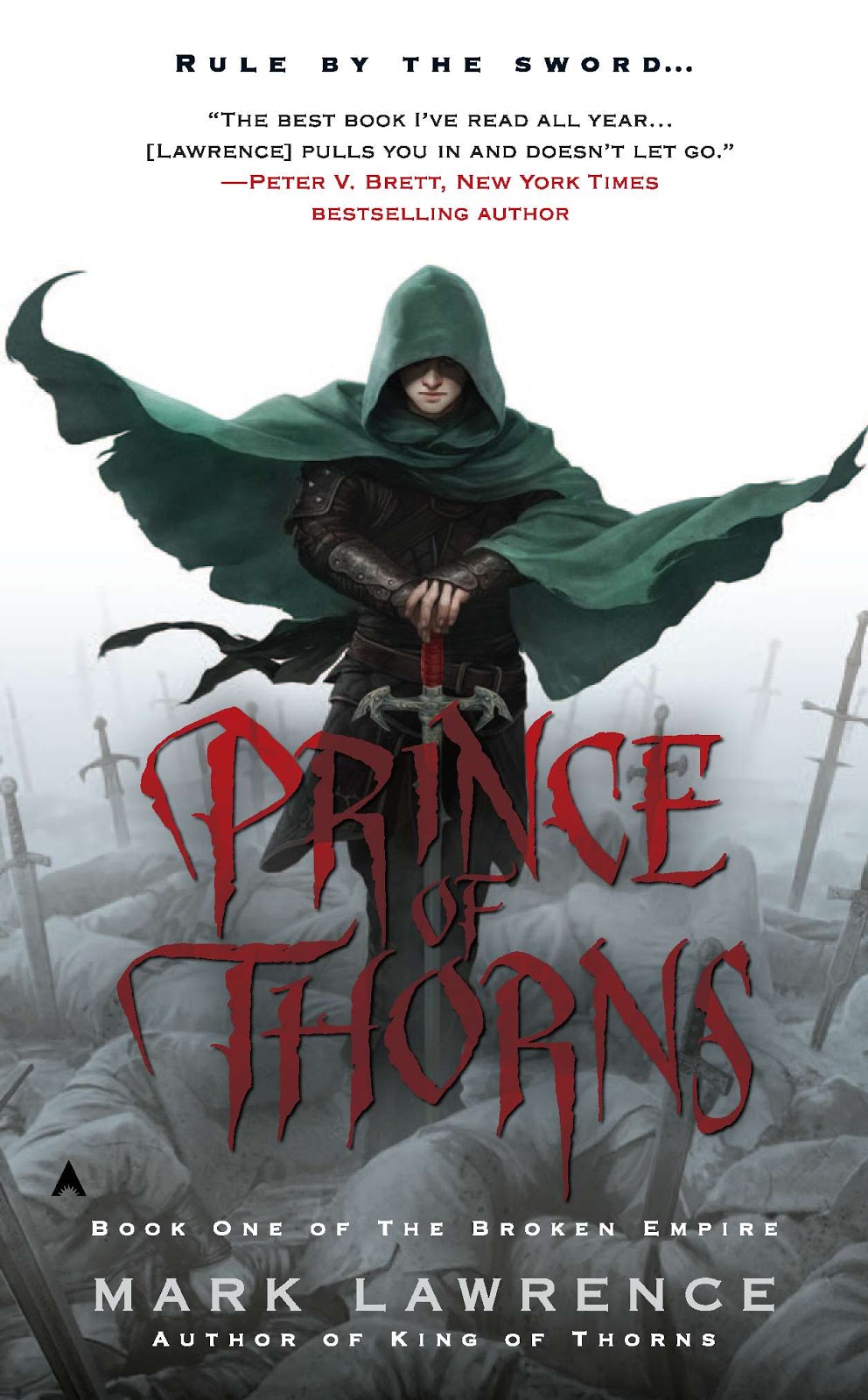
Book review: "Prince of Thorns" by Mark Lawrence
I have noticed "Prince of Thorns" by Mark Lawrence immediately after it came out, even though I don't remember how (I think of Tor.com), and it's been sitting in my Amazon wish-list ever since. My initial enthusiasms dropped after reading few reviews describing it as grimdark and unnecessary gritty. But last Sunday I decided to give it a try - and finished it at Monday's morning...
"Prince of Thorns" is told from first point of view and narrated by Honorous Jorg Ancrath. When the story starts, he is fourteen years old and a leader of brutal and violent bunch of bandits called the Brotherhood. Killing a brother for challenging him as leader is a normal occurrence. Attacking villages, burning people and raping their women is what the Brotherhood do - and Jorg is a scariest of them. But Jorg is a more than a simple bandit: Prince Jorg, the only heir of kingdom of Ancrath. Jorg was always a precocious child and had the best of tutors. But when he was 10 years old, his beloved younger brother and mother will brutally killed in front of his eyes. Thrown in the bush of briars, he accidentally survives, but something has snapped in his mind... After his father the King decides not to seek vengeance against Count Renar and accepting some material amends, Jorg escapes from home in seek of revenge, but as the book progresses, it will turns out that there are more complex game being played around...
First, if you want to enjoy this book, you just have to accept that Jorg is fourteen and leader of bandit gang. We could now discuss psychological and physical problems of a teenager leading bunch of big old men, but this is out of the point - it is fantasy after all. If you can accept it, you are ready for one hell of a ride.
This book is really grimdark - very brutal and graphically violent. Killing and burning people, raping and visiting whorehouses, unstable relationships in families - you have it all. But after you finish the book, you can notice that most (but not all) of this brutal stuff is in first part of book. Like Lawrence wanted to make a state about this being a gritty book and wished to make an impact. He succeeds in both point very well, and I noticed that "Prince of Thorns" is very successful book, so you can presume that people very hungry for it. Hype for "Game of Thrones" and ASoIaF proves it, as it does the success of Joe Abercrombie's "First Law" series and its sequels, and Richard Morgan's "A Land fit for Heroes" series.
This is not just the story of revenge. It first starts as it, but as it goes on, you will notice that Jorg has other goals of just revenging himself against Count Renar. He wants to prove himself to his father (who is maybe even bigger psychopath than Jorg, in class of Tywin Lannister), but more than that he wants to "win the game" and become the Emperor (we will get back to it later). But he is not the only with a larger agenda, especially when you meet Sageous. The story in general becomes much wider after they return to the Tall Castle. Another interesting thing is the parallel story of four years ago, that explains what happened after Jorg's brother and mother were killed, how he escaped and how he met the band. It also gives more background and explains how Jorg became the man (he is definitely no child anymore) he is.
The characters are also very deep. Since it is told from first POV, you get to know Jorg the best. He is just a crazy and violent psychopath at first, but you will soon see that there is more to him... You know that typical young fantasy hero, who is strong and tall good with sword, has natural affinity to magic, and it is also intelligent, outspoken and charming? Well, Jorg is exactly like that, only he is the anti-hero, using all this traits for getting his goals through, never mind who gets killed or injured along the way. He is terrible, but you have to root for him on account of his gutsiness and "never bend" attitude. Nevertheless, Lawrence is smart enough writer and makes him have some weaknesses, not to make him irritating. It reminds me much on Richard Morgan, whose Ringil is also so confident, but you see him afraid and insecure sometimes. Other characters are interesting and have several shades to them, but Jorg is the star of the book. I liked the short descriptions of Brothers before chapters - they were quite funny (in gristly sort of way). There was also a touch of Black Company camaraderie and Croaker's humor in Jorg's descriptions of his fellows.
Another surprise is the setting. In the beginning, Ancrath is just a typical medieval kingdom, and so it the world. Sure, there are some ghosts and some, let's say magicians, but this is typical fantasy at first. But as the book advances, you realize that this is actually a post-apocalyptic world!! The story takes place in Europe, castles are actually skyscrapers, and some of the magic is actually technology. I liked this turn of events very much. There is some really magic here also, but it fits very well.
Lawrence writing was very easy to read, without being too simple, and the book has very fast pace. Unfortunately, it is quite short - only 350 pages. But, at least is very intense read. Another small objection I have is that Jorg is sometimes just too lucky, even for a fantasy-story protagonist.
So, it can definitely be said that "Prince of Thorns" is not just a "gritty-book". It starts very violently and simply, but it expands in every way: story, characters, setting. For fans of Martin, Abercrombie and Richard Morgan...
Labels:
action,
anti-hero,
best books,
blood,
book,
complex,
dark,
fantasy,
fun,
good characters,
great,
gritty,
high fantasy,
intelligent,
Mark Lawrence,
The Broken Empire,
violent
Monday, June 24, 2013
Anime review: "Bakuman", third season
Few days ago I finished watching third and last season of "Bakuman", adapted from manga about drawing manga.
This season continues "Bakuman" plot where it left in previous season. Mashiro and Takagi have finally made a manga they are satisfied with (PCP - Perfect Crime Party) and they struggle to make it better not to lose their place in Shounen Jack. They have not lost their dream of getting an anime adaptation, so Mashiro can marry his love Miho (a condition set in middle school). Takagi is supported by his wife Kaya (also met in middle school), while two of them compete against other manga-artist present in Shounen Jack, most of them familiar from previous seasons, but with some additions.
This season if a bit different from previous two (if I remember correctly) by being more episodic - there are several arcs that are almost independent between them (especially Nanaime's). But by and large, there are no much changes from first and second seasons, so if you are a fan of "Bakuman", you will be more that satisfied with it.
I cannot be sure because I haven't read manga, but it feels a bit rushed in places, like they had to squeeze too much material in it. But at least the pace is good and there is no dragging... Ending is as expected, but very solid. And I like how it is clearly showed that Mashiro and Takagi won't lose their motivation, even though they fulfilled their dreams. It is interesting how the author succeeded in having an shounen battle-anime feel when the story couldn't be less apart from such.
Characters stay the best part of "Bakuman". As I said, there are no many new additions, but we got to know older ones much more, and there are some changes in their relationships. Niizuma, who is on one hand very funny, improbable and exaggerated character, is shown to be very dedicated and consistent. I like how Hiramaru gets more serious, even though he is still hilarious - and Joshida makes him a great pairing. Also, we got a bit of romance, spread throughout the anime. Rest of the characters are also solid (Fukuda, Aoki, etc.).
It was very nice to see some modern mobile phones, and android references, too. But that can be expected since this anime was finished a year ago and is set in present.
This season continues "Bakuman" plot where it left in previous season. Mashiro and Takagi have finally made a manga they are satisfied with (PCP - Perfect Crime Party) and they struggle to make it better not to lose their place in Shounen Jack. They have not lost their dream of getting an anime adaptation, so Mashiro can marry his love Miho (a condition set in middle school). Takagi is supported by his wife Kaya (also met in middle school), while two of them compete against other manga-artist present in Shounen Jack, most of them familiar from previous seasons, but with some additions.
This season if a bit different from previous two (if I remember correctly) by being more episodic - there are several arcs that are almost independent between them (especially Nanaime's). But by and large, there are no much changes from first and second seasons, so if you are a fan of "Bakuman", you will be more that satisfied with it.
I cannot be sure because I haven't read manga, but it feels a bit rushed in places, like they had to squeeze too much material in it. But at least the pace is good and there is no dragging... Ending is as expected, but very solid. And I like how it is clearly showed that Mashiro and Takagi won't lose their motivation, even though they fulfilled their dreams. It is interesting how the author succeeded in having an shounen battle-anime feel when the story couldn't be less apart from such.
Characters stay the best part of "Bakuman". As I said, there are no many new additions, but we got to know older ones much more, and there are some changes in their relationships. Niizuma, who is on one hand very funny, improbable and exaggerated character, is shown to be very dedicated and consistent. I like how Hiramaru gets more serious, even though he is still hilarious - and Joshida makes him a great pairing. Also, we got a bit of romance, spread throughout the anime. Rest of the characters are also solid (Fukuda, Aoki, etc.).
It was very nice to see some modern mobile phones, and android references, too. But that can be expected since this anime was finished a year ago and is set in present.
The worst part of "Bakuman" is really bad and old-looking style of characters and drawings. Thankfully, this is character- and story-driven anime, so it doesn't matter much. Interesting how we have very poor art, but it becomes good (or at least more detailed) when it comes to manga they are drawing. Voice acting and music is solid, but nothing to praise much. There are 25 episodes in total.
Labels:
anime,
Bakuman,
character development,
contemporary,
daily life,
fun,
funny,
good characters,
great,
humor,
no spoilers,
realistic setting,
romance,
seinen,
slapstick
Wednesday, June 19, 2013
Book reivew: "Century of the Soldier" by Paul Kearney
Well, it is almost three weeks ago that I have read this omnibus, "Century of the Soldier", which comprises last three books from "Monarchies of God" series by Paul Kearney, but I've been too busy to make a post about it. Good think I took some notes, because I would be lost what to write.
I have read the first omnibus, "Hawkwood and the Kings" almost a year ago and had a good experience with it, which I described in the post. Again, in "Century of the Soldier", it is hard to make a short description because these are actually three books, and the last one happening almost 20 years after the middle one. But I will make a presumption that you have read the first two books. In essence, there are two main lines. In the east we have Corfe, as one main character, with bunch of other characters, fighting against the Merduks who are once again massively invading Torunna. In the West, we follow events in Henbrion, King Abeleyn's fight to reconquer his throne, helped by wizard Golophin, and return of captain Hawkwood from the far West. And the last book combines these two plots in one, where our heroes fight against the might of the Second Empire, a militaristic theocracy empowered by magic (Dweomer) and werewolves (among other things).
There are several things that differentiate this series from other. There is much sex, especially at the beginning of the first book in this omnibus. Even though I remember some of it from first omnibus, it definitely wasn't so bold. But I was much more surprised by brutal and graphical description of was violence, especially Merduk's rape and plunder through Torunna. Battle scenes are also pretty graphical. Kearney sometimes use trick Erikson often uses: talking through perspective of unimportant character that is later not even mentioned again.
I also liked how Kearney doesn't follow the tropes. We have an uncommon romance between younger man who is one of main characters, and (much) older woman. When I think about it, all love and marital relationships in these books are, well, not very healthy. There is also much of nice ambiguous morale - Golophin and others have to choose the side; Corfe and his love to his "daughter"...
Another specialty of this series is its magic system, Dweomer, but also its coexistence with gunpowder and cannons. Nothing much new compared to first two books, but this is a solid part for Kearney. This is not a classical fantasy - it is a historical fantasy but with a nice touch of magic, maybe akin to Guy Gavriel Kay's books.
I like Corfe's part in first books (there's no Hawkwood in first book), and things got pretty heated up in second book (which I like better). But pace is too fast in occasions and changes come to abrupt, which results in sudden and not-so-solid resolutions. I would have appreciated it more if the pace was consistent throughout the books.
There are very non-cheerful book - even when they are winning, our characters are not happy. Also, there is virtually no humor (except if you count Murad) and bantering between soldiers is bad (which I really take it as serious flaw).
All in all, "Monarchies of God" have some good points: interesting setting and unique magic system, realistic and gritty tone, complexity. "Century of the Soldier" has all this virtues, but I will remember it more by its flaws: not making any connection to characters and strange pace. Even though the overall impression of the series is more good than bad, I don't believe I will buy anything more by Paul Kearney - there is much more solid things out there.
Labels:
action,
alternate history,
books,
complex,
dark,
disappointment,
epic,
fantasy,
gritty,
history,
Monarchies of God,
monsters,
multiple POVs,
not very good,
Paul Kearney,
realistic,
religion,
violent
Sunday, May 19, 2013
Anime review: "Hyouka"
Few weeks ago AnimeReactor Community Awards were finally out. Most of the anime I watch I find and pick by myself, but I always check this yearly selection in case I miss some (I usually do). For last year, "Hyouka" won in three categories: Character Development, Male Lead and Slice-of-Life. I noticed "Hyouka" before, but I looked like a typical school comedy, probably based on some dating-sim or video-game, so I decided to skip it. But winning three categories made me change my mind, especially in these few weeks without any expected anime out.
"Hyouka" had a pretty uninformative and general description. Oreki Hotarou has just entered high-school. He is almost typical boy, except for his philosophy - he is an "energy-saving boy" and his motto is: "If I don't have to do something, I won't, but if I have to, I'll do it quickly.". Meaning, he avoid any unnecessary effort and obligation, even though he is not lazy. According to his life-style, he would avoid joining any high-school clubs, because it would ask for additional effort, but he is forced by his older sister to join Classic Literature Club. There he meets Chitanda Eru, also from his year, who is a very curious and dynamic girl - his complete opposite. Later they are joined by Fukube Satoshi, Oreki's best-friend, and Ibara Mayaka, a friend from their junior-high school.
Plot of "Hyouka" stems from Chitanda's curiosity (her phrase is "I can't stop thinking about it") and Oreki's uncanny ability to connect seemingly uncorrelated facts into a theory or explanation. It turns out that Oreki is a natural born detective - when he can be coerced to leave his usual low-energy state. There is no overall plot in this anime, only a bunch of standalone episodes and three mini-arcs made of two or three episode. At the beginning, I was wondering why this anime got an award in Slice-of-Life category when it was clearly a detective anime, but toward end focus shifts more to characters and their daily life than to plot.
Also, a word of advice. This anime has a pretty slow introduction, so give it some time to really start. It you like it when it reaches Seikitani Jun arc, things go only better from that point on.
From my description, you probably understand that I liked this anime, although it doesn't sound like anything extraordinary. And this is true, this anime is not extraordinary - but it is very, very good in every aspect. There is no big story here, but each episode and few arcs are very interesting, even if you don't like detective stories (I don't, really). Characters don't stand out, especially at the beginning, but they grow more complex and life-like whole time during this show. Animation and design also don't look anything special at first glance, but as you watch it, you will realize that a major effort is put in details and that everything fits right. There is also some romance, some comedy and much of light humor. Looking back now, this anime is like normalized (in sense that both high and low extremes are flatted out) "Haruhi Suzumiya" show. And I think that fans of it will also like "Hyouka". Despite slow and unimpressive start, this show ends as one really good anime.
There are some unexpected quirks in this anime. First, you rarely see a minor getting drunk in anime (even when it is accidentally). Secondly, it is not common that boy is attracted to girl only psychically (at least at first), except in ecchi anime. It usually involves unrealistic romance (e.g. Harima and Tenma from "School Rumble").
All in all, even not extraordinary, "Hyouka" is quietly great anime and I would recommend it to anybody who doesn't require action from anime their watch. It is interesting, sometimes mysterious, lively and fun all the way.
Subscribe to:
Posts (Atom)