Sunday, June 30, 2013

Book review: "Prince of Thorns" by Mark Lawrence

I have noticed "Prince of Thorns" by Mark Lawrence immediately after it came out, even though I don't remember how (I think of Tor.com), and it's been sitting in my Amazon wish-list ever since. My initial enthusiasms dropped after reading few reviews describing it as grimdark and unnecessary gritty. But last Sunday I decided to give it a try - and finished it at Monday's morning...
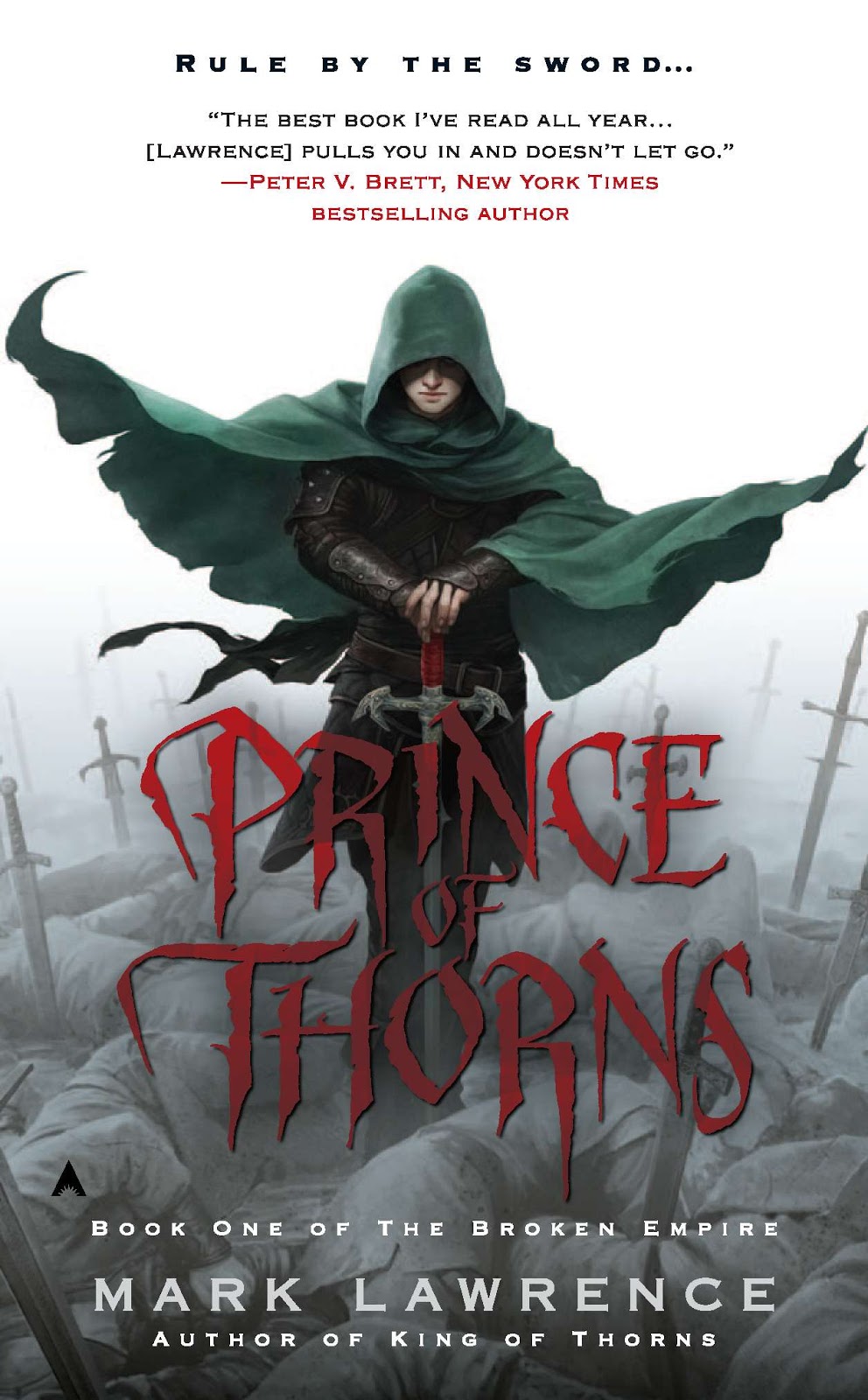

"Prince of Thorns" is told from first point of view and narrated by Honorous Jorg Ancrath. When the story starts, he is fourteen years old and a leader of brutal and violent bunch of bandits called the Brotherhood. Killing a brother for challenging him as leader is a normal occurrence. Attacking villages, burning people and raping their women is what the Brotherhood do - and Jorg is a scariest of them. But Jorg is a more than a simple bandit: Prince Jorg, the only heir of kingdom of Ancrath. Jorg was always a precocious child and had the best of tutors. But when he was 10 years old, his beloved younger brother and mother will brutally killed in front of his eyes. Thrown in the bush of briars, he accidentally survives, but something has snapped in his mind... After his father the King decides not to seek vengeance against Count Renar and accepting some material amends, Jorg escapes from home in seek of revenge, but as the book progresses, it will turns out that there are more complex game being played around...

First, if you want to enjoy this book, you just have to accept that Jorg is fourteen and leader of bandit gang. We could now discuss psychological and physical problems of a teenager leading bunch of big old men, but this is out of the point - it is fantasy after all. If you can accept it, you are ready for one hell of a ride.

This book is really grimdark - very brutal and graphically violent. Killing and burning people, raping and visiting whorehouses, unstable relationships in families - you have it all. But after you finish the book, you can notice that most (but not all) of this brutal stuff is in first part of book. Like Lawrence wanted to make a state about this being a gritty book and wished to make an impact. He succeeds in both point very well, and I noticed that "Prince of Thorns" is very successful book, so you can presume that people very hungry for it. Hype for "Game of Thrones" and ASoIaF proves it, as it does the success of Joe Abercrombie's "First Law" series and its sequels, and Richard Morgan's "A Land fit for Heroes" series.

This is not just the story of revenge. It first starts as it, but as it goes on, you will notice that Jorg has other goals of just revenging himself against Count Renar. He wants to prove himself to his father (who is maybe even bigger psychopath than Jorg, in class of Tywin Lannister), but more than that he wants to "win the game" and become the Emperor (we will get back to it later). But he is not the only with a larger agenda, especially when you meet Sageous. The story in general becomes much wider after they return to the Tall Castle. Another interesting thing is the parallel story of four years ago, that explains what happened after Jorg's brother and mother were killed, how he escaped and how he met the band. It also gives more background and explains how Jorg became the man (he is definitely no child anymore) he is.

The characters are also very deep. Since it is told from first POV, you get to know Jorg the best. He is just a crazy and violent psychopath at first, but you will soon see that there is more to him... You know that typical young fantasy hero, who is strong and tall good with sword, has natural affinity to magic, and it is also intelligent, outspoken and charming? Well, Jorg is exactly like that, only he is the anti-hero, using all this traits for getting his goals through, never mind who gets killed or injured along the way. He is terrible, but you have to root for him on account of his gutsiness and "never bend" attitude. Nevertheless, Lawrence is smart enough writer and makes him have some weaknesses, not to make him irritating. It reminds me much on Richard Morgan, whose Ringil is also so confident, but you see him afraid and insecure sometimes. Other characters are interesting and have several shades to them, but Jorg is the star of the book. I liked the short descriptions of Brothers before chapters - they were quite funny (in gristly sort of way). There was also a touch of Black Company camaraderie and Croaker's humor in Jorg's descriptions of his fellows.


Another surprise is the setting. In the beginning, Ancrath is just a typical medieval kingdom, and so it the world. Sure, there are some ghosts and some, let's say magicians, but this is typical fantasy at first. But as the book advances, you realize that this is actually a post-apocalyptic world!! The story takes place in Europe, castles are actually skyscrapers, and some of the magic is actually technology. I liked this turn of events very much. There is some really magic here also, but it fits very well.

Lawrence writing was very easy to read, without being too simple, and the book has very fast pace. Unfortunately, it is quite short - only 350 pages. But, at least is very intense read. Another small objection I have is that Jorg is sometimes just too lucky, even for a fantasy-story protagonist.

So, it can definitely be said that "Prince of Thorns" is not just a "gritty-book". It starts very violently and simply, but it expands in every way: story, characters, setting. For fans of Martin, Abercrombie and Richard Morgan...

Monday, June 24, 2013

Anime review: "Bakuman", third season

Few days ago I finished watching third and last season of "Bakuman", adapted from manga about drawing manga.


This season continues "Bakuman" plot where it left in previous season. Mashiro and Takagi have finally made a manga they are satisfied with (PCP - Perfect Crime Party) and they struggle to make it better not to lose their place in Shounen Jack. They have not lost their dream of getting an anime adaptation, so Mashiro can marry his love Miho (a condition set in middle school). Takagi is supported by his wife Kaya (also met in middle school), while two of them compete against other manga-artist present in Shounen Jack, most of them familiar from previous seasons, but with some additions.

This season if a bit different from previous two (if I remember correctly) by being more episodic - there are several arcs that are almost independent between them (especially Nanaime's). But by and large, there are no much changes from first and second seasons, so if you are a fan of "Bakuman", you will be more that satisfied with it.

I cannot be sure because I haven't read manga, but it feels a bit rushed in places, like they had to squeeze too much material in it. But at least the pace is good and there is no dragging... Ending is as expected, but very solid. And I like how it is clearly showed that Mashiro and Takagi won't lose their motivation, even though they fulfilled their dreams. It is interesting how the author succeeded in having an shounen battle-anime feel when the story couldn't be less apart from such.

Characters stay the best part of "Bakuman". As I said, there are no many new additions, but we got to know older ones much more, and there are some changes in their relationships. Niizuma, who is on one hand very funny, improbable and exaggerated character, is shown to be very dedicated and consistent. I like how Hiramaru gets more serious, even though he is still hilarious - and Joshida makes him a great pairing. Also, we got a bit of romance, spread throughout the anime. Rest of the characters are also solid (Fukuda, Aoki, etc.).

It was very nice to see some modern mobile phones, and android references, too. But that can be expected since this anime was finished a year ago and is set in present.

The worst part of "Bakuman" is really bad and old-looking style of characters and drawings. Thankfully, this is character- and story-driven anime, so it doesn't matter much. Interesting how we have very poor art, but it becomes good (or at least more detailed) when it comes to manga they are drawing. Voice acting and music is solid, but nothing to praise much. There are 25 episodes in total.

In short, "Bakuman" continues with style and spirit of previous seasons, so if you liked it before, you will like it here also. I would recommend this series to everybody who likes otaku-stuff and daily-life anime, and fans of "Genshiken".

Wednesday, June 19, 2013

Book reivew: "Century of the Soldier" by Paul Kearney

Well, it is almost three weeks ago that I have read this omnibus, "Century of the Soldier", which comprises last three books from "Monarchies of God" series by Paul Kearney, but I've been too busy to make a post about it. Good think I took some notes, because I would be lost what to write.


I have read the first omnibus, "Hawkwood and the Kings" almost a year ago and had a good experience with it, which I described in the post. Again, in "Century of the Soldier", it is hard to make a short description because these are actually three books, and the last one happening almost 20 years after the middle one. But I will make a presumption that you have read the first two books. In essence, there are two main lines. In the east we have Corfe, as one main character, with bunch of other characters, fighting against the Merduks who are once again massively invading Torunna. In the West, we follow events in Henbrion, King Abeleyn's fight to reconquer his throne, helped by wizard Golophin, and return of captain Hawkwood from the far West. And the last book combines these two plots in one, where our heroes fight against the might of the Second Empire, a militaristic theocracy empowered by magic (Dweomer) and werewolves (among other things).

There are several things that differentiate this series from other. There is much sex, especially at the beginning of the first book in this omnibus. Even though I remember some of it from first omnibus, it definitely wasn't so bold. But I was much more surprised by brutal and graphical description of was violence, especially Merduk's rape and plunder through Torunna. Battle scenes are also pretty graphical. Kearney sometimes use trick Erikson often uses: talking through perspective of unimportant character that is later not even mentioned again.

I also liked how Kearney doesn't follow the tropes. We have an uncommon romance between younger man who is one of main characters, and (much) older woman. When I think about it, all love and marital relationships in these books are, well, not very healthy. There is also much of nice ambiguous morale - Golophin and others have to choose the side; Corfe and his love to his "daughter"...

Another specialty of this series is its magic system, Dweomer, but also its coexistence with gunpowder and cannons. Nothing much new compared to first two books, but this is a solid part for Kearney. This is not a classical fantasy - it is a historical fantasy but with a nice touch of magic, maybe akin to Guy Gavriel Kay's books.

What is not a solid part of Kearney is his narration, which is very sterile. In these three books I failed to make any connections to characters, so even when they make unexpected decisions (like Bardolin) or even die (and Kearney is not afraid of killing main characters, which will become more evident later), I just don't care. There was no real spark to interest me in fate of people.

I like Corfe's part in first books (there's no Hawkwood in first book), and things got pretty heated up in second book (which I like better). But pace is too fast in occasions and changes come to abrupt, which results in sudden and not-so-solid resolutions. I would have appreciated it more if the pace was consistent throughout the books.

There are very non-cheerful book - even when they are winning, our characters are not happy. Also, there is virtually no humor (except if you count Murad) and bantering between soldiers is bad (which I really take it as serious flaw).

All in all, "Monarchies of God" have some good points: interesting setting and unique magic system, realistic and gritty tone, complexity. "Century of the Soldier" has all this virtues, but I will remember it more by its flaws: not making any connection to characters and strange pace. Even though the overall impression of the series is more good than bad, I don't believe I will buy anything more by Paul Kearney - there is much more solid things out there.

Sunday, May 19, 2013

Anime review: "Hyouka"

Few weeks ago AnimeReactor Community Awards were finally out. Most of the anime I watch I find and pick by myself, but I always check this yearly selection in case I miss some (I usually do). For last year, "Hyouka" won in three categories: Character Development, Male Lead and Slice-of-Life. I noticed "Hyouka" before, but I looked like a typical school comedy, probably based on some dating-sim or video-game, so I decided to skip it. But winning three categories made me change my mind, especially in these few weeks without any expected anime out.


"Hyouka" had a pretty uninformative and general description. Oreki Hotarou has just entered high-school. He is almost typical boy, except for his philosophy - he is an "energy-saving boy" and his motto is: "If I don't have to do something, I won't, but if I have to, I'll do it quickly.". Meaning, he avoid any unnecessary effort and obligation, even though he is not lazy. According to his life-style, he would avoid joining any high-school clubs, because it would ask for additional effort, but he is forced by his older sister to join Classic Literature Club. There he meets Chitanda Eru, also from his year, who is a very curious and dynamic girl - his complete opposite. Later they are joined by Fukube Satoshi, Oreki's best-friend, and Ibara Mayaka, a friend from their junior-high school.

Plot of "Hyouka" stems from Chitanda's curiosity (her phrase is "I can't stop thinking about it") and Oreki's uncanny ability to connect seemingly uncorrelated facts into a theory or explanation. It turns out that Oreki is a natural born detective - when he can be coerced to leave his usual low-energy state. There is no overall plot in this anime, only a bunch of standalone episodes and three mini-arcs made of two or three episode. At the beginning, I was wondering why this anime got an award in Slice-of-Life category when it was clearly a detective anime, but toward end focus shifts more to characters and their daily life than to plot.

Also, a word of advice. This anime has a pretty slow introduction, so give it some time to really start. It you like it when it reaches Seikitani Jun arc, things go only better from that point on.

From my description, you probably understand that I liked this anime, although it doesn't sound like anything extraordinary. And this is true, this anime is not extraordinary - but it is very, very good in every aspect. There is no big story here, but each episode and few arcs are very interesting, even if you don't like detective stories (I don't, really). Characters don't stand out, especially at the beginning, but they grow more complex and life-like whole time during this show. Animation and design also don't look anything special at first glance, but as you watch it, you will realize that a major effort is put in details and that everything fits right. There is also some romance, some comedy and much of light humor. Looking back now, this anime is like normalized (in sense that both high and low extremes are flatted out) "Haruhi Suzumiya" show. And I think that fans of it will also like "Hyouka". Despite slow and unimpressive start, this show ends as one really good anime.

The show doesn't have many characters. Except four main, there are only some recurring supporting characters, but they are all made good. Again, I stress that this anime really deservedly won first place in Character Development category (as both jury and community pick). This is most evident in Oreki, who quite grows in self-confidence and gradually changes his life-style.

There are some unexpected quirks in this anime. First, you rarely see a minor getting drunk in anime (even when it is accidentally). Secondly, it is not common that boy is attracted to girl only psychically (at least at first), except in ecchi anime. It usually involves unrealistic romance (e.g. Harima and Tenma from "School Rumble").


The show has 22 episodes, and there is one OVA which is actually a normal standalone episode. As I said, visually anime doesn't look much, but quality is actually pretty high and it stays that way whole time. There is really much care put into details: clothes, furniture, surroundings... It is obvious that anime had pretty good production.

All in all, even not extraordinary, "Hyouka" is quietly great anime and I would recommend it to anybody who doesn't require action from anime their watch. It is interesting, sometimes mysterious, lively and fun all the way.

Monday, May 6, 2013

Movie reviews: "Jack Reacher" and "Iron Man 3"

This week I have watched two movies.

First I watched at my friend's place, "Jack Reacher". Before watching, I knew that it starred Tom Cruise and I didn't have any expectations from it.


After a former US sniper-specialist James Barr gets framed for murdering of 6 innocent people in broad-daylight, his only chance is Jack Reacher, an ex-military policeman and investigator. Together with his defender Helen, he tries to find how and why did Barr get framed. What they discover will endanger their lives...

"The law has limits. He does not." This writes on the movie poster and describes the movie perfectly. The movie starts as a thriller and ends as a action movie with big gun-showdown. And throughout the movie, Tom Cruise is best in anything he does: he is a brilliant investigator with photographic memory, a confident ladies-man, a skilled martial-artist and of course the impeccable marksman.

If Tom Cruise's character was replaced with a team of three or four people that shared his skills, this would be very believable movie. But even so, "Jack Reacher" is not a bad movie. It has a nice and intriguing plot that keeps you guessing what will happen next, few comic scenes and nice action. If you don't have big expectations, you could have a nice time with this film, as I did.

And this weekend I went to the movies to watch the new "Iron Man 3". I am not very versed in "Iron Man" setting, but when I learned that this movie features Mandarin, his arch-enemy, it made me have big expectations.


The "Iron Man 3" is set after the last (and first) "The Avengers" movie. Tony Stark is without any real occupation, wasting time in his basement and suffering from anxiety attacks that are the consequence of events from "The Avengers". But now USA is threatened by a new villain, a terrorist known as Mandarin, who is somewhat connected with the group called AIM and biologist Maya Hanses, one of Stark's ex-conquests.

Well, without wading into spoilers, let's just say that Mandarin was a the same time a disappointment and hilarious surprise. My girlfriend, who had no expectations, found it (and the movie itself) great, while I was mildly dissatisfied.

The movie is fun, fun, fun with occasional action. Robert Downey Jr. really goes well with Iron Man role and is very funny in it. I also expected more focus on Iron Man suits, but the movie goes, let's say, back to the roots.

Of course, the movie is technologically ridiculous: there was something about "recalibrating the ISDN servers on van's roof". Also, the whole idea a mechanic can make and repair a suit is nonsensical, but you just have to accept it.

From some scenes at the end of the movie, it can be implied that this is the last movie in this sequence. But I just checked on Wikipedia and it says that we can expect at least one more movie with Downey Jr. as Iron Man (although it is not confirmed).

But all in all, "Iron Man 3" is a funny and exciting movie and I would recommend it to anybody who wants to enjoy an evening in nice action, humor and special effects.

Book of review: "God of Clocks" by Alan Campbell

This weekend I finished "God of Clocks" by Allan Campbell, the last book in his "Deepgate Codex" trilogy. I really liked his first book, "Scar Night" and found it very gritty and full of epic action. The second one, "Iron Angel" took the series to an unexpected expansion, making it very different from the first one, but I liked it very much also. So I had some expectation from this last one.


In last book, things weren't going were well for our main heroes (although this is maybe a wrong word). Even though they managed to save Dill from Hell's King Menoa, Menoa had used them to deliver twelve unstoppable arconites to the world of living. To thwart him, they devise a desperate plan: former Spine assassin Rachel Heal, thaumaturgist Mina Green, god places in glass body Hasp will lead arconite Dill to the God of Time Sabor, where they will attack the Heaven in hope that this will anger Ayen, mother of all creation, enough that she will destroy all arconites. At the same time, the god Cospinol and his servant John Archer, with former Mesmerist Alice Harper serving as they guide, will try to make a distraction and attack Menoa's stronghold in Hell...

At first, I had some trouble adapting to "God of Clocks" because I forgot a lot what happened at the end of its prequel, "Iron Angel". But I overcome this fast, especially because this book feel almost like a continuation of the last part of "Iron Angel": the Pandermia, the Mesmerists, Hell, arconites, war between gods... Of course, it is hard to add new elements in last book of series, but after a tremendous change between "Scar Night" and its sequel, I expected some surprise.

There are two big flaws in this book in my opinion. First is the constant action. From the page one till the end, you don't get any rest. It's action, action, action. I know that this sound strange, because action equals interesting. But you don't get any time to absorb what is happening and you are just constantly jumping from one scene to another, without really getting an attachment to plot and characters. It all leaves you tired from reading.

I admit that plot is interesting and really unpredictable, but here is the second, more important flaw: the ending. This book looks like Campbell wrote half of it and then decided that he doesn't feel like writing it any more. But since he was obligate to finish it, he wrote up the plot-line that gives ending, rearanged chapter and left everything else at cliffhanger. Sure, book had an ending, even a satisfactory one, but there is just too much question left unanswered. Too much...

Campbell's characters in last two books were superb. Here they retain most of their quality, the old ones. Several new characters are good, although not exceptional. But again, the abrupt ending leaves both heir history and future unresolved and unfinished. The bright point was reappearance of Carnival as a character, but even though she got some pages, they can be compressed to few words: anger, violence, unbending. This would be all right I she got some resolution at the end, but that nonsensical two pages just don't cut it.

All in all, "God of Clocks" was a big disappointment for me. It had a big potential, with really unique setting, great characters and very gritty and dark atmosphere. But sudden ending ruined the experience for me. Not sure if I would recommend this book even the fans of the series.

Sunday, May 5, 2013

Anime review: "Hyouge Mono"

I don't really remember how or when it started, but I know that I have been eagerly waiting for this show to be subbed for months, maybe even more than a year. I always had a liking for historical-based items (be it books, movies or anime) and "Hyouge Mono" looked like one. On the other hand, I had some similar expectations from "Sengoku Basara" (which disappointed me very, very much) and even more so from "Souten Kouro" (which took a completely different direction than I expected). But "Hyouge Mono" fitted those expectations perfectly: a complex and deeply historical anime with a bunch of characters and realistic details.


"Hyouge Mono" is set on the eve of Sengoku period in Japan, starting somewhere in last years of rule of Oda Nobunaga. In the anime we follow the important events in Japan's history for next ten years, including the wars, politics and cultural life. This is seen primary from the eyes of Furuta Sasuke, who starts as a lowly vassal to Oda Nobunaga. What differentiates Furuta from bunch of other warriors and vassals is that he is actually more of an aesthete than a warrior. But to enjoy life of an aesthete, one needs to have money. Luckily for him, aesthetes, especially those interested in the way of tea, are on the rise in this time...

Sengoku period is a very turbulent time for Japan, a time of constant warring before final unification of Japan. Of course, such times gave rise to many popular warriors and leaders, like Oda Nobunaga, Toyotomi Hideyoshi and Tokugawa Ieyasu (to name the most prominent). And as such, it is a ripe pool of ideas for anime.

There are several obvious and important aspects that make this anime different from your usual one. First one is that Furuta is in no way the main character - the show doesn't actually have one. Furuta is only the means through which we follow the events, plot and other characters. He is not even an important man, especially at the beginning of the show, and he has to bend toward the will of others. In the end, he is just a conveniently placed close to important people with small influence on the events. This is a somewhat common occurrence in books (let's only mention Guy Gavriel Kay, who use it all the time), but I don't remember seeing it in anime much (maybe in few josei anime). Actually, there is even less focus of Furuta in later parts of anime.

Secondly, it cannot be said that this anime has a plot in classical sense. We are suddenly immersed in an ongoing world full of events, we follow it for some time (10 years and 39 episodes) and then we leave it without the feel on conclusion you have when some show is finished. At one time, somewhere around 25th episode, I have made a note "totally don't know where the plot is going", because I expected first part to be the introduction and second the real revelation of the story, but I was wrong.


And third, the biggest difference is the level of historical accuracy and details. In my 200+ anime that I have watched, I don't remember ever watching such anime. I can't say that I am a student of Japanese history, since most that I know about it came from common knowledge, anime, Wikipedia and articles on Internet and magazines. There is even a warning at the start of every episode that this is a work of fiction. But on the other hand, every character, important event and even things and concepts can be found on Wikipedia or other online encyclopedia. Yes, a lots of events, or better said, reasons behind events are made more dramatic or romantic (not in sense of love), but nevertheless, the amount of accurate historical details is astounding. Interesting, characters even speak with slightly archaic speech, and subtitles that I had reflected that.

Of course, the theme of anime is strange also: the Japanese tea ceremony. I never encountered this before, and I thought it to be completely fabricated. I was very surprised when I went to Wikipedia and found out that it isn't. This gives the anime a somewhat slow and serious, but at the same time funny aspect. Furuta's tea-obsession looks ridiculous from our perspective, but I see it was a serious business at the time. There is a lot of details about tea ceremonies and talk about elegance and aesthetics. If there is a message that this anime wants to convey, then it is something like: "Always do your best in everything, but never fret about it - be elegant and relaxed". This is evident for Furuta's character that is, as I said, obsessed, pretentious and overeager to become famous as aesthete, even contrary to his sincere liking of the way of tea. Later he grows much and becomes more relaxed and enjoys the tea and beauty for itself.

This brings us to another topic: characters. There is really a bunch of them and it takes time to become familiar with them (especially since lot of them change - this is war, after all). It helps if you are familiar with the Sengoku period. They change appearance, clothes, hairstyles. But more important, they really change during the anime. Furuta, Rikyu, Hashiba - at the end, they are very different people from those who they were when we met them. I even like them more in the second part of the show, when they are more mature and relaxed...


Even though "Hyouge Mono" is a serious and historical anime, there is really a lot of humor. A lots of it steam from Furuta's obsession for art pieces, and the faces he makes (I was delightful to see that Troll-face in episode 16, during the shrimp-mongering dance). Also, it is funny when someone pricks his bubble of self-importance. But it is interesting that there is some humor that is not intended toward viewer (so that we laugh at characters), but it is more the humor between the characters so the viewer can laugh with them (like when Furuta steals the tea-jar lid). On the other hand, it is easily to forget that this funny little man is actually a warrior and veteran but we are reminded of that on few occasions.

The ending was really something. It was a slow rise during few episodes to a glorious culmination - a powerful and emotional ending. It was delighted to see that mange that anime is based upon is still ongoing - which means I can hope for eventual sequel.

I was a bit disappointed by Date Masamune's appearance and mannerism, who looks like he escaped from "Sengoku Basara". On the other hand, he was very funny, and in the end did fit with the rest of characters.

Animation and colors in nothing over the top, but it is very good. Design of characters and care for details (I mention clothes and hairstyles) are on the other hand superb. As is the voice-acting.

It's been a long time since I gave some anime 10 on AniDB (I gave them all around when I was younger), but "Hyouge Mono" definitely deserves it: complex and detailed, historically based with realistic characters, no good guys, no main character, almost a slice-of-life in turbulent times - this really an unique seinen anime. Unfortunately, I don't think it will be deservedly appreciated because it will be too hard for majority of viewers. But if you consider yourself a fan of seinen or historical anime, give this a try.