Showing posts with label demons. Show all posts

Tuesday, February 11, 2014

Anime review: "Blood Lad"

Few months ago I saw an announcement for the "Blood Lad" and got an impression of some vampire-otaku comedy, which sounded nice, so I decided to add it to my wishlist. In the meantime I saw few good review of this series and I gave it a try last week.


"Blood Lad" starts with showing Staz, the main character, loosing time. He is a boss of a province in the demon-world and a vampire. But more important for the show, at least in the beginning, he is obsessed with Japanese culture, plays eroge, collect figurines and reads manga. So when his underling brings him news that alive Japanese girl, Fuyumi, is wondering his section of demon-world, he is in frenzy to meet her. Coincidentally, during this encounter he gets challenged by some upstart and while he has no problem in defeating him, unfortunately Fuyumui loses her life and becomes a ghost. Staz, being more or less a good guy, promises to bring her back to life, which will put him in line against female space-jumpers, his estranged and sadistic brother, demon world's aristocracy, etc.

"Blood Lad" starts very shounen and slapstick, and it stays like this during whole this season. So if you don't enjoy first one or two episodes, you will not like it later. You know the recipe: powering ups, big fights, lots of falling down, crazy costumes or character's designs... But for me, it hits the spot. It stays goofy, but it does get more serious later, as more complex plot elements start, so it can be enjoyed by more mature viewers. On the other hand, if has some pretty violent scenes. There are few nice jokes referencing other anime, manga and games - like "Dragon Ball".

Plot starts very simple, with Staz's quest to restore Fuyumi to life, but it soon becomes apparent that there are deeper currents going around. Not that Staz is necessarily aware of them. Unfortunately, the season ends when it starts to get very interesting. So I join the other reviewers - give us another season! I watched the OVA - it is direct continuation of the series, but also doesn't give a satisfactory (or any) conclusion.

There is not much to say about characters. They are typical for shounen anime: shallow, one-dimensional, somewhat ridiculous. But that is exactly what you need sometimes. There are constant additions, so we will have to wait for next season to see how they hold up.


When I started watching "Blood Lad", one of my first questions was "boing?". Yes, it definitely is. But even though this show has all female characters drawn anatomically dubious and it gives occasional fan service scene, it is far from ecchi.

I really like the visual side of this anime: bright, vibrant colors, good design of characters, fast-flowing animation. But here, voice acting is also very good! I especially liked Braz, who has a great voice - like a real vampire, low, quiet and snake-like.

To summarize, if you like wacky shounen anime with some fights and fanservice, "Blood Lad" is an anime for you. Especially that it has only 10 episodes, so you can finish it in a day or two.

Tuesday, November 12, 2013

Anime review: "Nurarihyon no Mago"

I don't know why or when I put "Nurarihyon no Mago" in my wishlist, but I have watched it last week because I felt like watching some simple shounen action anime. It turned out that I should have picked something else.


"Nurarihyon no Mago" is a typical shounen anime. Nura Rikuo is a high-school boy, proper and a do-gooder. But he is also grandson of leader of strong Nura demon clan, legendary Nurarihyon. He lives with his grandfather, mother and numerous demons from the Nura clan. Despite his inheritance, he refuses to follow his demon side and wants to live as a human, together with his friends from school, who are unaware of anything. But things are getting complicated in demon world and Rikuo's thirteenth birthday, mark of demon's majority, is coming close...

As I said, "Nurarihyon no Mago" follows typical shounen tropes. A kid who doesn't want to accept his other side, being pushed into it by circumstances and care for his friends. Also, there is a stream of gradually stronger enemies, culminating in fight against leader of another demon clan (based on tanukis).

But in realization, this anime doesn't suffice. First few episodes are very bad, too generic and childish. This is also true for the main character, who is bland. There is a predictable pattern - Rikuo is attacked, defended by his demon friends/servants until they prove to be too weak and then his alter ego appears who wins everything with no effort, paralely spattering cool sayings.

There is no concern for consistency: e.g. when a building explodes, what happens with destroyed parts? Another: one room is breaking apart, while people in the next one don't realize a thing. There are only confused explanations about relationship between demons and humans. Prior history and Rikuo's origins are totally neglected, even though missing of his father just begs for explanation. The ending is pretty dull, especially the last fight. Also, what was the point with the sword??


I don't even want to go into characters. They are tropes, with no background, no dimension and no character. They also scream and shout a lot.

I had big doubts after first three episodes whether to continue watching it. There are few good episodes in the middle, but even they are nothing to be proud of. I finished it more to confirm my opinion that this is a bad anime.

Design of characters and background is also bad, so the anime doesn't have anything commend itself on visual or audio side. That CGI train was especially irritating. There are 24 episodes.

All in all, "Nurarihyon no Mago" is one of the worst anime I have watched in a long time, and I wouldn't even recommend it to most avid shounen action fans. If you want to watch a really good shounen anime with demons, watch "Kekkaishi"!

Sunday, July 21, 2013

Anime review: "Berserk"

"Berserk" is among the first anime I have ever watched (among first 10, of more than 200 that I watched until now) and it was one of my favorite ever. I even read the manga, at least the published volumes at the time. Curiously, the manga is still ongoing after more than 20 years! So when I saw that something new from the franchise has been coming out, I was excited. My excitement waxed when I saw it was a collection of three movies with the same material as the original anime series, but there was no chance in me missing that. So when the movies were finally dubbed, I jumped right at them...


These three movies in "Berserk" franchise depict the youth of the main protagonist, Guts. A parent-less child, he has grown up with a mercenary band and later become a freelancer wielding in impossibly big sword. During one his jobs, a siege, he single-handedly slays a famous mercenary. This attracts the attention of the Band of the Hawk and their charismatic leader, young Griffith. Initial reluctant, Guts is forced to join them, but later he distinguishes himself and become one of the leaders, strucking a great friendship with Griffith and love-hate relationship with Casca, another young, but female leader. The Band exploits the long-lasting war between Tudor and Midland, so much that King of Midland promotes them to nobility...

I realized that I almost described the whole plot of the movies... The reason for it is that these three movies depict only the "Golden Age arc", which is only the prequel of this story. The real action actually starts after, but this story is also very interesting. Especially when the more fantastic elements of it come forward: the Crimson Behelit, Zodd the Immoral, the God Hand... After mostly classical medieval fighting anime, this aspect of anime is very surprising and increases the tensions... Especially when the Eclipse comes!


"Berserk" belongs to dark fantasy and action genres, with lots of fighting, blood and violence. It is somewhere between shounen and seinen series. I really liked the setting, which changes much from realistic medieval to full fantasy, including a lot of themes. As setting, character change and grow (or descend) during the anime. It is no wonder this is one of most appreciated mange for lots of people.

But this is all applicable to the series itself; but what about these three movies?

The movies are pretty much true to the manga, but they skip some of the details. To those unfamiliar to prior anime or manga, this shouldn't mean much by itself. But on the other way, the original anime, "Kenpuu Denki Berserk", which was 25 episodes long, had much more room to show details and establish a more complex setting and provide the viewers with full "Berserk" experience.


Also, the "Golden Age" arc is not the beginning of "Berserk" manga. Mange starts with current Guts (I will avoid spoilers) and his fight against Apostles, and then he has a long flashback to his past - which is actually the "Golden Age" arc. Original anime follows this principle so it is more successful in hooking new fans. These movies concentrate solely on the "Golden Age" which, in my opinion, is poorer choice. Because, if they have any attention to continue the plot with new movies (and I read rumors that they do plan so), they will be forced to skip this part.

One of the most notable aspects of this anime is the very extensive use of CGI animation. While I don't like it myself, some people do - but I think that most will agree it was done not so good here. It just doesn't look natural. It has some advantages, like that architecture is very detailed and realistic, but moving people are just bad and too generic.

The anime stays true to violent nature of "Berserk", which means that there is a lot (really, a lot) of blood, nudity, sex, violence. When I saw the animation, I though they will "adapt" the show to wider audience; but they didn't and I appreciate that.

I don't remember the music from the original anime, but here is very good.

The final verdict? Even though I liked this new adaptation of "Berserk", I would not really recommend it. For those unfamiliar to the series, I would direct them to the original anime "Kenpuu Denki Berserk", which captures the feeling and experience of manga much better - this version is inferior in this respect. The movies are not bad, but I would really recommend the only to those who haven't watched or read "Berserk" for long time and just want a quick reminder. To everybody else, go watch the original.

Monday, February 18, 2013

Anime review: "Nekomonogatari (Kuro)"

As I mention, I plan to watch few anime shows in next weeks. I wanted to watch "Nekomonogatari" since I've seen it on AniDB in December, and planned to watch it in between "Towers of Midnight" and "A Memory of Light". But when aMoL arrived, I was still at "The Gathering Storm", so it got delayed. But watched the anime this weekend, and its only flaw is that it has only 4 episodes.


"Nekomonogatari" follows the same principles as "Bakemonogatari" and "Nisemonogatari", a mix of fantasy, romance, Japanese mythology, ecchi and comedy. For those who didn't like "Nisemonogatari", but liked the original "Bakemonogatari", you will be happy, because NKMG (short for "Nekomonogatari") is much close to BMG that to NMG. So, after this hard sentence, let us continue with the review. NKMG was a New Year's special, and it has only 4 episodes - one arc.

It actually takes place immediately before NMG, but after the "Kizumonogatari", which will describe the actual beginning of series. The arc here deals with bakeneko (Monster-Cat) Oddity, and the female obsessed by it Hanekawa Tsubasa, best friend of main character Araragi Koyomi.

As you can surmise for last paragraph, this whole series is pretty non-linear. The particular "seasons" are linear, but they are pretty much mixed up. This may presents some difficulties to occasional viewer, but I find it very appealing.

The story itself is very interesting. Even though it deals with a topic usual for Japan mythology-based anime (bakeneko - I think this is third anime dealing with it), it is in no way dull or familiar. Especially when it is placed in "Bakemonogatari" setting. As usual, this means a lot of talking scenes and lots of flashbacks with no explanation. Ecchi element is much less expressed than in "Nisemonogatari", but it is present. I didn't expect such action scene at the end - but I liked it. There is a very dark streak in background, dealing with domestic violence, but this has always been a part of this series.

One of strongest points of "Nekomonogatari" (and other from this series) is beautiful art. Backgrounds are CGI, very nicely done, and characters are drawn, even better. I just love such bright and vibrant colors. The show also has very good sound effects.

"Nekomonogatari" is a great treat for fans of "Bakemonogatari" and a tease until we wait for "Bakemonogatari: Second Season", sometime later in this year. I really enjoyed there four episodes.

Sunday, August 12, 2012

Book review: "The Wishsong of Shannara" by Terry Brooks

I was very happy to start reading "The Wishsong of Shannara" by Terry Brook, because I knew that after this I was done with "The Shannara Trilogy" and I could move on to better stuff. But I was once again surprised, because toward the end I actually enjoyed the book.


Again, "The Wishsong of Shannara" starts some years after the previous book. After the end of "The Elfstones of Shannara" and defeat of Demons, Will Omshford has married Eretria and returned to the Shady Vale, where he became a famous Healer and got two children, Brin (older daughter) and Jair (younger son). But it turned out that Will's playing with the Elfstones backfired and gave his children a strange and new ability, the wishsong. In Brin it manifested as the power to change world around her by song; Jair, on the other hand, was able just to make an illusion of change. One day while Will and Eretria were on a trip, after being absent for all these years from the Four Land, Alannon reappear in Shady Vale to collect Brin and take her to a dangerous journey - to destroy the book of evil magic, the same one that turned Druid Brona to evil Warlock Lord, as this can only be done with power of the wishsong. On this trip they are joined by Rone Lean, grandson of Menion Leah. Jair is to stay at home and guard their back, from both their parents (who would object to this journey) and Mord Wraiths (magicians turned evil by the book).

It this intro sounds a bit too fast, that is all right - the same is with the book itself. You found there information in few pages and the adventure immediately starts, with no one asking why. Again, there is new and unplanned addition to setting, convenient for the plot, which no one asks much about. But if you accept this, you are in for a pretty decent book. This is a much faster and lighter book than the first two - and although it has similar number of pages, it is read much faster. It is divided to two main plotlines, Brin's and Jair's - there are other POVs too, but these two are obviously main characters and we see the most of the book from their view. Brin's part was a bit to angsty in places, but she is such characters. Jair's part was, on the other hand, much more fun to read - lots of action, fighting, cleverness. He also has a much larger cast around himself, so their dynamic was more interesting. Nice last part of the book, especially description of Maeldrom forest - this was one of rare ingenious parts.

There is much characters in this book, and we don't meet everybody at the beginning. Although Brooks intended Garet Jax to be the most imposing one (as I gathered from his introduction), I found Slanter the most interesting and complex character. Other character are good and interesting (especially Cogline), if you don't mind single-mindedness much. This was the first book in series to feature genuine humor, and I appreciated that much. On the other hand, while I can say I was every warmed up for Alannon, in this book he was most irritating so far - he is described as philosophizer, teacher, wanderer - never seen him doing anything of that.

A reader could again find many inconsistencies if he would look for them, but there are not so obvious here and I didn't mind them. Curiously, the old hero is forgotten and does't appear any more - Will here, as was with Shea in "The Elfstones of Shannara" My biggest objection is that bad guys are still indistinctive and mute.

Just a note: this book not connected with plot, just by setting and some characters - every one is stand-alone.

"The Wishsong of Shannnara" is actually a pretty good book, especially Jair's part, compared to first two (especially the first). But while I was reading it, a also happened to read this. I know that taste is not something to discuss, and I am aware that Shannara series has a tons of fans... But compared to this, this book was bland - these few chapters written by Erikson contain more history, drama, epic, magic, characters, etc. than complete Shannara original trilogy! It was something in range of Eddings, but not of Feist who is much faster and funnier. Although it is not completely bad, it is not something I would really recommend since there are much better books out there.

Monday, August 6, 2012

Book review: "The Elfstones of Shannara" by Terry Brooks

I had a pretty busy week, so I was slow with my reading and then late with writing this review. Also, I wasn't much into reading it after the disaster that was "The Sword of Shannara". Thankfully, I again remembered to make some notes. So, here is my review of the second book in "Original Shannara Trilogy" by Terry Brooks: "The Elfstones of Shannara".


Events in this book take place some fifty years after the defeat of Warlock Lord in tSoS. There were no major problems in Four Lands for some time now: Gnomes kept themselves peaceful, Elves and Dwarves were nurturing they friendship, and even the Trolls were slowly getting friendly with others. Humans drifted a bit toward the isolationism, but they were at least not bothering anyone. But this is about to change. Ellcrys, a sacred tree of Elves, one which even they forgot the true reason of existence, is dying. And with its death, Deamons of the old times, times even before human dominance, kept away by Ellcrys and its spell of Forbidding, will be released from their prison. The only chance Elves and other races have, is to plant a seed of Ellcrys. Amberle, granddaughter of Elven King Eventine Essendil, unwillingly set on a journey to find a mythical Bloodfire, and by immersing the seed in it, restoring the Forbidding. On this quest, she is guarded by Will, grandson of Shea Ohmsford, sent by Allanon as the only person who can wield the Elfstones and thus protect Amberle from the Demons. Meanwhile, Allanon and the Elves, with every allies they can find, will try to stall the Demons from overrunning the whole land...

The start of "The Elfstones of Shannara" makes brighter promise that "The Sword of Shannara". It introduces a new and original story, more distinctive and powerful main enemy, new and larger cast of characters... After few dozen pages, you get the feeling like someone else wrote this second book - humor, women, not everyone is noble... there is even seduction - which would be impossible in "The Sword of Shannara", at least for simple reason that there wasn't any women. Compared to tSoS, this is a big improvement. For me, most interesting part was in later stages of the book, when they were first exploring the Wilderun. I was surprised with somewhat abrupt ending.

But considering this book alone, there is still much room for improvement. Even though this plot is original (as in not copied from some other writer) it is still a common fantasy story. Maybe it was fresher when it was originally published in 1982, but nowadays it sounds like something from a bad fantasy movie. Also, it is quite dour fantasy - there is not much humor, almost everybody is noble and serious.

There is still some problems with setting, although not as much in tSos:  years don't match; Elves live longer, but Essendil and few other Elves are old with 80... Also, a missing community of Elves would be much more convincing if they didn't live 3 days from the rest of their people; also, wouldn't someone see the giant elf-carrying birds? Characters are also better, but as I said, they are too dour and serious. Allanon is irritating instead of mysterious, as he is constantly referred to.

I also realized one of the things that were bothering me. Why are all the bad guys mute? Introduction in the book, featuring the Dagda Mor, made me hopeful, but he proved a bit disappointment, same as the Changeling and the Reaper. I understand that is classical epic fantasy, but some more understanding and exploration of the other side would be appreciated.

One curious note: when Brooks first introduced Rovers, my immediate action was to compare the release dates of "The Eye of the World" and tEoS, and a to think "Why would Jordan stoop so low of base his Tinker of Brooks' Rovers?!". Continued reading made me realize they are not SO much similar. Nevertheless, I am curious whether Robert Jordan really made homage to Brooks, or they are just both based on Gypsies or some other source?

Again, comparing "The Elfstones of Shannara" to "The Sword of Shannara" makes the former a dramatic improvement, but considering today standards (even though this can't be taken as mitigation, since "Lord of the Rings" was published almost 20 years earlier and is still a fresh book), this is not very good book. But if this trend continues, fourth or fifth sequels could be good.

Saturday, July 7, 2012

Book review: "Iron Angel" by Alan Campbell

I was very busy this week (had two whole-day trips) so I didn't found time before today, even though I finished "Iron Angel" by Alan Campbell last weekend. This is the second book in trilogy called "Deepgate Codex", and sincerely, I haven't expected much from it. You know the drill: new author, first trilogy, second book - it usually ends badly. But "Iron Angel" just proved me wrong...


"Iron Angel" is separated in three parts. First part is what I expected - after defeating and killing god Ulcis, ex-Church angel Dill and ex-Spine (Church assassins) Rachel Heal are on the run from Deepgate. Even though they finally come on friendly terms with immortal and invincible Carnival, her craving for blood separated them, so now they are on their own. Chased be Spine, who took over things in Deepgate, they will soon learn that there are other enemies to consider. Rys, god of flowers and knives, had sent his elder brother Cosnipol, god of brine and salt, to investigate Ulcis' death and avenge him.

So far, if you have read enough books, this is a pattern you probably recognize - after defeating the big bad in first book or season, our heroes find themselves in trouble after finding out that big bad was only a captain. With defeating him, they just forced his superiors (real big bad) so turn his attention toward them. Another trope is when it is revealed that big bad was not so bad after all and he was actually keeping poor and weak people from the real big bad (e.g. "Tengen Toppa Gurren Lagann" in anime, or "Mistborn" trilogy by Brandon Sanderson in books). First part of the book follows the first trope, while second and third are closer to the second one.

Reading second part was like reading a totally new series. Only things connecting it to "Scar Night" was Dill as main character and seeing things from his POV. In third part we lose even that, although some old characters come back. Plot and setting expansion introduced in these two parts is quite big. As you noticed, I am trying to avoid spoilers, so you will have to believe me that they are both great. I am only sorry that I didn't reread "Scar Night" before reading "Iron Angel" (I didn't expect such turn-around), so I can't be sure if setting is consistent. I was especially surprised and delighted by resolution regarding PRC management - I am only sorry that the effect will be spoiled in my second reading. There are some real clever details that make this setting very complex. Plot in general is very interesting and completely unpredictable.

Pace of plot is very fast, maybe even a bit too fast. I wouldn't mind this book being a hundred or two pages longer (it is only 500 pages long) - but I am a fan of complex settings and I am always hungry for new details. But on the other hand, that would make "Iron Angel" less impressive book - such hard pace make it very intensive and it's not letting you relax. One of best points of this book was its description of Hell (whole second part) and characters connected to it. It was done really originally and the effect of it was surreal. Or maybe weird. In any case, it was great and unexpected. You should be warned that there is a lot of graphic violence, and even more blood. Blood is actually one of its structural elements.

Characters are very nicely written and interesting. They remain a bit mysterious because their reasons and motivations are left hidden. But when Campbell devotes himself to them, he makes them feel believable and real. There is a bunch of new and important characters: Hasp, Alice Harper, Mina Green, John Anchor... My only surprise was that Carnival was almost nonexistent in this book - but maybe she will have a larger role in the last book.

The biggest surprise comes at the end - and then book ends with an enormous cliffhanger. It almost made me immediately go to Amazon and buying its sequel, but I was able to stop myself.

"Iron Angel" was a terrific book introducing massive amount of new elements, a big surprise when I expected weak and tepid sequel. If last part, "God of Clocks", is good as this one, "Deepgate Codex" will be promoted to one of my favorite short series of all time. A recommendation to everybody who searches for a bit of unconventional fantasy.

Sunday, December 25, 2011

Book review: "Scar Night" by Alan Campbell

"Scar Night", and whole "The Deepgate Codex" trilogy by Alan Campbell has been in my wish-list for few years now, but somehow there was always something with higher priority. Since I planned to have a two-week vacation around Christmas and there were no high-profile books on schedule right now, I decided to include SN to my reading-pile. From reading blurbs and comments on Amazon, I knew that book took place in some unique setting and that included vampires and angels - not the usual characters in my favorite books. Phrase "urban fantasy" was also thrown occasionally.

I have to admit I have been wrong about this term. I thought that urban fantasy means some combination of classical fantasy elements with contemporary setting - kind of "Twilight", "Vampire Diaries", "Buffy", etc. Although I don't immediately judge this type of books/series as bad, they are not my typical pair of sleeves. So when I read one praise of front cover telling how good urban fantasy book this it, I half-way reconciled with this being a wrong choice. After reading it, I am happy to say that I learned two new things: "Scar Night" is a great book and urban fantasy only means that the story takes place in some kind of a city (whether historic, imagined or contemporary, it doesn't matter). This would mean that the "Perdido Street Station" by China MiƩville, a book I really liked, is also an urban fantasy even though I didn't realize it.


Now, let's get back to the book. "Scar Night" takes place in very unique setting of Deepgate city. This is a large city build completely on network of chains and suspended over enormous chasm. Why would someone do a thing like that, you ask? Because the chasm is a home of Ulcis, the God of Chains. Three thousand years ago, Ulcis was banished from the Heaven and thrown in this deep pit. Calis, his greatest angel and leader of Ninety-Nine (other angels) helped neighboring tribes of establish there a city and a religion. And this religion tells that all loyal believers, after death and being thrown in Ulcis' pit, will found their new eternal life there and join Ulcis' armies that will one day retake the Heaven. Now, three thousand years later, Deepgate is the only city on continent and its airships control all territory in surrounding - except small conclaves inhabited by nomadic infidels Heshettes. Dill is a young angel and only surviving descendant of Calis. Since his role will be mostly ceremonial, he has been ignored and left to wander the Temple alone. Now has come the time for him to take his role as figure of faith.

This is where our story starts. I don't see any way of describing it in some details without revealing major spoilers. Let's just say that, although somewhat predictable, plot is very well written and never boring. Pace is good, with lots of things going on. I presume you will be able to guess many things once you reach middle of the book, but there will be few surprises and you will not be disappointed.

First few chapters were somewhat hard to read. It is a quite original setting and Campbell really doesn't pamper the reader, so I was confused at first. But after this initial hardship, story flow without any turbulence - this was one of those books you just can't stop reading.

As the setting, characters are also unique point of this book. Dill, presented from the start as main characters, actually doesn't have much importance as one would expect. He servers as one of POVs and through him we learn much about setting and plot, but he is not a factor in the story. Mostly he is just following what others and fate prepare for him. Sure, he makes few important choices and does a lot of growing up, but I get a feeling this was only introduction to his character and he will play a bigger role in later books. Rachel is probably the real main character of this book. Nicely written female character, one that doesn't accept things as they are and fights her fate; with her troubled background, she makes one enjoyable character. Carnival is another strong female character, but a more tragic one - something of a fallen angel. Devon is one perfect mad scientist - I must say I was surprised about his later importance and role, but I was also delighted with his story. Other supporting characters (Presbyter Sypes, Fogwill, Clay...) are all nicely written.

One of the biggest positive surprises was Mr Nettle. When he was introduced at the beginning I didn't like him, but later he become a real star of the book. I must say I was a bit disappointed with ending, because it didn't deal with his fate as much as it should have, but I hope that this only means that he will appear again. For those who had read "The Stars My Destination" by Alfred Bester, it is enough to say that Mr Nettle was obviously made with Gulliver Foyle as model. His adventure in the Maze was one of the best parts of the book.

I've read somewhere that Campbell has a role in making of Grand Theft Auto. I don't know how important that role was, but I can totally believe it. This book is very gritty and brutal, as is humor in it. I am accustomed to all kinds of abnormal jokes and stories, but I was surprises with the joke Devon played on Heshettes with the rags - it was an original joke, but a brutal one. Nevertheless, the humor in the book is very good and it made me chuckle quite few times.

My only objection to the book is actually only a potential objection. The book is good as it is - it is a compact and encapsulated unit, with no loose ends. It has definite ending and the only thing that announce a sequel is last few sentences. If this sequel proves to be a good book, then all is OK. But I am afraid that it could turn out to be just an unplanned sequel whose only purpose is to pull more money from the people who liked the original. I presume we'll see after reading this sequel, "The Iron Angel".

As it is, "Scar Night" was one great book. It has original setting and unbelievably good character; although the story is a bit more predictive, it is still complex and enjoyable. A definite recommendation for those who like grittier and darker fantasy.

Happy New Year, by the way!!

Tuesday, June 28, 2011

Book review: "The Desert Spear" by Peter V. Brett

Last weekend I finished reading "The Desert Spear", a sequel to "The Painted Man" by Peter V. Brett. I was thinking about rereading TPM before TDS, but I wasn't really in a mood for that, so I decided to do a reread when last book gets published. This turned out to be a mistake, before I forgot how fun was TPM and was then pleasantly surprised by TDS, even though I think the pleasure would be even bigger if I haven't spent lots of time trying to remember details from TPM.


"The Desert Spear" came out last year, but there wasn't a paperback edition available to me, so I waited until now. Even when I was reading TPM, I knew that reviews were good but not brilliant. I think this is a fair assessment:  "Demon Cycle" books are not the best or most original or best written fantasy series on the market, but they are very fun to read. So don't expect a new "Lord of the Rings"; but expect a good fantasy book with rich characters and exciting plot, set in not-so-wide but nicely build world.

TDS is a sequel, but it starts with events even before the ones in TPM. Although this is not unique, it is not so common occurrence in fantasy books of this caliber. First part of book is told from point of view of Jardir. He didn't have much appearance in prequel, although his role had very impact. He was also described as something like a bad guy. Now we have simultaneously events from present (of the book), after the events in TPM, and from Jardir's past, which start few years before TPM (since he is older that Arlen, main character of TPM).

We are told about Jardir childhood and growing up in Fort Krasia, one of Free cities (I don't know why I though there are seven of them). Krasnians and their society were introduced in TPM, but here we have a much detailed and wider description of it. It is somewhat based on Islam culture: language, relationship between men and women, belief that death in fight guarantees you place in Heaven, etc. I must say that this is one of least likable societies I have read about. TPM wasn't one of the books that clearly differentiate people on good and bad: there were demons, who were the enemies, but it was their nature. Humans, the good guys, are not in any way all good, clean and decent: they are stupid, dirty, rapists, villains... So, when we got POV from Krasnian society, which was depicted somewhat badly in last book, I expected a turn, where they are shown to have redeeming qualities that are invisible from the outside. Surprisingly, this was not the case: even though Krasnians are not evil per se, or without any qualities, they are still described as stupid, wasteful, fanatic, without consideration and believing in their natural superiority. What is even more miserable is that this assessment is probably true for many societies in past, and even in present. And Jardir is a perfect specimen of his society. He believes himself as smart (and he is compared to some of his fellow citizen), but he doesn't even have the capability to understand how easily he is being manipulated. He did something awful to his best friend (actually, to many of this best friends), but even when he know that what he did was wrong, he excuse himself that is was his right and duty to do it. But in the end, he induces more pity than anger from reader.

His part of the book takes at third of the book, and it last until the events from his past start to concur with the present. Then we have addition of other characters, Leesha and Rojer, know to us from TPM. With them we have a direct continuation of events from the first book, an aftermath of battle of Cutter's Hollow, now known as Deliverer's Hollow. We have depiction of how everybody except two of them start to regards Arlen as new Deliverer, even though he denies it. We also have a closer description of politics in Free cities. There is one new and old character: Reena. She had a small part at the beginning of TPM; now she gets upgraded to a real main character. Interesting thing is that her plot doesn't have much importance in the course of the book. It is strange that author would invest so much in one pretty unimportant character, but her part was in no way dull. From one side it describes in detail life in one small part of the world, and from the other side goes deeply in characterization of few in no way ideal characters.

Things get much more intense later when Arlen gets his POV, after quite long time, and main characters start to mingle. It is always interesting to see the contrast between how character sees himself and how other characters see him. And we have a lot of this in TDS. Also, the clash of cultures is always fun to read. Arlen POVs are very interesting to read, not so much because of his plot, which is very intense in its own right, but because we have one character that we got very acquainted in first book, but then he got very much changed, and this change was seen only from third persons. He often remembers earlier Arlen and it very compelling when you can compare them, because they are in the same time very different and very similar.

All parts of book are very interesting and very fun to read. TPM was stretched over probably more than fifteen years; TDS, after retelling this whole period from point of a completely new character, concentrates on period of maybe three month. Even though the plot is interesting, it is action plot about clash of cultures, something familiar from other books or movies. What are unique to this book are its characters and their description from several different sources.

I also has to mention one more aspect. Even though the demon aspect of this setting doesn't have much coverage in this book, few short pages mean a lot. For first time we have point of view of a demon and we learn something about their way of thinking. This few passages succeeded in making me even more interested in this setting. Also, a nice touch was the indication that this is actually postapocalyptic setting in alternate future of Earth (books about war-machines).

Also, although I can't be sure without the reread of TPM, I think that Brett's writing style got improved in this book, which also adds to enjoyment of this book. Just a few technical details: book has around 750 pages. It also has a preview of the last book, called "The Daylight War", which is announced for 2012.

All in all, "The Desert Spear" is a very good book in its own right, and even better as sequel to "The Painted Man". Not dull in any moment, and with supreme characterization, it will be a good read to every reader who even remotely liked "The Painted Man". If you read the first book, don't miss this one.

Tuesday, February 1, 2011

Movie review: "Constantine"

"Constantine" is one more in line of older movies I planned to watch. I knew it was based on comic, featuring guy fighting demons. Few friends recommended it as a good watch.


The movie definitely has that "comic-books" feel. I can't pinpoint it, but it has the same feel as older "Batman" movies. It features a contemporary world, but with difference that Hell, Heaven, angels and demons are real and are in constant war. Heaven and Hell made a pact about not directly involving themselves in this fight, so they efforts are realized by proxies. John Constantine (played by Keanu Reeves) is a private detective, specialized in fighting against demons; he was able to see them since he was a child. His main problem is that because of his visions he tried to kill himself; thus his soul is intended for hell. He is (unsuccessfully) trying to repent it by destroying demons, doing Heaven's dirty work. He will get involved with Angela Dodson, a police officer trying to solve her twin-sister's alleged suicide. This will take them in the middle of plot between Hell and Heaven...

First part of the movie is very good. Of course, you have to accept that this is a comic-book adaptation and know what to expect. Constantine is witty and dark bad-ass with a comic sidekick; there is a bar where demons and humans mingle together; Church get regular visits from angels; there is a nerd-guy selling dragon's breath... The usual stuff. Nevertheless, it is all well.

First part of the movie is focused on worldbuilding and this is the best part of the movie. Second half of the movie, focusing on Dodson-twins-plot is not so good. Things are rushed at moments and then dragged for unnecessary time. I completely lost interest about the fate of main characters during this time. I think that this setting has a potential, but decision to focus on this case was a wrong one. The ending is then again very good. It was totally predictable, but it was good anyway. A well-guessed combination of humor, drama and action.

In summary, "Constantine" is good-enough movie for fans of similar-movies, but it doesn't succeed in in fully utilizing this setting. I hope that there will be sequel, but better that this one. Other than that, it is an OK movie for spending an evening watching it.

Thursday, January 27, 2011

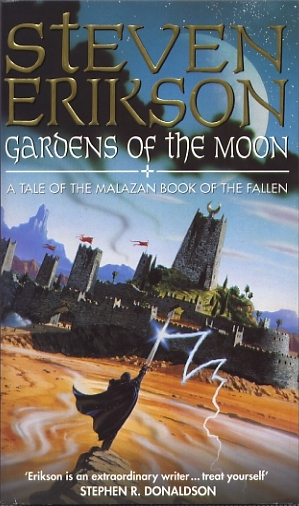
MBotF reread: "Gardens of the Moon" by Steven Erikson

It is almost a week since I finished "Gardens of the Moon", but I have been somewhat busy lately, so only now did I found time to write this post.

Following "Malazan Reread of the Fallen" on Tor.com is having one side-effect I haven't counted on. I felt like I have read this book only couple of months ago, so reading it again didn't have the same potency as usual. Thankfully, I am almost on the point of outrunning the Tor-reread, which is now somewhere after the beginning of second half of "Deadhouse Gates". I don't feel like doing a complete review of 12 years old book; there are countless good reviews out there. I will just note a few of my comments and opinions.

(First time seeing this cover)

This is the first book in the series and it was written almost 10 years before it was published, and it that time Erikson couldn't be sure this would be accepted as series. Nevertheless, book doesn't have the feel of being a stand-alone novel (contrary example: "Wizard's First Rule"; transition to its sequel doesn't feel natural at all and is very abrupt). Instead, thank to Erikson style, it give a feel of being plunged in the middle of long-running series. Erikson doesn't explain many things in the first run; he throws a bunch of information at readers, and then explains it layer by layer (and by layer and by layer).

This book, as whole series, is very complex, multi-layered and overwhelming book. It introduces few dozens of characters (I mean the important ones...), three continents, several human and non-human races, one of the most complex magic systems ever, real-life-like politics. But as I said, this if only the first book in series. Later books only get more complex and full. And the content of it: you name, you got it. Demons: checked. Sorcery and wizards: checked. Fighting and armies: checked. Gods and religion: checked. Mystery: double and triple checked...

I actually can't find anything bad to say about it. Only objection one could name about it, is that it can be too complicated for some readers. Not everybody likes their books this complex. But for those who like multiple plots and POVs, epic, gray-morality, etc. will be thrilled by this book. If you don't like it, don't even try its sequels; if anything, they are even more Malazan!

Saturday, January 22, 2011

Movie review: "Season of the Witch"

Last weekend girlfriend and I decided to go to cinema, and between "13" and "Season of the Witch" we picked the later. I don't usually like Nicholas Cage's movies, but it turns out this wasn't so bad after all.


First scene of the movie is very realistic and violent scene of hanging and drowning of three witches. During night, one of them comes back to life and kills the priest responsible for it. Then we are switched to a completely different scenery. In this movie, Cage plays Behmen and Ron Perlman plays Felson. They are buddy-buddy pair of knights, fighting infidels in the Crusades. After a massacre of civilians, they are sickened by war, and especially by Church which preaches the war as just and holy. They dessert and start a journey to their homes, but they get caught eventually, in a town besieged by plague. In fact, whole country is plagued. They are offered freedom in exchange for transporting a young women accused of being a witch and a source of the plague, to a remote monastery. Disappointed by Church, they decline at first. But Behmen thinks girl innocent and abused by Church, so he decides to escort her, hoping she will get a fairer trail in the monastery. A company is assembled and thus the journey starts...

First part of the movie is nothing exceptional, but it is done decently good. Cage and Perlman make a funny pair (I was reminded of Gibson-Glover relationship from "Lethal Weapon" series) and they don't look stupid at it. Atrocities of the war and its consequences are shown very solid and convincing. But journey, the middle part of the movies is really good! We are shown some very confronting facts and everything is left to audience's imagination. You can't be sure what is really going on and who is good and who bad. Very mysterious! There are few especially good and intense scenes (the maze, the bridge and the wolves). Until the end you are left to wonder...

...And then comes the end which leaves nothing to imagination, which sucks. It is not a bad ending; it is very emotional and intense. But after all those psychological games that left me in guessing what's going on, they reveal it all. And final bad guy feels a bit stupid and unimaginative. I would prefer ending being left undecided and mysterious, and then this would be really great movie. The positive side would be that ending is surprising; I don't think many persons would guess it.

In the end, "Season of the Witch" is a nice movie, with somewhat spoiled ending. But definitely a nice way to spend an evening, especially if you like fantasy.

Monday, January 3, 2011

Anime review: "Ayakashi - Japanese Classic Horror"

I stumbled across this anime few times before, but first time I seriously considered watching it was after watching "Mononoke". AniDB article about it claimed it shared one of the characters. It is relatively short (11 episodes), so I watched it last week, between "Daggerspell" and "Stonewielder" (post about it will be next).

"Ayakashi - Japanese Classic Horror" is 2006 anime adapting three Japanese classic horror stories. The three are completely different in setting and style, even in animation, so I will describe each of them separately.


"Yotsuya Ghost Story" is based on "Yotsuya Kaidan", Japanese most famous ghost story (at least according to Wikipedia). It is a tragical story about Iemon and Oiwa. Iemon is a ronin who wants to marry Oiwa, despite opposition from her father. He slays him and then uses his death as a mortar for his marriage, claiming he will help Oiwa as a husband to revenge her father. Everything is well for some time, but slowly Iemon's true face starts to show. He finally abandons Oiwa for richer and younger woman, who poisons Oiwa. This is the start of tragedy where everyone connected to two of them will end dead. Iemon refuses to admit any guilt and slowly sinks into madness, seeing Oiwa everywhere. There is also a parallel tragic story, about Osuda and Yomoschichi, which is interwoven with the first plot.

Story is interesting but not especially original. Probably you even saw it or parts of it, since it was adapted and partly used numerous times. It is not really scary also. Animation is decent, although looking older than 2006. Most interesting details it the way it is represented: story is narrated by the "original" author of the story, who claims he was inspired by Oiwa's ghost to write it. He also claims that the story is cursed and everybody who takes part in screening, acting or writing it ends dead.


"The Legend of Tenshu" is completely different kind of story. It is a love story between Himekawa Zusho-no-Suke, a young falconer, and Tomi-Hime, ruler of Forgoten Gods, kind of powerful and scary demons that feed with human flesh. This a complete mini-anime and I am wondering why is haven't been expanded to full-sized anime. It even has comedy-relief characters. Story is interesting and tense; there is action, comedy, romance... Again, animation is a bit weak, and design of characters could have been more original. But story is definitely good.


Last, "Bakeneko" is a star of this collection. It features the medicine-seller from "Mononoke" in one more exorcism adventure. Or better to say, this is the original story, that was later extended to whole series. It has original animation, original characters and great story. I loved it. This was only really scary story; not in visuals, but in setting and style. For those who didn't watch "Mononoke"; don't be put off by seemingly archaic animation. Definitely a recommendation!

My next post will be about "Stonewielder" by Ian C. Esslemont.

Friday, October 8, 2010

Anime review: Box of Goblins

After giving up on "K-On!!" I switched to "Box of Goblins". It is a 2008 anime which I had in my wishlist for some time, but never gave it much thought. I decided to watch it because I wanted something serious and short. It turned out this was a big score!


It's hard to define "Box of Goblins". In first episode we are introduced to two high-school girls. One, Kanako, is a captivating and popular, while other, Yoriko, is not. But for some reason Kanako befriends Yoriko, and so Yoriko starts to practically worship her. There is a lot of talk about reincarnation, past lives and future and so on. It gave me completely different fell of the anime than I expected. Then, a crime happens and Kanako ends up almost dead. This is where the action starts.

Show is quite a mix. It starts with philosophical mussing of a teenage girl, but then changes to a detective story. Then to supernatural mystery based on Japanese mythology. And then again to science fiction action... But it does so in such a great way that all feels natural. Show is broken in different POVs and in between we have slices of history (probably imagined, but looking realistic) that gives it a feel of real-life story. It has a resemblance to "Aoi Bungaku" series, because it happens in first half of 20th century (after WWII, which is important) and has that creepy mood, dark tones and surreal scenes. But it also has something of a Frankenstein novel (you will see why if you bear till the end).

We have a moderately large cast of some dozen important characters. What is peculiar that some of the main character got introduced only after half of the show. All characters are interesting. For some we get a nice characterization, realized from one side by inner monologue and from other by psychology analyze by others. While other character are just shown from the outside and we don't know anything of their history or motives. I hope for more series revolving around these characters, because two of them (exorcist and private detective) have great potential. I just checked Wikipedia: anime is based on a novel, and there is a series of novels by same author (Kyogoku Natsuhiko) with one of them a main character.

Visually, it's quite strong and realistic. The same is true for audio. And it has to be pretty good for me to notice it.

Anyway, I'm quite surprised that this "Box of Goblins" is not more famous. Although, first episode can be something of a turn-off, but after second and third, you should be already hooked up on this great fantasy-SF mystery-history mix. Definitely an anime for all fans of seinen and mystery shows.

Monday, August 9, 2010

Manga review: Naruto

Wow, this took me longer that I thought it will, almost three weeks! On the other hand, it has more than 500 chapters for now (505th was the last I've read so far), most of them 16 pages or more, it's no wonder. Include with that the fact that I've read it on-line (Narutofan.com), so it takes time to load it...


I have a special attachment to "Naruto". It is the first anime I watched when I started regularly followin anime several years ago. Before that, I watched only "Dragon Ball" (original and Z), "Sailor Moon" and "Hellsing" randomly and on TV (except "Hellsing", I got that on DVD). I really got into anime after getting "flat" (unlimited monthly bandwidth) and discovering wonderful world of torrents.

I don't really remember why I picked "Naruto", but it showed as a good decision. Unlike "Bleach", which I liked for first 50 episodes and later it became repetitive and boring, I find "Naruto" still interesting and watch it regularly. After original 135 episodes of "Naruto", I actually watched some 30 episodes, before really understanding what "filler" means. And then came "Naruto Shippuuden" with its super-slow episodes; I'll  always remember the fight with Sasori, which took some 6 or 7 episodes. But now I really like this anime, and judging by manga, there will be some really interesting stuff in future.

Let's get back to the review. First, "Naruto" is shounen action manga (and anime) about ninjas. Author of the manga, Kishimoto Masashi, is a fan of Toriyama Akira, author of "Dragon Ball", so I think that those who liked "DB" will like "Naruto", also (at least, that was the case with me). Manga features an imagined world, consisting of several countries, where each (or at least the bigger ones) has a ninja village. Ninjas perform various tasks (missions), for their sovereign lords, citizens of their own country, or even for foreigners. In case of war, they serve as army. Series is not based on real ninjas; you can expect "magical" skills, talking animals, super-strength and super-speed, etc. As this is shounen manga, it doesn't encumber with "smaller" details: existence of electricity, uncommon political situation or other things like that. Instead, this series focus on interesting fights (and unique skills of characters) and passionate and emotive relationships; primary, the friendship between two main characters, Naruto and Sasuke.

Main character of this anime is Uzumaki Naruto. At the beginning of the show, he is some 12 years old student in ninja academy. His main interests are making pranks on teachers and creating troubles; also, he's poor at ninja skills and has no friends. Reason for him being alone is that at the day of his birth, his village (Konohagakure) was attacked by super-strong demon fox. To prevent destruction of the village, Naruto's parents sacrificed themselves and sealed the fox inside him. For some "reasons", this is kept as secret from Naruto and kids his age and younger. Of course, all the adults know the truth (at least partially) and they ostracize Naruto because of fear, anger or grief. Naturally, kids take after their parents, so Naruto is left friendless (except his teacher Iruka).

But Naruto is not too depressed with his fate; instead, he dreams of becoming a Hokage (leader of his village and strongest ninja there). That was, all villagers will be forced "to acknowledge" him (I stress this because this is the main theme of first part of series). In the meantime, he uses his pranks as a way of getting attention. Soon after the graduation at academy, he will be joined in team with two of his classmates: Sasuke and Sakura. Sasuke is a boy from renowned ninja-family of Uchiha, best student of the year (two of them are joined because the school tries to make balanced teams - Naruto is the worst one). Sakura is a normal girl, excelling in theory of ninja skills, but unremarkable in practicing them. She is also infatuated with Sasuke (as every other girl in class); in same time, she is Naruto's love interest. Even though three of them don't have much in common, after first mission they will develop bonds that will form their later lives.

As I mentioned in one of my previous posts, I always find hard to review a long-running manga. And "Naruto" is really long-running. With five hundred chapters it's the longest manga I ever read. In anime adaptation, it has around 250 original episodes and some 100 filler episodes, and anime has quite a lot to catch up with manga. My meaning is that it's hard to write about story because I can't write only about beginning of the story which is only an introduction (that would be meaningless because story changes after a while), but also I can't write about later stages that are important (at least, not without revealing spoilers). So, I will just say that "Naruto" actually HAS a story, as opposed to "Bleach" and "Dragon Ball". I am mentioning these two again for two reasons: I watched them; and they would be "Naruto's" direct competitors. As I understand it, there is also "One Piece", but I haven't watched or read it. "Dragon Ball" doesn't have an overall story - it just a "new opponent-new training-new fight" pattern. "Bleach" has some kind of story, but I think it's just a cover for same patter as in DB. Again: "Naruto" has a story. It is not a masterpiece of storytelling, but it is there. It is a story about friendship between Naruto and Sasuke; about picking the hard choices and not relenting. I also has many other motives and themes, but you will have to read it (or watch it) for yourself.

On the other hand, "Naruto" IS a shounen action series about ninjas. As I mentioned before, the world is nicely imagined, with no irritating flaws. There are lots of characters, but they are divided in groups (check "Cast Herd"), so it's not hard to follow who is who. Each character will have its own unique powers and skills and they are quite original. Meaning, they are not just a fifth variation of the same power - each have its place and rules. Characters are mostly well done (no one irritated me or made me lose faith in author's taste) and unique. Series has a lot of funny moments and inside-jokes; it made me laugh often. Fights are very good, dynamic and intense. They are not like second World Martial Arts Tournament in DB (which almost made me cry) or Goku vs. Freeza fight, but "Naruto" has its moments.

As I read manga after I watched anime, I noticed that I actually like anime version better. Despite the fillers, anime takes time to broaden and elaborate situations, without inserting unnecessary elements (if you ignore fillers). That was mostly evident after I passed events that are serialized in anime. Manga brings distilled events and skeleton of the story, but I think I will enjoy it in full really after watching the anime. But I will have to wait awhile for that.

And now, the final conclusion. In my opinion, if you are in search for long-running fighting shounen series and have even remote interest in ninja, I think you will like "Naruto". If you watched and liked "Dragon Ball", you will like "Naruto" (maybe even more; I did). If you are reading manga, then it's OK. But if you start watching anime and you don't become a fan (as me), I would advise you to find out which episodes are fillers, if you don't want to completely lose interest in series. For original episodes, fillers start after 135th episode. And for "Shippuuden", check this.

Also, allow me to recommend an anime that I found better that both "Naruto" and "Bleach". It's "Kekkaishi", a shounen action anime about young boy exorcising evil spirits. Unfortunately, it has only 52 episodes, but series is still ongoing, so I hope for more.

Tuesday, July 6, 2010

Manga review: xxxHolic


I always find it hard to review manga, because all those manga I have read were longer ones. It is much easier to review a single anime season or a single book as a part of series. In longer runs, books/anime/manga introduce new elements to the story, new characters and so on...Then you have to either summarize the plot too much or reveal spoilers.

For example, "Buffy the Vampire Slayer" TV series. It has been quite long ago that I watched it, but if I remember correctly, first season or two consist mostly of single episodes (with no connection to others). It is only in later seasons that we are introduced to longer stories, encompassing multiple episodes or even seasons.

Why am I talking about this? Because "xxxHolic" is similar to "Buffy" (or "Angel" and any number of other action series) in that way. Story follows Watanuki Kimihiro, a high-school boy who is living alone, because his parents are dead. And why he is so special that he deserves a manga? Because he is able to see ayakashi, yokai and other paranormal beings that most people are unaware of. More so, he somehow draws these creatures to himself and is often forced to flee from them. This is about to change when he "accidentally" runs into shop run by mysterious Yuuko. She explains him that she is a witch who grants wishes and that only those with a wish are able to come into her shop. More, she is willing to grant him his wish to release him from curse of drawing ghosts to him. As a pay, he will work part-time in her shop after school, as a cleaner and a cook, until he pays of his debt.

His life won't get much peaceful after that. From one side, he will have his hands full with chores at the shop. On the other side, he will often be forced to help Yuuko with granting the wishes, which are mostly paranormal and mystical in nature. Connection with Yuuko and his abilities will also make him something of a "celebrity" in the spirit-world.

In his adventures, he will often be joined with Doumeki Shizuka from his school. Their relationship is quite complicated (and is often used as a source of comical relief). Watanuki can't stand Doumeki from the time of their first encounter and at the sight of him (encouraged by Doumeki's superior attitude toward him) becomes irritated (in comical way), but for some reason, other people think they are best friends. He will have to accept Doumeki as a part of his life when he finds out that Doumeki, even though can't see spirits, have an ability to exorcise them. One of people who think that Watanuki and Doumenki are great friends is Himawari Kunogi. She goes to the same school as the two of them and is also Watanuki's (not-so) secret love. She will also be drawn in Watanuki's supernatural adventures.

As I said, story at first consist of unconnected "episodes", where Watanuki helps Yuuko to grant various customer's wishes, mostly in detective-style, trying to find the source of their misfortune. He (and Doumeki, and in minor way Himawari) will learn more about the spirit world, its strange inhabitants and even more stranger rules. In later episodes, the true story will begin to unravel. And this story is really epic in its scope.

Unfortunately, reader will never learn it complete. That is, if he/she doesn't read "Tsubasa Chronicle". This manga (also adapted to anime as "xxxHolic") is connected with this in some smaller part of the story. But it is actually this minor part that is crucial for understanding events in later parts of the series. It turns out that main characters of "Tsubasa" are "important customers" of Yuuko; even more, main male character from "Tsubasa" has a complicated connection to Watanuki.

All in all, although it sounds confusing (and it is, unless you read both manga), this is actually very nice manga. "Cases" they solve (or wishes they grant) are mysterious and often based on human psychology. This is also very funny manga. Most jokes are based on Watanuki's character and his relationship with Doumeki. Also, it has very complex and detailed world, based on Japanese mythology (though I can't be sure how much of that is "real" mythology and have much have authors imagined themselves). Also, almost every chapter features some original Japanese dish, for those who like food reference (I do).

Main characters, especially Watanuki and Doumeki are great. They are much idealized, but they also have their own weaknesses. Yuuko is very intriguing character; she is also mean sometimes, especially toward Watanuki, which is always funny. Himawari is one of the main characterc, but mostly passive, occasionally giving advice to Watanuki's or serving as his object of love. There is also a lot of side characters, most of them from the spirit world.

Design of characters is unique CLAMP's, meaning unnaturally tall and elongated characters. Everybody looks nice, even the occasional bad guys.

As bad side of series, I would single sometimes confusing dialogs: conversations often wander into metaphysical discussions and have many jumps. And also, separating the stories between two series ("xxxHolic" and "Tsubasa") means you have to read both manga. And if you don't like "Tsubasa" (like I don't), you have a choice to be unaware of some important parts of the plot or to force yourself to read something you don't really like.

In short, very nice manga appropriate for both younger and older audience, also for readers of both genders. It has nice story and funny jokes, interesting world and complex characters. Sometimes a bit confusing, but a good choice if you are looking for intelligent, non-action manga.