While I was writing a list of epic fantasy series, I had to browse through all my posts, so I noticed how many good anime I watched last year and the one before that. Compared to them, this is a poor year.
I can't say that I haven't watched anything good. "The Flower We Saw That Day" was a very good anime, but it was not really great, and it was somewhat short. "Fate/Zero 2012" was interesting and intense, but it was just an action anime, suitable for losing few hours, but not something to make you ponder (and it was a direct continuation of last year anime, so I am not sure it counts). "Daily Lives of High School Boys" was good, for a slapstick comedy, but I forgot about it the next day. I had big hopes for "Nisemonogatari", and although it was good, even great in some aspects, it didn't reach the quality of "Bakemonogatari"
I think I can freely say that so far this year haven't provided anything legendary, as were "Durarara!!", "Katanagatari", "Tatami Galaxy" or bunch of other anime in past years. Is there anything else I can hope for in next few months?
Well, there is "Sakamichi no Apollon", which looks like it could be impressive, as I usually find josei titles. I plan to watch it soon, maybe even this month. "Bakuman (2012)" will start coming out in October, but I can't count this as this year' hit (it's a third season, and I will extend into 2013) nor is it so good. Except this two, the only thing that looks like it could be of real worth is "Mardock Scramble", which last part is coming out this month - I didn't watch the first two, but this sounds interesting.
All in all, this is a anime poor year - there is no anime that I will remember in several years and say "Wow! That was a great anime! I must watch it again!". But I hope that I will dig something up next year, when reviews and ratings on AniDB settle a bit.
Monday, September 3, 2012
Sunday, September 2, 2012
Epic fantasy series list: What is out there - part 1
I have been thinking about this post for some time now, but somehow I would always fail to find time to finish it. But since I am on vacation now and have some spare time, I decided to give it a go: a list of epic fantasy series I know something about.
First I want to make a clarification. Wikipedia defines epic or high fantasy like this. Also, there is a list of high fantasy novels here. I agree with these definitions and lists in most points, but disagree in some. For example, I would never characterize Discworld series or R. A. Salvatore's Drizzt Do'Urden (which is now missing from the list, but I was there before) or any other Forgotten Realms books as such. I really love some of these books, but they are not epic. They miss that sense of drama and end-of-the-word feeling. I would make distinction between epic and high fantasy - high fantasy is just fantasy that is complex, held strictly to magical systems, depicts setting and characters in realistic and believable manner.
Anyway, even though this post it titled "Epic fantasy series", I don't intend to hold strictly to any conditions and definitions. This is just a list of books and series I would recommend to someone who would ask for some good epic fantasy series. Some of them I have read whole, some just few books, and some I just heard of or read about. But I hope this list will help some fan deciding what to read next.
First mention must be dedicated to "The Lord of the Rings" by J. R. R. Tolkien. Maybe people will disagree with me, but I think that you can't be an epic fantasy fan if you haven't read and don't at least respect LotR. I can understand claims that there are better new series, that you like some other writers more, that it has flaws, but it this defining work of epic fantasy doesn't tickle you enjoyment glands, that you are not a fan! Tolkien wasn't the first; he didn't invent elves, orcs and dwarves; but he did what Microsoft did to PCs during 90s - made them popular and available to the common people. I don't think I need to describe what "The Lord of the Rings" is about - if you already don't know, than you have lived in a cave for past 10 years and you will not read this blog in any case. But it is sufficient to say that if you like any number of books from this list, and haven't already read LotR, then do it - you will not regret. You will find here the epic struggle between noble heroes against ugly and dark adversaries; noble elves, sturdy dwarves and feral orcs; magical rings, wise wizards and buried monsters; tragedy, love and epic battles... When I think about it, I haven't read it for almost ten years - maybe it's a time for a new reread.
Now we can continue with the "big three" - my three personal favorites.
"A Song of Ice and Fire" by George R. R. Martin is mentioned first simply because I have read it first of the three. And I read it first simply because it was one of few modern fantasy series translated to the Croatian. This can be your first clue, a simple economic law - only the most popular work get translated to such a number of languages that it include Croatian. aSoIaF is in a way the new tLotR - not in contents, but in its popularity, first between hard-core fans, and now with even non-readers - by mega-popular HBO TV show "Game of Thrones". In contents, aSoIaF and tLotR could not be more different. "A Song of Ice and Fire" features more politics than magic; characters and society real enough that they sound like they are from some history book; intrigue, political machinations and sex. But there is a more profound difference: the grey morality. As you continue toward third and further books, you will realize that there are no characters that are good or evil: they are just people, some weak, some strong, some sick, they try to their best in a world not really benevolent to them. Other differences include grittiness, recognizing the fact that people have bodily functions (like going to toilet or having sexual urges), equal importance of men and women (but acknowledging their different roles in medieval-like society). On the other hand, Martin is not always easy to his characters or reader. Main characters will die never to return; characters that you like and cheer for will be put to unexpected levels of hardship; characters you believed weak and evil will later be portrayed with sympathy and recognition. The last book so far, "A Dance with Dragons", really surprised me with amount of explicit violence and unexpected turns of the plot. But if you like big books (big by volume, complexity and content), this is one of the books for you. There are five books published, and two more announced, although it is possible (in my opinion) that there will be a few more.
ASoIaF reread: "A Game of Thrones" and "A Clash of Kings
ASoIaF reread: "A Storm of Swords" by George R. R. Martin
ASoIaF reread: "A Feast for Crows"
Book review: "A Dance with Dragons" by George R. R. Martin
Just started a re-read of "A Song of Ice and Fire" by George R. R. Martin
Comment: "Game of Thrones" TV show
TV show review: "Game of Thrones"
TV show review: "Game of Thrones", second season
"The Wheel of Time" by Robert Jordan is a series that for the long time I would pinpoint as the one that I liked the most. Not the best one, but most likable. It is a first series that I have read when I started buying book from Amazon and reading on English, so I presume I will always have some special connection to it. WoT is a shift from aSoIaF to LotR again: a somewhat classical epic story about clash between Light and Dark, in a fantasy world with kingdoms, Princes and Princesses, magic and sorceresses, whose main cast is young people unaware of their great destiny (shepherd becoming the King and the Savior); lots of romance and romantic notions. I liked it because it has tons of characters and millions of little details that almost in no way contradict each other and make a very complex setting and history. There is a lot of magic which plays a large role in the setting (contrary to the aSoIaF where magic is almost nonexistent, especially in first few books), and the magic system is also very complex. Characters are very likable, especially the main few dozen (jokingly), and funny. Much of this humor is based on male-female differences and "differences" and Jordan was fond of making strange social relationship between them. Readers objected this series' tectonic pace and a large number of plots and subplots - I on the other hand, like this series specifically for these reasons. These objections are now partly nullified since most of the book are now out (last book is coming out this winter), so a new reader doesn't have to wait several year for next book only to find out that his favorite characters is not even in it. Another important this is that unfortunately Robert Jordan passed away from illness before writing what was supposed to be that last, twelfth book. But he left a mountain of notes, so his widows selected another writer, Brandon Sanderson, to finish the series. He split this last book in three, and successfully finished two of them, while the last one ("A Memory of Light") will be coming out next year. I would recommend this series to everybody who likes their epic fantasy Tolkienesque and romantic, especially to teenager fans.
Not a Book review: "Crossroads of Twillight" and "Knife of Dreams" by Robert Jordan
Book review: "The Gathering Storm" by Robert Jordan and Brandon Sanderson
Book review: "Towers of Midnight" by Robert Jordan and Brandon Sanderson
"Towers of Midnight" frenzy
Not lucky!
"Malazan Book of the Fallen" by Steven Erikson is a series that I would probably pick as my current favorite, if I was forced to. This is probably the most ambitious and audacious fantasy series I have read so far (SF has galaxy-spanning series that I would say sound more ambitious, but that is SF). This series was finished this year and has in total 10 books. But there are additions in form of books by Ian C. Esslemont who writes side-stories in this setting (they created this setting together; by the way, don't read Esslemont until you become a fan of MBotF, he's not as good as Erikson), some smaller humorous side-stories written by Erikson, and a new prequel trilogy call "Kharkanas Trilogy" by Erikson himself (which is easily as good as original MBotF). This series is great in all points: setting, story, characters and writing. The setting spans hundreds of thousands of years in past of the series' present, it has several large continents and numerous magical "warrens" (I am in lack of single-word description for warren). Erikson is a professional archaeologist and anthropologist, and this is strongly felt in his books: while other writers have races and nations, he has cultures! But the most impressive thing about this setting is that, in 10 and more books Erikson painted and implied only the borders of its portions, and filled marvelously only some of them. If he was willing, I believe that he could write at least two dozens more of books in this setting, revealing only what he suggested in his first books (something like Esslemont has been doing). Story is brilliant and complex; so complex that even though I have read most of the books several times, I can't explain what and why really happened in full extent - you just have to read it for yourself. There is action, war, epic battles, personal duels, mystery, intrigue, history, politics - you just name it and there it is. And characters... Well, there are a lot of them: I think there are certainly at least a hundred with POV and several hundred named characters. Erikons is fond of giving to even unimportant and unnamed characters unique and believable personality; he is also fond of random villagers revealing the truths of life. And his main characters (all hundred or so) are simply brilliant: some are artist and philosophers; others are lowly and gritty soldiers, while some are wild and "stupid" barbarians. But they are complex and life-like - Erikson is at same level with Martin when it comes to "grey characters" (hello Kallor) and I don't think I can name a single evil characters in this series. Be careful, for Erikson will make you fill pity for even the scariest and brutal sociopath. While I consider his writing one of his best points, it will put off a lots of readers, especially if the endure till later books. Erikons is a great philosopher and his characters will spend several pages thinking about themselves and world, asking fundamental questions of both, but not moving plot a single pace. He will make you wonder about life and death, why some people suffer and what is the nature of death, loyalty, passion... This series is quite gritty and violent - one of the recurring themes is that "children die". This is especially true for later books, when Erikson will make some of his characters go through unimaginable stresses and tortures. On the other hand, his books are extremely humorous and he has written some of the funniest characters I ever met (yes, Pust, I am talking about you). Although I spent last 3000 characters praising Erikson, his books are not for all. If you expect some light fantasy to relax you for couple of hours, these are not for you. Erikson asks for your attention, you will probably be forced to read the series at least twice, and it will often make you question yourself and your philosophy. But if you like this stuff, think yourself a power-fan of epic fantasy, or think that R. Scott Bakker is OK, please try "Malazan Book of the Fallen".
I first planned for this to be a single post, but now I see that it has grown even though I just started. So, a change of plans: I will be splitting it in several posts.
First I want to make a clarification. Wikipedia defines epic or high fantasy like this. Also, there is a list of high fantasy novels here. I agree with these definitions and lists in most points, but disagree in some. For example, I would never characterize Discworld series or R. A. Salvatore's Drizzt Do'Urden (which is now missing from the list, but I was there before) or any other Forgotten Realms books as such. I really love some of these books, but they are not epic. They miss that sense of drama and end-of-the-word feeling. I would make distinction between epic and high fantasy - high fantasy is just fantasy that is complex, held strictly to magical systems, depicts setting and characters in realistic and believable manner.
Anyway, even though this post it titled "Epic fantasy series", I don't intend to hold strictly to any conditions and definitions. This is just a list of books and series I would recommend to someone who would ask for some good epic fantasy series. Some of them I have read whole, some just few books, and some I just heard of or read about. But I hope this list will help some fan deciding what to read next.
First mention must be dedicated to "The Lord of the Rings" by J. R. R. Tolkien. Maybe people will disagree with me, but I think that you can't be an epic fantasy fan if you haven't read and don't at least respect LotR. I can understand claims that there are better new series, that you like some other writers more, that it has flaws, but it this defining work of epic fantasy doesn't tickle you enjoyment glands, that you are not a fan! Tolkien wasn't the first; he didn't invent elves, orcs and dwarves; but he did what Microsoft did to PCs during 90s - made them popular and available to the common people. I don't think I need to describe what "The Lord of the Rings" is about - if you already don't know, than you have lived in a cave for past 10 years and you will not read this blog in any case. But it is sufficient to say that if you like any number of books from this list, and haven't already read LotR, then do it - you will not regret. You will find here the epic struggle between noble heroes against ugly and dark adversaries; noble elves, sturdy dwarves and feral orcs; magical rings, wise wizards and buried monsters; tragedy, love and epic battles... When I think about it, I haven't read it for almost ten years - maybe it's a time for a new reread.
Now we can continue with the "big three" - my three personal favorites.
"A Song of Ice and Fire" by George R. R. Martin is mentioned first simply because I have read it first of the three. And I read it first simply because it was one of few modern fantasy series translated to the Croatian. This can be your first clue, a simple economic law - only the most popular work get translated to such a number of languages that it include Croatian. aSoIaF is in a way the new tLotR - not in contents, but in its popularity, first between hard-core fans, and now with even non-readers - by mega-popular HBO TV show "Game of Thrones". In contents, aSoIaF and tLotR could not be more different. "A Song of Ice and Fire" features more politics than magic; characters and society real enough that they sound like they are from some history book; intrigue, political machinations and sex. But there is a more profound difference: the grey morality. As you continue toward third and further books, you will realize that there are no characters that are good or evil: they are just people, some weak, some strong, some sick, they try to their best in a world not really benevolent to them. Other differences include grittiness, recognizing the fact that people have bodily functions (like going to toilet or having sexual urges), equal importance of men and women (but acknowledging their different roles in medieval-like society). On the other hand, Martin is not always easy to his characters or reader. Main characters will die never to return; characters that you like and cheer for will be put to unexpected levels of hardship; characters you believed weak and evil will later be portrayed with sympathy and recognition. The last book so far, "A Dance with Dragons", really surprised me with amount of explicit violence and unexpected turns of the plot. But if you like big books (big by volume, complexity and content), this is one of the books for you. There are five books published, and two more announced, although it is possible (in my opinion) that there will be a few more.
ASoIaF reread: "A Game of Thrones" and "A Clash of Kings
ASoIaF reread: "A Storm of Swords" by George R. R. Martin
ASoIaF reread: "A Feast for Crows"
Book review: "A Dance with Dragons" by George R. R. Martin
Just started a re-read of "A Song of Ice and Fire" by George R. R. Martin
Comment: "Game of Thrones" TV show
TV show review: "Game of Thrones"
TV show review: "Game of Thrones", second season
"The Wheel of Time" by Robert Jordan is a series that for the long time I would pinpoint as the one that I liked the most. Not the best one, but most likable. It is a first series that I have read when I started buying book from Amazon and reading on English, so I presume I will always have some special connection to it. WoT is a shift from aSoIaF to LotR again: a somewhat classical epic story about clash between Light and Dark, in a fantasy world with kingdoms, Princes and Princesses, magic and sorceresses, whose main cast is young people unaware of their great destiny (shepherd becoming the King and the Savior); lots of romance and romantic notions. I liked it because it has tons of characters and millions of little details that almost in no way contradict each other and make a very complex setting and history. There is a lot of magic which plays a large role in the setting (contrary to the aSoIaF where magic is almost nonexistent, especially in first few books), and the magic system is also very complex. Characters are very likable, especially the main few dozen (jokingly), and funny. Much of this humor is based on male-female differences and "differences" and Jordan was fond of making strange social relationship between them. Readers objected this series' tectonic pace and a large number of plots and subplots - I on the other hand, like this series specifically for these reasons. These objections are now partly nullified since most of the book are now out (last book is coming out this winter), so a new reader doesn't have to wait several year for next book only to find out that his favorite characters is not even in it. Another important this is that unfortunately Robert Jordan passed away from illness before writing what was supposed to be that last, twelfth book. But he left a mountain of notes, so his widows selected another writer, Brandon Sanderson, to finish the series. He split this last book in three, and successfully finished two of them, while the last one ("A Memory of Light") will be coming out next year. I would recommend this series to everybody who likes their epic fantasy Tolkienesque and romantic, especially to teenager fans.
Not a Book review: "Crossroads of Twillight" and "Knife of Dreams" by Robert Jordan
Book review: "The Gathering Storm" by Robert Jordan and Brandon Sanderson
Book review: "Towers of Midnight" by Robert Jordan and Brandon Sanderson
"Towers of Midnight" frenzy
Not lucky!
"Malazan Book of the Fallen" by Steven Erikson is a series that I would probably pick as my current favorite, if I was forced to. This is probably the most ambitious and audacious fantasy series I have read so far (SF has galaxy-spanning series that I would say sound more ambitious, but that is SF). This series was finished this year and has in total 10 books. But there are additions in form of books by Ian C. Esslemont who writes side-stories in this setting (they created this setting together; by the way, don't read Esslemont until you become a fan of MBotF, he's not as good as Erikson), some smaller humorous side-stories written by Erikson, and a new prequel trilogy call "Kharkanas Trilogy" by Erikson himself (which is easily as good as original MBotF). This series is great in all points: setting, story, characters and writing. The setting spans hundreds of thousands of years in past of the series' present, it has several large continents and numerous magical "warrens" (I am in lack of single-word description for warren). Erikson is a professional archaeologist and anthropologist, and this is strongly felt in his books: while other writers have races and nations, he has cultures! But the most impressive thing about this setting is that, in 10 and more books Erikson painted and implied only the borders of its portions, and filled marvelously only some of them. If he was willing, I believe that he could write at least two dozens more of books in this setting, revealing only what he suggested in his first books (something like Esslemont has been doing). Story is brilliant and complex; so complex that even though I have read most of the books several times, I can't explain what and why really happened in full extent - you just have to read it for yourself. There is action, war, epic battles, personal duels, mystery, intrigue, history, politics - you just name it and there it is. And characters... Well, there are a lot of them: I think there are certainly at least a hundred with POV and several hundred named characters. Erikons is fond of giving to even unimportant and unnamed characters unique and believable personality; he is also fond of random villagers revealing the truths of life. And his main characters (all hundred or so) are simply brilliant: some are artist and philosophers; others are lowly and gritty soldiers, while some are wild and "stupid" barbarians. But they are complex and life-like - Erikson is at same level with Martin when it comes to "grey characters" (hello Kallor) and I don't think I can name a single evil characters in this series. Be careful, for Erikson will make you fill pity for even the scariest and brutal sociopath. While I consider his writing one of his best points, it will put off a lots of readers, especially if the endure till later books. Erikons is a great philosopher and his characters will spend several pages thinking about themselves and world, asking fundamental questions of both, but not moving plot a single pace. He will make you wonder about life and death, why some people suffer and what is the nature of death, loyalty, passion... This series is quite gritty and violent - one of the recurring themes is that "children die". This is especially true for later books, when Erikson will make some of his characters go through unimaginable stresses and tortures. On the other hand, his books are extremely humorous and he has written some of the funniest characters I ever met (yes, Pust, I am talking about you). Although I spent last 3000 characters praising Erikson, his books are not for all. If you expect some light fantasy to relax you for couple of hours, these are not for you. Erikson asks for your attention, you will probably be forced to read the series at least twice, and it will often make you question yourself and your philosophy. But if you like this stuff, think yourself a power-fan of epic fantasy, or think that R. Scott Bakker is OK, please try "Malazan Book of the Fallen".
Book review: "Forge of Darkness" by Steven Erikson
Book review: "The First Collected Tales of Bauchelain and Korbal Broach" by Steven Erikson
Book review: "Night of Knives" by Ian Cameron Esslemont
Book re-read: "Night of Knives" by Ian C. Esslemont
Book review: "Return of the Crimson Guard" by Ian C. Esslemont
Book re-read: "Return of the Crimson Guard" by Ian C. Esslemont
Book review: "Stonewielder" by Ian C. Esslemont
Book re-read: "Stonewielder" by Ian C. Esslemont
Book review: "Orb Sceptre Throne" by Ian C. Esslemont
"Dust of Dreams" - interlude
Just started a re-read of the "Malazan Book of the Fallen" by Steven Erikson
Is there no more Karsa?
Great review of "Malazan book of the Fallen" on SFsite
Book review: "The First Collected Tales of Bauchelain and Korbal Broach" by Steven Erikson
Book review: "Night of Knives" by Ian Cameron Esslemont
Book re-read: "Night of Knives" by Ian C. Esslemont
Book review: "Return of the Crimson Guard" by Ian C. Esslemont
Book re-read: "Return of the Crimson Guard" by Ian C. Esslemont
Book review: "Stonewielder" by Ian C. Esslemont
Book re-read: "Stonewielder" by Ian C. Esslemont
Book review: "Orb Sceptre Throne" by Ian C. Esslemont
"Dust of Dreams" - interlude
Just started a re-read of the "Malazan Book of the Fallen" by Steven Erikson
Is there no more Karsa?
Great review of "Malazan book of the Fallen" on SFsite
I first planned for this to be a single post, but now I see that it has grown even though I just started. So, a change of plans: I will be splitting it in several posts.


Sunday, August 26, 2012
Book review: "Hawkwood and the Kings" by Paul Kearney
I have encountered "Monarchies of God" series by Paul Kearney in a some review at SFsite.com some time ago, although I forgot most of the details. I had some vague impression of Hawkwood being a mercenary leader in Middle-Age based Europe with existence of magic. When Amazon.com started pumping my recommendation with historical fantasy books because I had "Hawkwood and the Kings" in my wish list, my interest somewhat dropped. But the series still had good reviews, there was some recommendation by Steven Erikson (I don't usually care about front-cover generic recommendations) and it was pretty short (only two omnibuses), I decided to give it a try.
I first planned to do two reviews, one for each books in the omnibus ("Hawkwood's Voyage" and "The Heretic Kings"), but when I started reading the second book, I realized that there is no real distinction between them - the plot goes on immediately. This is actually one book split in two (or more probable, five) chunks.

It is pretty hard to comprise the story of "Hawkwood and the Kings" in one paragraph. Even though these books are very short (416 pages for the whole omnibus), there is a lot of going on. These books are clearly based on 15th and 16th century Europe, during the Turkish Invasions and discovery of American continent. We have several unconnected plot lines viewed from different POVs that make a pretty detailed picture of the setting and the plot. But this is not a historical fiction - history is different, geography, mentality... And of course, this is the setting that contains things like magic, Thaumaturgies Guild, werewolves, homonculus... I again have to repeat that there is really much "meat" in plot for such short books.
A titular character of the first book, Richard Hawkwood, is a moderately successful sea-captain in Kingdom of Abrusio (based on Spain). He gets coerced (almost blackmailed) by a nobleman Murado to captain the voyage whose mission is to find the "West Continent" revealed in a sea-log in possession of Murado. But he doesn't know that this log reveals several prior voyages which all ended bad for those involved, and most of them included some connection to magic. To make their situation worse, King Abeley (another POV characters) forces them to pick a special cast of colonist: Dweomer folk (licensed Guild mages, herbal women, shapeshifters, soothsayers...) who recently got in problems when Ramusian Church (depicted upon Catholic Church) started a series of witch-hunts and prosecutions, most of them ending in burnings. Unofficial leader of this contingent of colonist becomes Bardoling, a capable but unassuming mage and ex-soldier, whose main wish is to protect his young associate, werewolf Griella. Young King Abeley is trying to do the most he can to protect his people, remove the yoke of Church from his government and at the same time help his fellow monarchs in the east who are being invaded by Merduks. Other characters include Corfe (deserting offices, flying from fall of Aekir after its capture by Merduks), Heria (his wife, captured by Merduks), Gollophin (mage adviser of King Abeley), Albrect (older librarian in Church capital of Chabrion, in possession of some interesting documents), Merduk Sultan and other... This is just a synopsis of the first book - I could not describe that of the second one without revealing spoilers; and anyway, as I said, these two books can be read as one.
Prime characteristic of this book, connected to its shortness, is its fast pace. There is really much going on; we have short chapters, each with few shifts of POV in between. So these books successfully grip your attention, if you are into this. At the beginning I was reminded much to Guy Gavriel Kay, especially to "The Lions of Al-Rassan" (one of my favorite books). But later differences start kicking in, and this becomes very distinctive book. I had some problems in the very beginning with warming up to this book, because it uses much of "naval talk" (I don't even want to start listing these words), and I am not into this kind of books (especially not in pirates). But as things start shifting to other focuses, I made the necessary adjustment and enjoyed the book. One of the best attributes of this book was its attention to politics - I really like this focus in books. And of course, it was not presented from just one side, so you have to weight your preferences on your own.
There are much characters in these book, too much to describe them in details. But each one is well written, with his/hers own agenda. These characters are sometimes on conflicting sides, and I really like when writer forces us to think about the sided on our own, instead preparing everything for reader by making a clear distinction on good and bad side. They are all complex, possessing multiple sides to their personality and you will not have any problem remembering who is who. But characters are also included in the biggest objection I had with Kearney's writing - and that is the lack of empathy and connection to characters. They are interesting, but hey all stay pretty remote and reader is somehow not included in their suffering. Also, one could complain about the lack of female characters in this book.
Writing is pretty good, except too much sailor-talk in several instances. It sounds like Kearney really looked into details he wrote about: sailing, guns, society... He focuses more on dialog and plot advancing than on descriptions of surrounding - but when he does, it is done properly. There is some humor in these books, arising mostly from the witticism of the characters, but the tone in overall is mostly darker. This is, I think, a book that can be enjoyed be various types of readers - they are short, but full of details; they are fast, but complex.
All in all, "Hawkwood and the Kings" is one very good book, especially if you like history-based books with lots of details and interesting plot. My biggest objection is its shortness, but I definitely plan to read and enjoy the second omnibus "Century of the Soldier".
I first planned to do two reviews, one for each books in the omnibus ("Hawkwood's Voyage" and "The Heretic Kings"), but when I started reading the second book, I realized that there is no real distinction between them - the plot goes on immediately. This is actually one book split in two (or more probable, five) chunks.

It is pretty hard to comprise the story of "Hawkwood and the Kings" in one paragraph. Even though these books are very short (416 pages for the whole omnibus), there is a lot of going on. These books are clearly based on 15th and 16th century Europe, during the Turkish Invasions and discovery of American continent. We have several unconnected plot lines viewed from different POVs that make a pretty detailed picture of the setting and the plot. But this is not a historical fiction - history is different, geography, mentality... And of course, this is the setting that contains things like magic, Thaumaturgies Guild, werewolves, homonculus... I again have to repeat that there is really much "meat" in plot for such short books.
A titular character of the first book, Richard Hawkwood, is a moderately successful sea-captain in Kingdom of Abrusio (based on Spain). He gets coerced (almost blackmailed) by a nobleman Murado to captain the voyage whose mission is to find the "West Continent" revealed in a sea-log in possession of Murado. But he doesn't know that this log reveals several prior voyages which all ended bad for those involved, and most of them included some connection to magic. To make their situation worse, King Abeley (another POV characters) forces them to pick a special cast of colonist: Dweomer folk (licensed Guild mages, herbal women, shapeshifters, soothsayers...) who recently got in problems when Ramusian Church (depicted upon Catholic Church) started a series of witch-hunts and prosecutions, most of them ending in burnings. Unofficial leader of this contingent of colonist becomes Bardoling, a capable but unassuming mage and ex-soldier, whose main wish is to protect his young associate, werewolf Griella. Young King Abeley is trying to do the most he can to protect his people, remove the yoke of Church from his government and at the same time help his fellow monarchs in the east who are being invaded by Merduks. Other characters include Corfe (deserting offices, flying from fall of Aekir after its capture by Merduks), Heria (his wife, captured by Merduks), Gollophin (mage adviser of King Abeley), Albrect (older librarian in Church capital of Chabrion, in possession of some interesting documents), Merduk Sultan and other... This is just a synopsis of the first book - I could not describe that of the second one without revealing spoilers; and anyway, as I said, these two books can be read as one.
Prime characteristic of this book, connected to its shortness, is its fast pace. There is really much going on; we have short chapters, each with few shifts of POV in between. So these books successfully grip your attention, if you are into this. At the beginning I was reminded much to Guy Gavriel Kay, especially to "The Lions of Al-Rassan" (one of my favorite books). But later differences start kicking in, and this becomes very distinctive book. I had some problems in the very beginning with warming up to this book, because it uses much of "naval talk" (I don't even want to start listing these words), and I am not into this kind of books (especially not in pirates). But as things start shifting to other focuses, I made the necessary adjustment and enjoyed the book. One of the best attributes of this book was its attention to politics - I really like this focus in books. And of course, it was not presented from just one side, so you have to weight your preferences on your own.
There are much characters in these book, too much to describe them in details. But each one is well written, with his/hers own agenda. These characters are sometimes on conflicting sides, and I really like when writer forces us to think about the sided on our own, instead preparing everything for reader by making a clear distinction on good and bad side. They are all complex, possessing multiple sides to their personality and you will not have any problem remembering who is who. But characters are also included in the biggest objection I had with Kearney's writing - and that is the lack of empathy and connection to characters. They are interesting, but hey all stay pretty remote and reader is somehow not included in their suffering. Also, one could complain about the lack of female characters in this book.
Writing is pretty good, except too much sailor-talk in several instances. It sounds like Kearney really looked into details he wrote about: sailing, guns, society... He focuses more on dialog and plot advancing than on descriptions of surrounding - but when he does, it is done properly. There is some humor in these books, arising mostly from the witticism of the characters, but the tone in overall is mostly darker. This is, I think, a book that can be enjoyed be various types of readers - they are short, but full of details; they are fast, but complex.
All in all, "Hawkwood and the Kings" is one very good book, especially if you like history-based books with lots of details and interesting plot. My biggest objection is its shortness, but I definitely plan to read and enjoy the second omnibus "Century of the Soldier".
Sunday, August 19, 2012
Anime review: "Seitokai Yakuindomo"
After finishing "Daily Lives of High-School Boys" several weeks ago, I noticed several comments recommending "Seitokai Yakuindomo" to those who liked the former. They also warned that it was an anime with high amount of sexual jokes, some of them pretty heavy, so it was not appropriate for those easily offended. Since there are currently no other anime I have set my eyes upon (except "Hyouge Mono", but nobody is doing the translation!!!), I decided to give it a try.

Identically to "Daily Lives of High-School Boys", "Seitokai Yakuindomo" is anime composing of several scenes/sketches per episode, something apparently called 4-koma style. Here we follow Tsuda Takatoshi who is just entering a high-school. The school he picked (because it was closest) was until this year all-girls school, so he is one of few boys there. On the first day he is selected by a presumptuous President of Student Council to be a new member, which will define the rest of his first-year. The Council consists of three other girls: President Amakusa Shino (presumptuous and full of misconceptions about boys), Secretary Schichijou Aria (rich and ditzy, fond of perverted jokes) and Treasurer Hagimura Suzu (genius trapped in a child's body).
There is no real plot, but the show has some form of time-continuity, and we follow our characters in whole-years school events: exams, excursion, sport-festival, art-festival. There is also the unavoidable trip to beach with overnight stay at the hot-springs. The jokes are heavy (they include talks about sexual toys, extreme sex, bondage...), but they stay jokes - they are neither crass nor erotic. This is not ecchi anime, and there is almost none fanservices. The jokes cleverly originate between girl's misconceptions about teen boys (who are seen as masturbating perverted freaks), intentional shameless desire to make Tsuda uncomfortable (he is pretty normal - actually a bit too reserved for a rare boy in girl-school) and some originally perverted streaks of few characters (Shino is obsessed with bondage, Aria owns several vibrators...). But there is nothing explicit in this series, and most jokes are presented orally (no pun intended). Oh, yes, there is also a lot of slapstick and pun-based jokes.
Whether you will find these jokes funny depends mostly on yourself. I found jokes funny, but not much. I think that authors intended the jokes to be more shocking, so I you are not easily shocked by sexual content, these jokes lose much of their impact. Still, there are some genuinely funny jokes, and it is always funny to see Tsuda's antics focused on Shino.
Interesting, there is even some innocent romance in this series. I actually got warmed up to the characters toward the end. Except the main four characters, there are some half a dozen supporting characters, like Hata (member of newspaper club that likes to take improper pictures to sell them on the Internet), Igarashi (female member of Discipline Comity that is chronically scared of boys), Naruko (teacher attracted to younger males)...
The graphical side of the anime is not impressive. Design of characters is especially generic and bland, but I appreciate it that they are not in the school uniform all the time and possess more than one set of clothes. There is some nice OP and ED. Music in between is intentionally made sleazy. There are 12 episodes total, but there are two more sequels with few more OVAs.
But in the end, "Seitokai Yukaindomo" is not really an anime to recommend. There are funnier high-school comedies out there ("School Rumble" for example). And for the jokes the work you would have to be not easily offended, but easily shocked by the sexual content at the same time. But on the other hand, if you like high-school comedies and don't have anything other to watch, this is not a bad anime.

Identically to "Daily Lives of High-School Boys", "Seitokai Yakuindomo" is anime composing of several scenes/sketches per episode, something apparently called 4-koma style. Here we follow Tsuda Takatoshi who is just entering a high-school. The school he picked (because it was closest) was until this year all-girls school, so he is one of few boys there. On the first day he is selected by a presumptuous President of Student Council to be a new member, which will define the rest of his first-year. The Council consists of three other girls: President Amakusa Shino (presumptuous and full of misconceptions about boys), Secretary Schichijou Aria (rich and ditzy, fond of perverted jokes) and Treasurer Hagimura Suzu (genius trapped in a child's body).
There is no real plot, but the show has some form of time-continuity, and we follow our characters in whole-years school events: exams, excursion, sport-festival, art-festival. There is also the unavoidable trip to beach with overnight stay at the hot-springs. The jokes are heavy (they include talks about sexual toys, extreme sex, bondage...), but they stay jokes - they are neither crass nor erotic. This is not ecchi anime, and there is almost none fanservices. The jokes cleverly originate between girl's misconceptions about teen boys (who are seen as masturbating perverted freaks), intentional shameless desire to make Tsuda uncomfortable (he is pretty normal - actually a bit too reserved for a rare boy in girl-school) and some originally perverted streaks of few characters (Shino is obsessed with bondage, Aria owns several vibrators...). But there is nothing explicit in this series, and most jokes are presented orally (no pun intended). Oh, yes, there is also a lot of slapstick and pun-based jokes.
Whether you will find these jokes funny depends mostly on yourself. I found jokes funny, but not much. I think that authors intended the jokes to be more shocking, so I you are not easily shocked by sexual content, these jokes lose much of their impact. Still, there are some genuinely funny jokes, and it is always funny to see Tsuda's antics focused on Shino.
Interesting, there is even some innocent romance in this series. I actually got warmed up to the characters toward the end. Except the main four characters, there are some half a dozen supporting characters, like Hata (member of newspaper club that likes to take improper pictures to sell them on the Internet), Igarashi (female member of Discipline Comity that is chronically scared of boys), Naruko (teacher attracted to younger males)...
The graphical side of the anime is not impressive. Design of characters is especially generic and bland, but I appreciate it that they are not in the school uniform all the time and possess more than one set of clothes. There is some nice OP and ED. Music in between is intentionally made sleazy. There are 12 episodes total, but there are two more sequels with few more OVAs.
But in the end, "Seitokai Yukaindomo" is not really an anime to recommend. There are funnier high-school comedies out there ("School Rumble" for example). And for the jokes the work you would have to be not easily offended, but easily shocked by the sexual content at the same time. But on the other hand, if you like high-school comedies and don't have anything other to watch, this is not a bad anime.
Thursday, August 16, 2012
Book review: "Forge of Darkness" by Steven Erikson
This was a bit unexpected, but after reading first two chapters of "Forge of Darkness" on Tor.com (link), I just couldn't stop myself and I had to buy the book immediately. I am more of "what is done, is done" type of person and I don't like milking of a dead cow by inventing endless sequels and prequels. But "Malazan Book of the Fallen" is one of my favorite series so far (I hate saying something is best or number one, but if someone would put a gun to my head and asked me what my best series is, I would squeak out "MBotF") and I have something of respect and belief in Steven Erikson that whatever he writes, he will give the utmost of himself. Curiously, I have these same feelings for Guy Gavriel Kay's books - although I didn't like all his books, I will read any new one he writes. But anyway, I expected "Forge of Darkness" to be something of a classical prequel, explaining something already know, but in more details. Instead, we got a new series capable of rivaling even MBotF, if they weren't so intertwined.

First I would like to say that "Forge of Darkness" can be read without knowing anything about "Malazan Book of the Fallen". FoD actually has a softer introduction to this setting than it was "Gardens of the Moon". A new reader starting with GotM will be confused for most of the book, with abundance of details about characters, mythology, world and especially magic. A new reader starting with FoD will found an unique setting focused on characters and social relationships - only later will all the strangeness and uniqueness of this setting come knocking (or better said, banging) on the door.
So, to a newcomer, the plot will sound something like this: several years have passed since the wars that were imposed on Tiste people and they had enjoyed the peace and prosperity. But new troubles are brewing. Soldiers, who have given so much of their lives and futures, feel neglected and ungratefully pushed aside now that the wars are over. Ruler of Tiste, Mother Darkness has recently reached to the godhood, and this helped to unite the most of Tiste in common faith. But her stubborn insisting on keeping her Consort Draconus at her side has served to make the nobility resentful toward him. Some elements of the army recognized this as opportunity to sow turmoil and restore their own importance, but all their plans will be revered by sudden emergence of some entity from sea of Vitr on the North.
For the fans, it enough to just list a few name from Dramatis Personae: Anomander, Silchas Ruin, Andarist, Draconus, Osserc, Caladan Brood, Kilmandaros, Hood, Gothos... But don't expect this book to be full of fanservice details and treats. These characters where mysterious in MBotF, they stay mysterious here, and I don't expect you fill find much revelations about them in subsequent parts. But this is all right, because this mystery is a necessary part of them. There is a lot of new characters, and you will follow this book through their eyes and their wonder. Even though some details can be seen as contradictory compared to MBotF, they are not, really - a lot of history is changed in 300000 years. Also, Erikson never really skirted from concept of unreliable narrator. So, to me, everything here seamed plausible, convincing and consistent - feel free to think otherwise. Imagine reading MBotF after this - it has become a series to read at least thrice: first time, a reread to defeat the confusion, and then reread after "Forge of Darkness", when everything you thought you knew is set upside down (well, not everything, not even much; but this book put some characters in completely different light).
Even though he said here that "Kharkanas Trilogy" will be different from "Malazan Book of the Fallen", and be more of a traditional fantasy, this is the usual Erikson. As I said, introduction is a bit softer for the new readers - at least the first quarter of the book. But ultimately, this book proves as a much more brutal start of the series than it was Gardens of the Moon, reminding me more of the later books in the series, as "The Reaper's Gale" or "Toll the Hounds". There is a surprising amount of sexual violence in later parts of the book, and they are very explicit - didn't expect it. Sure, there was rape and torture before (e.g. "Reaper's Gale"), but not like this. Erikson is not easy to its readers; at the contrary, he makes them go through some hard experiences. As can be expected, there is a lot of tragedy - even thought I knew from MBotF about some endings, I still hoped they will not realize. And I must admit that the last POV in this book made me shed a tear.
On the happier side, I can testify that Jaghut are funny as ever. Writing is beautiful, but I expect that lots of newcomers will be rejected with typical Erikson's monologs about philosophy. This is one thing in which "Gardens of the Moon" proves to be easier for the new readers, as it consist mostly of action - this side of "Forge of Darkness" is more similar to "Toll the Hounds" and later books.
For the conclusion, I want to say that with "Forge of Darkness" Steven Erikson succeeded in making a new series great as "Malazan Book of the Fallen" in quality, but different in its substance. It definitely deserves a recommendation for all fans - but expect a new and independent series and be ready to be swept of your feet. As for the unfamiliar readers, if you expect more from your fantasy than action, and like gray morality and hard questions, give this book a try.
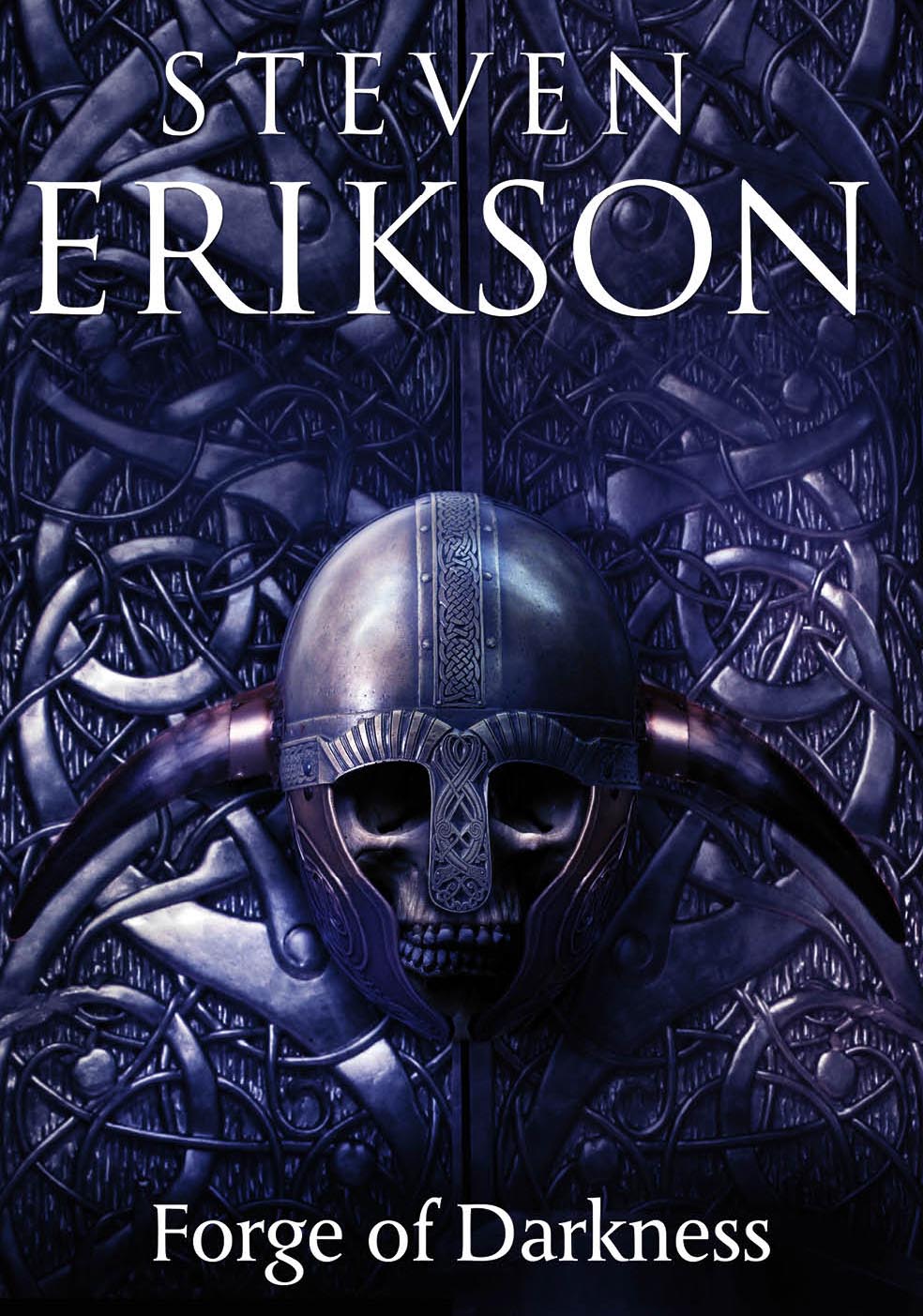
First I would like to say that "Forge of Darkness" can be read without knowing anything about "Malazan Book of the Fallen". FoD actually has a softer introduction to this setting than it was "Gardens of the Moon". A new reader starting with GotM will be confused for most of the book, with abundance of details about characters, mythology, world and especially magic. A new reader starting with FoD will found an unique setting focused on characters and social relationships - only later will all the strangeness and uniqueness of this setting come knocking (or better said, banging) on the door.
So, to a newcomer, the plot will sound something like this: several years have passed since the wars that were imposed on Tiste people and they had enjoyed the peace and prosperity. But new troubles are brewing. Soldiers, who have given so much of their lives and futures, feel neglected and ungratefully pushed aside now that the wars are over. Ruler of Tiste, Mother Darkness has recently reached to the godhood, and this helped to unite the most of Tiste in common faith. But her stubborn insisting on keeping her Consort Draconus at her side has served to make the nobility resentful toward him. Some elements of the army recognized this as opportunity to sow turmoil and restore their own importance, but all their plans will be revered by sudden emergence of some entity from sea of Vitr on the North.
For the fans, it enough to just list a few name from Dramatis Personae: Anomander, Silchas Ruin, Andarist, Draconus, Osserc, Caladan Brood, Kilmandaros, Hood, Gothos... But don't expect this book to be full of fanservice details and treats. These characters where mysterious in MBotF, they stay mysterious here, and I don't expect you fill find much revelations about them in subsequent parts. But this is all right, because this mystery is a necessary part of them. There is a lot of new characters, and you will follow this book through their eyes and their wonder. Even though some details can be seen as contradictory compared to MBotF, they are not, really - a lot of history is changed in 300000 years. Also, Erikson never really skirted from concept of unreliable narrator. So, to me, everything here seamed plausible, convincing and consistent - feel free to think otherwise. Imagine reading MBotF after this - it has become a series to read at least thrice: first time, a reread to defeat the confusion, and then reread after "Forge of Darkness", when everything you thought you knew is set upside down (well, not everything, not even much; but this book put some characters in completely different light).
Even though he said here that "Kharkanas Trilogy" will be different from "Malazan Book of the Fallen", and be more of a traditional fantasy, this is the usual Erikson. As I said, introduction is a bit softer for the new readers - at least the first quarter of the book. But ultimately, this book proves as a much more brutal start of the series than it was Gardens of the Moon, reminding me more of the later books in the series, as "The Reaper's Gale" or "Toll the Hounds". There is a surprising amount of sexual violence in later parts of the book, and they are very explicit - didn't expect it. Sure, there was rape and torture before (e.g. "Reaper's Gale"), but not like this. Erikson is not easy to its readers; at the contrary, he makes them go through some hard experiences. As can be expected, there is a lot of tragedy - even thought I knew from MBotF about some endings, I still hoped they will not realize. And I must admit that the last POV in this book made me shed a tear.
On the happier side, I can testify that Jaghut are funny as ever. Writing is beautiful, but I expect that lots of newcomers will be rejected with typical Erikson's monologs about philosophy. This is one thing in which "Gardens of the Moon" proves to be easier for the new readers, as it consist mostly of action - this side of "Forge of Darkness" is more similar to "Toll the Hounds" and later books.
For the conclusion, I want to say that with "Forge of Darkness" Steven Erikson succeeded in making a new series great as "Malazan Book of the Fallen" in quality, but different in its substance. It definitely deserves a recommendation for all fans - but expect a new and independent series and be ready to be swept of your feet. As for the unfamiliar readers, if you expect more from your fantasy than action, and like gray morality and hard questions, give this book a try.
Sunday, August 12, 2012
Book review: "The Wishsong of Shannara" by Terry Brooks
I was very happy to start reading "The Wishsong of Shannara" by Terry Brook, because I knew that after this I was done with "The Shannara Trilogy" and I could move on to better stuff. But I was once again surprised, because toward the end I actually enjoyed the book.

Again, "The Wishsong of Shannara" starts some years after the previous book. After the end of "The Elfstones of Shannara" and defeat of Demons, Will Omshford has married Eretria and returned to the Shady Vale, where he became a famous Healer and got two children, Brin (older daughter) and Jair (younger son). But it turned out that Will's playing with the Elfstones backfired and gave his children a strange and new ability, the wishsong. In Brin it manifested as the power to change world around her by song; Jair, on the other hand, was able just to make an illusion of change. One day while Will and Eretria were on a trip, after being absent for all these years from the Four Land, Alannon reappear in Shady Vale to collect Brin and take her to a dangerous journey - to destroy the book of evil magic, the same one that turned Druid Brona to evil Warlock Lord, as this can only be done with power of the wishsong. On this trip they are joined by Rone Lean, grandson of Menion Leah. Jair is to stay at home and guard their back, from both their parents (who would object to this journey) and Mord Wraiths (magicians turned evil by the book).
It this intro sounds a bit too fast, that is all right - the same is with the book itself. You found there information in few pages and the adventure immediately starts, with no one asking why. Again, there is new and unplanned addition to setting, convenient for the plot, which no one asks much about. But if you accept this, you are in for a pretty decent book. This is a much faster and lighter book than the first two - and although it has similar number of pages, it is read much faster. It is divided to two main plotlines, Brin's and Jair's - there are other POVs too, but these two are obviously main characters and we see the most of the book from their view. Brin's part was a bit to angsty in places, but she is such characters. Jair's part was, on the other hand, much more fun to read - lots of action, fighting, cleverness. He also has a much larger cast around himself, so their dynamic was more interesting. Nice last part of the book, especially description of Maeldrom forest - this was one of rare ingenious parts.
There is much characters in this book, and we don't meet everybody at the beginning. Although Brooks intended Garet Jax to be the most imposing one (as I gathered from his introduction), I found Slanter the most interesting and complex character. Other character are good and interesting (especially Cogline), if you don't mind single-mindedness much. This was the first book in series to feature genuine humor, and I appreciated that much. On the other hand, while I can say I was every warmed up for Alannon, in this book he was most irritating so far - he is described as philosophizer, teacher, wanderer - never seen him doing anything of that.
A reader could again find many inconsistencies if he would look for them, but there are not so obvious here and I didn't mind them. Curiously, the old hero is forgotten and does't appear any more - Will here, as was with Shea in "The Elfstones of Shannara" My biggest objection is that bad guys are still indistinctive and mute.

Again, "The Wishsong of Shannara" starts some years after the previous book. After the end of "The Elfstones of Shannara" and defeat of Demons, Will Omshford has married Eretria and returned to the Shady Vale, where he became a famous Healer and got two children, Brin (older daughter) and Jair (younger son). But it turned out that Will's playing with the Elfstones backfired and gave his children a strange and new ability, the wishsong. In Brin it manifested as the power to change world around her by song; Jair, on the other hand, was able just to make an illusion of change. One day while Will and Eretria were on a trip, after being absent for all these years from the Four Land, Alannon reappear in Shady Vale to collect Brin and take her to a dangerous journey - to destroy the book of evil magic, the same one that turned Druid Brona to evil Warlock Lord, as this can only be done with power of the wishsong. On this trip they are joined by Rone Lean, grandson of Menion Leah. Jair is to stay at home and guard their back, from both their parents (who would object to this journey) and Mord Wraiths (magicians turned evil by the book).
It this intro sounds a bit too fast, that is all right - the same is with the book itself. You found there information in few pages and the adventure immediately starts, with no one asking why. Again, there is new and unplanned addition to setting, convenient for the plot, which no one asks much about. But if you accept this, you are in for a pretty decent book. This is a much faster and lighter book than the first two - and although it has similar number of pages, it is read much faster. It is divided to two main plotlines, Brin's and Jair's - there are other POVs too, but these two are obviously main characters and we see the most of the book from their view. Brin's part was a bit to angsty in places, but she is such characters. Jair's part was, on the other hand, much more fun to read - lots of action, fighting, cleverness. He also has a much larger cast around himself, so their dynamic was more interesting. Nice last part of the book, especially description of Maeldrom forest - this was one of rare ingenious parts.
There is much characters in this book, and we don't meet everybody at the beginning. Although Brooks intended Garet Jax to be the most imposing one (as I gathered from his introduction), I found Slanter the most interesting and complex character. Other character are good and interesting (especially Cogline), if you don't mind single-mindedness much. This was the first book in series to feature genuine humor, and I appreciated that much. On the other hand, while I can say I was every warmed up for Alannon, in this book he was most irritating so far - he is described as philosophizer, teacher, wanderer - never seen him doing anything of that.
A reader could again find many inconsistencies if he would look for them, but there are not so obvious here and I didn't mind them. Curiously, the old hero is forgotten and does't appear any more - Will here, as was with Shea in "The Elfstones of Shannara" My biggest objection is that bad guys are still indistinctive and mute.
Just a note: this book not connected with plot, just by setting and some characters - every one is stand-alone.
"The Wishsong of Shannnara" is actually a pretty good book, especially Jair's part, compared to first two (especially the first). But while I was reading it, a also happened to read this. I know that taste is not something to discuss, and I am aware that Shannara series has a tons of fans... But compared to this, this book was bland - these few chapters written by Erikson contain more history, drama, epic, magic, characters, etc. than complete Shannara original trilogy! It was something in range of Eddings, but not of Feist who is much faster and funnier. Although it is not completely bad, it is not something I would really recommend since there are much better books out there.
Monday, August 6, 2012
Book review: "The Elfstones of Shannara" by Terry Brooks
I had a pretty busy week, so I was slow with my reading and then late with writing this review. Also, I wasn't much into reading it after the disaster that was "The Sword of Shannara". Thankfully, I again remembered to make some notes. So, here is my review of the second book in "Original Shannara Trilogy" by Terry Brooks: "The Elfstones of Shannara".

Events in this book take place some fifty years after the defeat of Warlock Lord in tSoS. There were no major problems in Four Lands for some time now: Gnomes kept themselves peaceful, Elves and Dwarves were nurturing they friendship, and even the Trolls were slowly getting friendly with others. Humans drifted a bit toward the isolationism, but they were at least not bothering anyone. But this is about to change. Ellcrys, a sacred tree of Elves, one which even they forgot the true reason of existence, is dying. And with its death, Deamons of the old times, times even before human dominance, kept away by Ellcrys and its spell of Forbidding, will be released from their prison. The only chance Elves and other races have, is to plant a seed of Ellcrys. Amberle, granddaughter of Elven King Eventine Essendil, unwillingly set on a journey to find a mythical Bloodfire, and by immersing the seed in it, restoring the Forbidding. On this quest, she is guarded by Will, grandson of Shea Ohmsford, sent by Allanon as the only person who can wield the Elfstones and thus protect Amberle from the Demons. Meanwhile, Allanon and the Elves, with every allies they can find, will try to stall the Demons from overrunning the whole land...
The start of "The Elfstones of Shannara" makes brighter promise that "The Sword of Shannara". It introduces a new and original story, more distinctive and powerful main enemy, new and larger cast of characters... After few dozen pages, you get the feeling like someone else wrote this second book - humor, women, not everyone is noble... there is even seduction - which would be impossible in "The Sword of Shannara", at least for simple reason that there wasn't any women. Compared to tSoS, this is a big improvement. For me, most interesting part was in later stages of the book, when they were first exploring the Wilderun. I was surprised with somewhat abrupt ending.
But considering this book alone, there is still much room for improvement. Even though this plot is original (as in not copied from some other writer) it is still a common fantasy story. Maybe it was fresher when it was originally published in 1982, but nowadays it sounds like something from a bad fantasy movie. Also, it is quite dour fantasy - there is not much humor, almost everybody is noble and serious.
There is still some problems with setting, although not as much in tSos: years don't match; Elves live longer, but Essendil and few other Elves are old with 80... Also, a missing community of Elves would be much more convincing if they didn't live 3 days from the rest of their people; also, wouldn't someone see the giant elf-carrying birds? Characters are also better, but as I said, they are too dour and serious. Allanon is irritating instead of mysterious, as he is constantly referred to.
I also realized one of the things that were bothering me. Why are all the bad guys mute? Introduction in the book, featuring the Dagda Mor, made me hopeful, but he proved a bit disappointment, same as the Changeling and the Reaper. I understand that is classical epic fantasy, but some more understanding and exploration of the other side would be appreciated.
One curious note: when Brooks first introduced Rovers, my immediate action was to compare the release dates of "The Eye of the World" and tEoS, and a to think "Why would Jordan stoop so low of base his Tinker of Brooks' Rovers?!". Continued reading made me realize they are not SO much similar. Nevertheless, I am curious whether Robert Jordan really made homage to Brooks, or they are just both based on Gypsies or some other source?
Again, comparing "The Elfstones of Shannara" to "The Sword of Shannara" makes the former a dramatic improvement, but considering today standards (even though this can't be taken as mitigation, since "Lord of the Rings" was published almost 20 years earlier and is still a fresh book), this is not very good book. But if this trend continues, fourth or fifth sequels could be good.

Events in this book take place some fifty years after the defeat of Warlock Lord in tSoS. There were no major problems in Four Lands for some time now: Gnomes kept themselves peaceful, Elves and Dwarves were nurturing they friendship, and even the Trolls were slowly getting friendly with others. Humans drifted a bit toward the isolationism, but they were at least not bothering anyone. But this is about to change. Ellcrys, a sacred tree of Elves, one which even they forgot the true reason of existence, is dying. And with its death, Deamons of the old times, times even before human dominance, kept away by Ellcrys and its spell of Forbidding, will be released from their prison. The only chance Elves and other races have, is to plant a seed of Ellcrys. Amberle, granddaughter of Elven King Eventine Essendil, unwillingly set on a journey to find a mythical Bloodfire, and by immersing the seed in it, restoring the Forbidding. On this quest, she is guarded by Will, grandson of Shea Ohmsford, sent by Allanon as the only person who can wield the Elfstones and thus protect Amberle from the Demons. Meanwhile, Allanon and the Elves, with every allies they can find, will try to stall the Demons from overrunning the whole land...
The start of "The Elfstones of Shannara" makes brighter promise that "The Sword of Shannara". It introduces a new and original story, more distinctive and powerful main enemy, new and larger cast of characters... After few dozen pages, you get the feeling like someone else wrote this second book - humor, women, not everyone is noble... there is even seduction - which would be impossible in "The Sword of Shannara", at least for simple reason that there wasn't any women. Compared to tSoS, this is a big improvement. For me, most interesting part was in later stages of the book, when they were first exploring the Wilderun. I was surprised with somewhat abrupt ending.
But considering this book alone, there is still much room for improvement. Even though this plot is original (as in not copied from some other writer) it is still a common fantasy story. Maybe it was fresher when it was originally published in 1982, but nowadays it sounds like something from a bad fantasy movie. Also, it is quite dour fantasy - there is not much humor, almost everybody is noble and serious.
There is still some problems with setting, although not as much in tSos: years don't match; Elves live longer, but Essendil and few other Elves are old with 80... Also, a missing community of Elves would be much more convincing if they didn't live 3 days from the rest of their people; also, wouldn't someone see the giant elf-carrying birds? Characters are also better, but as I said, they are too dour and serious. Allanon is irritating instead of mysterious, as he is constantly referred to.
I also realized one of the things that were bothering me. Why are all the bad guys mute? Introduction in the book, featuring the Dagda Mor, made me hopeful, but he proved a bit disappointment, same as the Changeling and the Reaper. I understand that is classical epic fantasy, but some more understanding and exploration of the other side would be appreciated.
One curious note: when Brooks first introduced Rovers, my immediate action was to compare the release dates of "The Eye of the World" and tEoS, and a to think "Why would Jordan stoop so low of base his Tinker of Brooks' Rovers?!". Continued reading made me realize they are not SO much similar. Nevertheless, I am curious whether Robert Jordan really made homage to Brooks, or they are just both based on Gypsies or some other source?
Again, comparing "The Elfstones of Shannara" to "The Sword of Shannara" makes the former a dramatic improvement, but considering today standards (even though this can't be taken as mitigation, since "Lord of the Rings" was published almost 20 years earlier and is still a fresh book), this is not very good book. But if this trend continues, fourth or fifth sequels could be good.
Subscribe to:
Posts (Atom)